Understanding opposites is one of the fastest ways to sharpen your vocabulary and elevate your writing clarity. When you know not just what a word means but also what it doesn’t mean, you gain control over tone, precision, and nuance.
This is especially important in academic writing, legal contexts, and professional communication where a single word choice can completely shift interpretation.
Mastering antonyms also helps you avoid repetition, improve sentence variety, and communicate ideas more effectively.
Whether you’re drafting essays, preparing reports, or enhancing SEO content, knowing the right opposite word allows you to express contrast with confidence and authority.
What Does “Deposition” Mean?
Deposition is a versatile term with multiple meanings depending on context:
- General meaning: The act of removing someone from power or position
- Legal meaning: A formal, recorded statement given under oath before trial
- Scientific meaning: The process of something being deposited or laid down (e.g., sediment)
Tone Explanation
The word typically carries a formal and authoritative tone, often used in legal, political, or academic contexts.
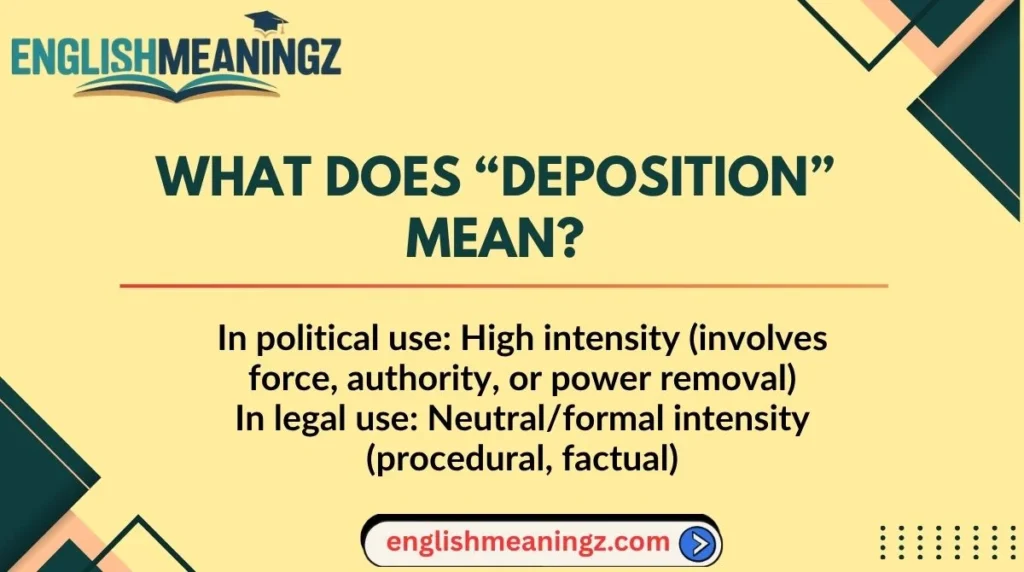
Emotional or Action Intensity
- In political use: High intensity (involves force, authority, or power removal)
- In legal use: Neutral/formal intensity (procedural, factual)
- In scientific use: Low emotional intensity (descriptive, technical)
Because of these varying meanings, its antonyms also differ depending on context.
14 Best Antonyms for “Deposition”
Retention
Meaning: Keeping or maintaining something
Tone: Formal / Academic
Example: The company ensured employee retention through better policies.
Why it’s opposite: Deposition removes; retention preserves.
Appointment
Meaning: Assigning someone to a position
Tone: Formal
Example: Her appointment as CEO marked a new era for the company.
Why it’s opposite: Deposition removes authority; appointment grants it.
Installation
Meaning: Officially placing someone in a role
Tone: Formal / Ceremonial
Example: The installation of the new president was widely celebrated.
Why it’s opposite: Opposes removal by emphasizing placement.
Promotion
Meaning: Advancement to a higher position
Tone: Professional
Example: His promotion came after years of dedication.
Why it’s opposite: Deposition lowers or removes status; promotion elevates it.
Election
Meaning: Choosing someone through voting
Tone: Formal / Political
Example: The election brought new leadership to the country.
Why it’s opposite: Represents gaining power rather than losing it.
Confirmation
Meaning: Official approval of a role or decision
Tone: Formal / Legal
Example: The senate confirmed her nomination unanimously.
Why it’s opposite: Reinforces authority instead of removing it.
Empowerment
Meaning: Giving power or authority
Tone: Emotional / Professional
Example: Education leads to empowerment in communities.
Why it’s opposite: Deposition strips power; empowerment gives it.
Establishment
Meaning: Setting up or creating something
Tone: Formal
Example: The establishment of new policies improved workflow.
Why it’s opposite: Focuses on creation, not removal.
Reinforcement
Meaning: Strengthening something
Tone: Academic
Example: Positive feedback acts as reinforcement for good behavior.
Why it’s opposite: Deposition weakens or removes; reinforcement strengthens.
Stabilization
Meaning: Making something steady or secure
Tone: Formal / Technical
Example: Economic stabilization was the government’s priority.
Why it’s opposite: Deposition creates disruption; stabilization ensures balance.
Support
Meaning: Backing or helping someone
Tone: Neutral
Example: She received strong support from her team.
Why it’s opposite: Support maintains position instead of removing it.
Validation
Meaning: Confirming legitimacy or correctness
Tone: Academic
Example: The experiment provided validation for the theory.
Why it’s opposite: Deposition questions or removes; validation confirms.
Elevation
Meaning: Raising something to a higher level
Tone: Formal
Example: His elevation to leadership was well deserved.
Why it’s opposite: Direct contrast to being brought down.
Ascension
Meaning: Rising to power or position
Tone: Formal / Literary
Example: The king’s ascension marked a historic moment.
Why it’s opposite: Represents gaining power instead of losing it.
Strong vs Mild Opposites
Not all antonyms carry the same intensity. Some are direct and powerful, while others are softer and context-dependent.
Strong Opposites
These directly reverse the idea of deposition:
- Ascension
- Promotion
- Empowerment
- Elevation
These words imply a complete reversal—from loss of power to gain of power.
Mild Opposites
These are less intense and depend on context:
- Support
- Stabilization
- Validation
- Reinforcement
They don’t directly oppose removal but instead suggest maintenance or strengthening.
Intensity Insight
Think of antonyms on a scale:
Deposition → Neutral → Reinforcement → Promotion → Ascension
This scale helps you choose the right level of contrast based on your writing purpose.
Context-Based Opposites
Because “deposition” has multiple meanings, its opposite changes depending on context.
Political Context
- Deposition → Election / Appointment
Used when discussing leadership changes.
Legal Context
- Deposition → Trial testimony (live) or informal discussion
Here, the contrast is between formal recorded statements and other forms of communication.
Scientific Context
- Deposition → Erosion / Removal
In geology, deposition means material settling; its opposite is material being taken away.
Practical Tip
Always identify the context first before selecting an antonym. Using the wrong opposite can confuse readers and weaken your writing.
Common Mistakes When Using Opposites
Using Contextually Incorrect Antonyms
❌ The erosion of the king from power
✔ The deposition of the king from power
Confusing Legal and Political Meanings
❌ His deposition to the role was successful
✔ His appointment to the role was successful
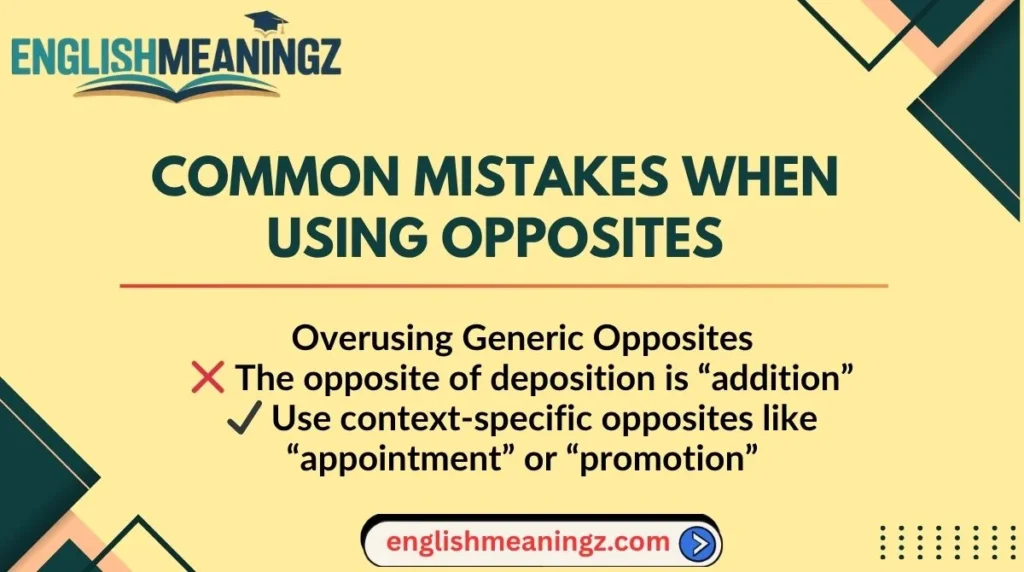
Overusing Generic Opposites
❌ The opposite of deposition is “addition”
✔ Use context-specific opposites like “appointment” or “promotion”
Ignoring Tone
❌ “Support” in a legal document
✔ “Confirmation” or “validation” fits better in formal writing
Sentence Transformation Examples
Original → Improved with Antonyms
- The deposition of the manager shocked everyone.
→ The promotion of the manager surprised everyone. - The leader faced deposition after protests.
→ The leader secured re-election after strong public support. - His deposition marked the end of his career.
→ His elevation marked the beginning of a successful career. - The deposition process was recorded legally.
→ The informal discussion was not recorded. - The deposition of power caused instability.
→ The stabilization of power restored confidence.
FAQs
What is the exact opposite of deposition?
There is no single universal opposite. It depends on context, but common ones include promotion, appointment, and ascension.
Is “promotion” always an antonym of deposition?
Yes, in most professional and hierarchical contexts, promotion is a strong opposite.
Can “support” be considered an antonym?
Yes, but it’s a mild or indirect antonym since it implies maintaining rather than reversing.
What is the legal opposite of deposition?
There is no strict legal antonym, but informal statements or live testimony can serve as contrasts.
Why does deposition have multiple opposites?
Because it has multiple meanings across legal, political, and scientific fields.
Which antonym is best for academic writing?
Words like confirmation, validation, and reinforcement work best in academic contexts.
How can I choose the right antonym?
Focus on context, tone, and intensity. Match your word choice to your audience and purpose.
Conclusion
Mastering antonyms for “deposition” is not just about memorizing vocabulary—it’s about understanding context, tone, and intensity.
Whether you’re writing academically, professionally, or creatively, selecting the right opposite word allows you to communicate with clarity and precision.
From strong contrasts like ascension and promotion to softer alternatives like support and validation, each antonym serves a specific purpose.
By applying these insights, you can transform your writing into something more dynamic, persuasive, and impactful.