Understanding opposites is one of the most effective ways to sharpen your writing and communication skills.
When you explore antonyms, you don’t just learn new words—you gain the ability to express contrast, nuance, and emotional depth with precision.
This is especially important for a word like consolation, which carries emotional weight and is often used in sensitive or reflective contexts.
In both academic and professional communication, choosing the right opposite can dramatically change the tone of a sentence.
Whether you are writing an essay, delivering a presentation, or crafting persuasive content, mastering antonyms allows you to communicate more clearly and powerfully.
Instead of sounding repetitive or vague, your language becomes more dynamic and intentional.
This article provides a complete, structured guide to understanding consolation antonyms, including meanings, tone variations, contextual usage, and common mistakes—so you can confidently use them in real-world communication.
What Does “Consolation” Mean?
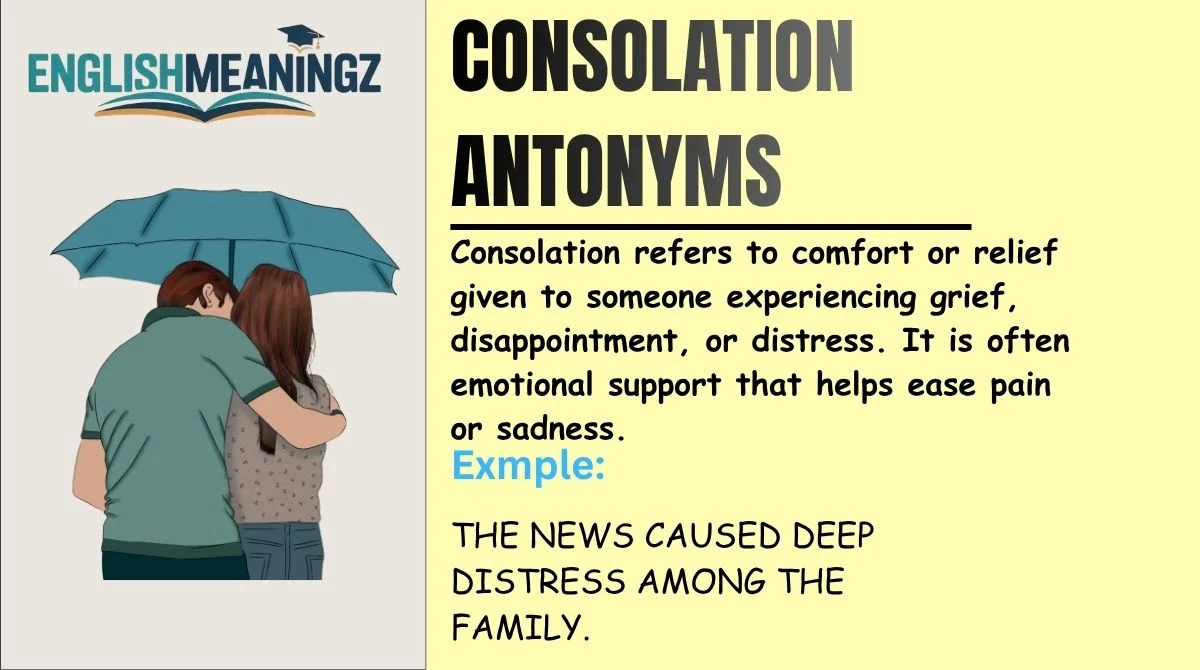
Consolation refers to comfort or relief given to someone experiencing grief, disappointment, or distress. It is often emotional support that helps ease pain or sadness.
Tone Explanation
The tone of consolation is typically empathetic, gentle, and supportive. It conveys kindness and understanding, often appearing in emotional or compassionate contexts.
Emotional Intensity
Consolation operates at a soothing emotional level. It reduces emotional pain rather than eliminating it entirely. It’s about easing discomfort, not removing the cause.
13 Best Antonyms for “Consolation”
1. Distress
Meaning: Extreme anxiety, sorrow, or pain
Tone: Emotional / Formal
Example: The news caused deep distress among the family.
Why it’s opposite: Instead of relieving pain, it intensifies suffering.
2. Agony
Meaning: Severe physical or emotional pain
Tone: Emotional
Example: He was in agony after the loss.
Why it’s opposite: Consolation soothes; agony represents unbearable pain.
3. Torment
Meaning: Intense suffering or mental anguish
Tone: Emotional / Literary
Example: Guilt became a constant torment for her.
Why it’s opposite: Torment prolongs suffering rather than easing it.
4. Misery
Meaning: A state of great unhappiness or discomfort
Tone: Emotional / Informal
Example: He lived in misery after losing his job.
Why it’s opposite: Consolation reduces sadness, while misery embodies it.
5. Anguish
Meaning: Deep emotional pain or distress
Tone: Emotional / Academic
Example: The decision caused her immense anguish.
Why it’s opposite: Anguish reflects unresolved emotional suffering.
6. Despair
Meaning: Complete loss of hope
Tone: Formal / Emotional
Example: He fell into despair after repeated failures.
Why it’s opposite: Consolation restores hope; despair destroys it.
7. Suffering
Meaning: The experience of pain or hardship
Tone: Neutral / Academic
Example: The community endured years of suffering.
Why it’s opposite: Consolation alleviates suffering, not causes it.
8. Heartbreak
Meaning: Overwhelming emotional pain, especially from loss
Tone: Emotional / Informal
Example: The breakup left her in heartbreak.
Why it’s opposite: Consolation heals emotional wounds; heartbreak creates them.
9. Discomfort
Meaning: Mild physical or emotional unease
Tone: Neutral
Example: The situation caused noticeable discomfort.
Why it’s opposite: Even mild unease contrasts with emotional relief.
10. Irritation
Meaning: Annoyance or mild anger
Tone: Informal
Example: His constant complaints caused irritation.
Why it’s opposite: Consolation calms emotions; irritation agitates them.
11. Pain
Meaning: Physical or emotional suffering
Tone: Neutral / Emotional
Example: The memory brought back old pain.
Why it’s opposite: Pain is what consolation aims to reduce.
12. Grief
Meaning: Deep sorrow, especially after loss
Tone: Emotional / Formal
Example: She was overwhelmed with grief.
Why it’s opposite: Consolation provides comfort during grief, making them conceptual opposites.
13. Depression
Meaning: Persistent sadness and loss of interest
Tone: Clinical / Academic
Example: He struggled with depression for years.
Why it’s opposite: Consolation uplifts, while depression pulls emotions downward.
14. Hopelessness
Meaning: A feeling that nothing will improve
Tone: Emotional / Academic
Example: The crisis created widespread hopelessness.
Why it’s opposite: Consolation brings reassurance; hopelessness removes it.
15. Anxiety
Meaning: A feeling of worry or nervousness
Tone: Neutral / Academic
Example: The uncertainty caused anxiety among employees.
Why it’s opposite: Consolation reduces worry, whereas anxiety increases it.
Strong vs Mild Opposites
Not all antonyms carry the same emotional intensity. Understanding this difference helps you choose the most appropriate word.
Strong Opposites (High Intensity):
Agony, torment, despair, anguish
- These express extreme emotional or psychological pain
- Best used in dramatic, literary, or serious contexts
Moderate Opposites:
Misery, suffering, grief, depression
- Reflect ongoing or significant emotional distress
- Common in both formal and informal writing
Mild Opposites:
Discomfort, irritation, anxiety
- Indicate lighter emotional states
- Suitable for everyday conversation and professional settings
Using the wrong intensity level can distort your message. For example, replacing “discomfort” with “agony” may exaggerate the situation unnecessarily.
Context-Based Opposites
Antonyms for consolation can vary depending on the situation.
Emotional Context:
- Consolation vs despair, grief, heartbreak
Physical Context:
- Consolation vs pain, discomfort
Psychological Context:
- Consolation vs anxiety, depression
Social Context:
- Consolation vs neglect or indifference (implied opposites)
This flexibility means you must always consider the context before selecting an antonym. A word that works in a medical discussion may not fit in a casual conversation.
Common Mistakes When Using Opposites
1. Choosing the Wrong Intensity
Incorrect: “He felt agony after a minor inconvenience.”
Correct: “He felt irritation after a minor inconvenience.”
2. Confusing Synonyms with Antonyms
Incorrect: “Support” as an opposite of consolation
Correct: Support is similar, not opposite
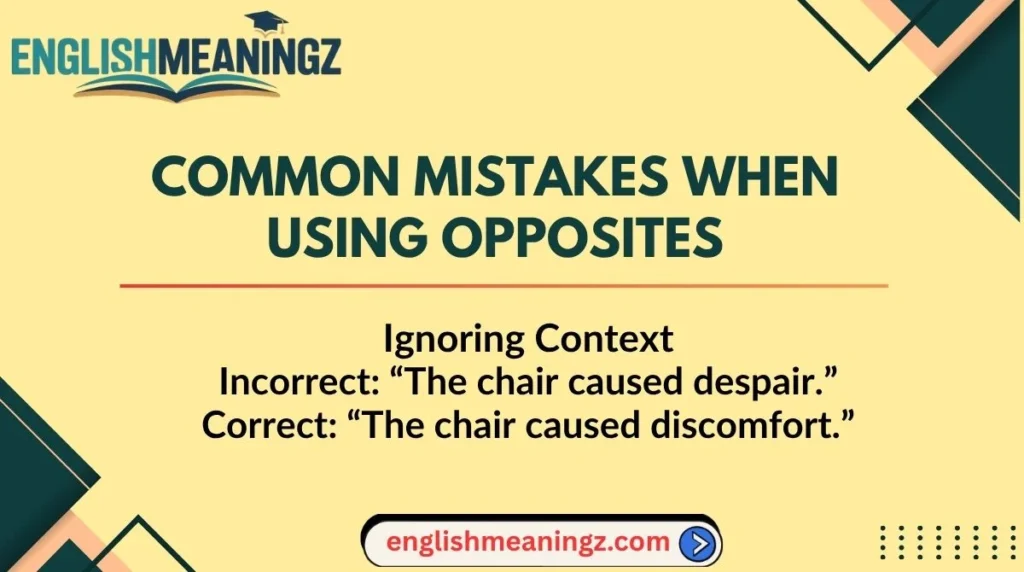
3. Ignoring Context
Incorrect: “The chair caused despair.”
Correct: “The chair caused discomfort.”
4. Overusing Dramatic Words
Words like torment or agony should be used carefully to avoid exaggeration.
5. Mixing Emotional and Physical Meanings
Be clear whether the situation is emotional or physical before choosing an antonym.
Sentence Transformation Examples
Here are five examples showing how antonyms change meaning:
- Original: Her words brought him consolation.
Transformed: Her words caused him distress. - Original: He found consolation in music.
Transformed: He found no relief and sank into despair. - Original: The gesture offered consolation to the victims.
Transformed: The lack of support deepened their suffering. - Original: She sought consolation after the loss.
Transformed: She was overwhelmed by grief after the loss. - Original: The message gave him consolation.
Transformed: The message increased his anxiety.
FAQs
What is the simplest antonym for consolation?
The simplest antonym is pain or distress, depending on context.
Are all antonyms of consolation emotional?
Mostly yes, but some can be physical, such as discomfort or pain.
Can “anger” be an antonym of consolation?
Not directly. Anger is a reaction, while consolation is a response to ease pain.
Which antonym is strongest in intensity?
Agony and torment are among the strongest opposites.
Is “stress” an antonym of consolation?
Yes, in certain contexts, as it represents mental strain rather than relief.
How do I choose the right antonym?
Consider tone, intensity, and context before selecting a word.
Why is learning antonyms important?
It improves clarity, enhances vocabulary, and allows more precise expression.
Conclusion
Mastering consolation antonyms is more than just expanding your vocabulary—it’s about gaining control over emotional expression and communication clarity.
By understanding the subtle differences between words like distress, despair, and discomfort, you can tailor your language to suit any context, whether academic, professional, or personal.
The key is balance: choose the right intensity, match the context, and avoid exaggeration. With consistent practice, these antonyms will become a natural part of your writing toolkit, helping you communicate with greater precision and impact.