Strong writing depends not only on choosing the right words but also on understanding their opposites. Antonyms sharpen meaning, improve contrast, and help readers clearly understand an idea.
When writers know both a word and its opposite, they gain greater control over tone, persuasion, and clarity.
In academic, professional, and creative communication, vocabulary precision is essential. Words shape arguments, define positions, and influence how readers interpret a message.
One powerful verb often used in writing is “bolster.” It appears frequently in academic essays, research papers, journalism, and business communication.
However, equally important are the antonyms of “bolster.” Knowing them allows writers to describe weakening arguments, failing support systems, declining confidence, or collapsing structures.
Understanding these opposites strengthens vocabulary flexibility and improves the overall quality of communication. This guide explores the meaning of bolster, presents more than a dozen clear antonyms, explains tone differences, and demonstrates how they function in real sentences.
What Does “Bolster” Mean?
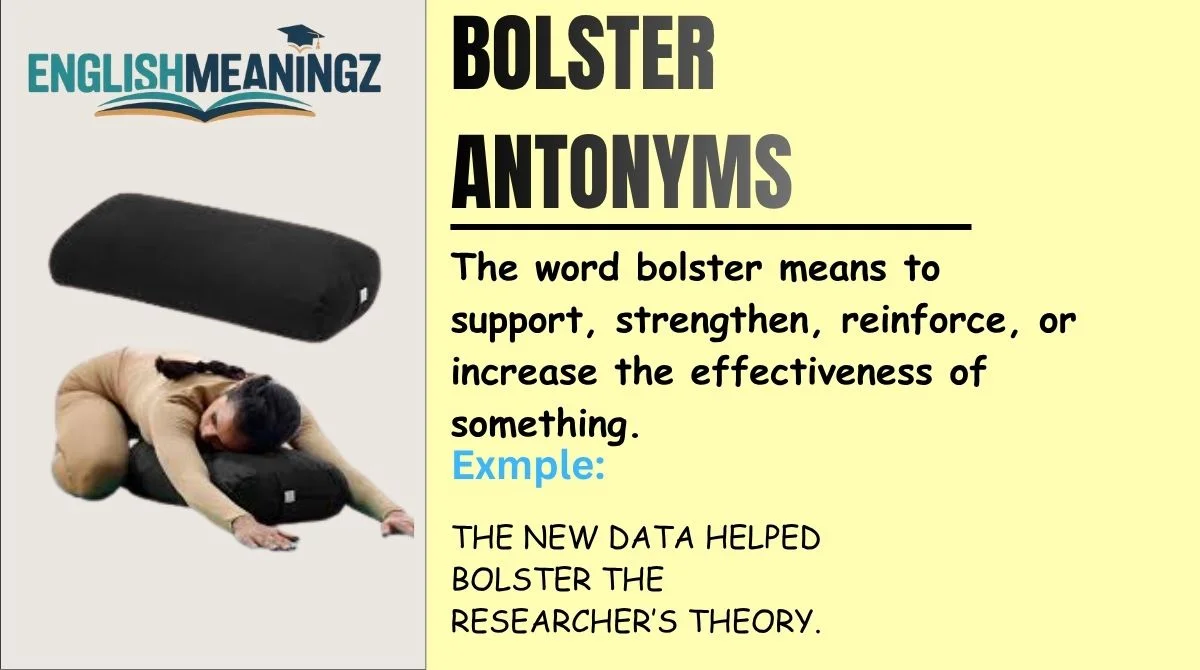
The word bolster means to support, strengthen, reinforce, or increase the effectiveness of something.
It is commonly used when someone provides evidence, encouragement, resources, or assistance that makes something stronger.
Examples:
- The new data helped bolster the researcher’s theory.
- Positive feedback bolstered her confidence before the presentation.
- Government policies were designed to bolster the national economy.
Tone Explanation
“Bolster” usually carries a positive and constructive tone. It implies improvement, reinforcement, or stabilization.
It is frequently used in:
- Academic writing
- Business communication
- Journalism
- Formal discussions
Emotional or Action Intensity
The action expressed by bolster involves strengthening something that already exists rather than creating something entirely new.
For example:
- Encouraging someone → bolsters their confidence
- Evidence → bolsters an argument
- Financial aid → bolsters an industry
Because of this meaning, antonyms of bolster generally involve weakening, damaging, undermining, or reducing support.
12 Best Antonyms for “Bolster”
Weaken
Meaning: To reduce strength, power, or effectiveness.
Tone: Neutral / Academic
Example Sentence:
The lack of credible data began to weaken the scientist’s argument.
Why It Is an Opposite:
While bolster strengthens something, weaken directly reduces its strength.
Undermine
Meaning: To gradually damage or weaken something from within.
Tone: Formal / Academic
Example Sentence:
False accusations can undermine a person’s reputation.
Why It Is an Opposite:
Bolstering builds support, whereas undermining erodes it over time.
Diminish
Meaning: To make something smaller, less important, or less effective.
Tone: Formal / Academic
Example Sentence:
Repeated mistakes began to diminish the company’s credibility.
Why It Is an Opposite:
Bolster increases strength; diminish reduces significance or power.
Sabotage
Meaning: To deliberately destroy or obstruct something.
Tone: Strong / Emotional
Example Sentence:
The insider attempted to sabotage the organization’s plans.
Why It Is an Opposite:
Instead of strengthening a system, sabotage intentionally damages it.
Damage
Meaning: To cause harm or reduce value.
Tone: Neutral
Example Sentence:
The scandal severely damaged the politician’s public image.
Why It Is an Opposite:
Bolster protects or strengthens; damage harms or weakens.
Discourage
Meaning: To reduce confidence or enthusiasm.
Tone: Emotional
Example Sentence:
Harsh criticism can discourage young writers.
Why It Is an Opposite:
Bolstering confidence motivates people, while discouragement lowers morale.
Erode
Meaning: To slowly wear away strength or support.
Tone: Formal / Academic
Example Sentence:
Public trust began to erode after the controversial decision.
Why It Is an Opposite:
Bolster builds support; erosion gradually removes it.
Impair
Meaning: To weaken the effectiveness or functioning of something.
Tone: Formal / Academic
Example Sentence:
Lack of sleep can impair cognitive performance.
Why It Is an Opposite:
Bolster improves function, while impairment reduces it.
Destroy
Meaning: To completely ruin or eliminate something.
Tone: Strong
Example Sentence:
The financial crisis nearly destroyed the small business.
Why It Is an Opposite:
Bolster stabilizes and strengthens; destruction eliminates entirely.
Reduce
Meaning: To make something smaller or less powerful.
Tone: Neutral / Formal
Example Sentence:
Budget cuts may reduce funding for scientific research.
Why It Is an Opposite:
Bolstering increases support, whereas reduction removes resources.
Suppress
Meaning: To stop or prevent something from developing.
Tone: Formal
Example Sentence:
Authorities tried to suppress the spread of misinformation.
Why It Is an Opposite:
Bolster encourages growth or support; suppression prevents it.
Cripple
Meaning: To severely weaken or disable something.
Tone: Strong / Emotional
Example Sentence:
The cyberattack threatened to cripple the entire system.
Why It Is an Opposite:
Instead of strengthening operations, crippling leaves them nearly powerless.
Debilitate
Meaning: To make someone or something weak and ineffective.
Tone: Formal / Academic
Example Sentence:
Chronic stress can debilitate both mental and physical health.
Why It Is an Opposite:
Bolster enhances strength, while debilitation drains it.
Undercut
Meaning: To weaken something by attacking its foundation.
Tone: Formal
Example Sentence:
The conflicting evidence began to undercut the theory.
Why It Is an Opposite:
Bolster supports a foundation, but undercutting destabilizes it.
Collapse
Meaning: To fail suddenly due to lack of support.
Tone: Strong
Example Sentence:
Without funding, the project quickly collapsed.
Why It Is an Opposite:
Bolster keeps systems stable; collapse occurs when support disappears.
Strong vs Mild Opposites
Antonyms do not all express the same intensity. Some simply reduce strength slightly, while others completely destroy support.
Mild Opposites
These indicate small or gradual weakening:
- Reduce
- Diminish
- Weaken
- Discourage
Example:
Negative feedback may discourage a writer but does not completely destroy their ability.
Moderate Opposites
These suggest serious weakening or loss of support:
- Undermine
- Impair
- Erode
- Undercut
Example:
Poor leadership can undermine employee morale.
Strong Opposites
These indicate severe or total damage:
- Sabotage
- Destroy
- Cripple
- Collapse
Example:
A major scandal can destroy a public career.
Understanding these intensity levels helps writers choose precise vocabulary depending on the situation.
Context-Based Opposites
Antonyms often depend on context. The opposite of bolster may change depending on what is being strengthened.
Confidence Context
Bolster: encourage confidence
Opposite: discourage confidence
Example:
- Her mentor bolstered her confidence.
- Harsh criticism discouraged her confidence.
Argument Context
Bolster: support an argument
Opposite: undermine an argument
Example:
- The data bolstered the hypothesis.
- Contradictory evidence undermined the hypothesis.
Economic Context
Bolster: strengthen an economy
Opposite: weaken or damage the economy
Example:
- Tax incentives bolstered business investment.
- Financial instability weakened economic growth.
Structural Context
Bolster: reinforce a structure
Opposite: damage or collapse a structure
Example:
- Engineers bolstered the bridge’s foundation.
- The earthquake damaged the bridge.
Choosing the correct antonym depends entirely on what kind of support is being removed.
Common Mistakes When Using Opposites
Even experienced writers sometimes misuse antonyms. Here are several common errors.
Using “Oppose” Instead of a True Antonym
Incorrect:
The evidence opposed the theory.
Better:
The evidence undermined the theory.
“Oppose” expresses disagreement but does not necessarily weaken support.
Confusing “Reduce” With “Destroy”
Incorrect:
Budget cuts destroyed funding.
Better:
Budget cuts reduced funding.
“Destroy” suggests complete elimination, while “reduce” simply lowers the amount.
Overusing Extreme Words
Incorrect:
Minor criticism destroyed her confidence.
Better:
Minor criticism discouraged her confidence.
Extreme antonyms should only be used when the situation truly warrants them.
Ignoring Tone
Some antonyms are too emotional for academic writing.
Example:
Academic writing prefers:
- undermine
- diminish
- impair
Instead of:
- cripple
- sabotage
Tone awareness ensures vocabulary remains appropriate for the context.
Sentence Transformation Examples
Rewriting sentences using antonyms helps demonstrate how meaning changes.
Original
The new research bolstered the scientist’s theory.
Opposite Version:
Conflicting results undermined the scientist’s theory.
Original
Positive feedback bolstered her confidence.
Opposite Version:
Harsh criticism discouraged her confidence.
Original
Financial investment bolstered the local economy.
Opposite Version:
Market instability weakened the local economy.
Original
Evidence bolstered the lawyer’s argument.
Opposite Version:
Contradictions diminished the lawyer’s argument.
Original
Strong leadership bolstered team morale.
Opposite Version:
Poor management eroded team morale.
FAQs
What is the most direct antonym of bolster?
The most direct antonyms include weaken, undermine, and diminish because they clearly express the removal of support or strength.
Is “undermine” stronger than “weaken”?
Yes. Undermine suggests a deeper, more strategic weakening that often happens gradually or internally.
Can “discourage” be an antonym of bolster?
Yes, especially when the context involves confidence, motivation, or emotional support.
Is “destroy” always an appropriate opposite?
No. It is an extreme antonym and should only be used when something is completely ruined.
Which antonyms work best in academic writing?
Common academic choices include:
- undermine
- diminish
- impair
- erode
These maintain a professional tone.
Are antonyms always exact opposites?
Not always. Many antonyms represent different levels of opposition rather than perfect opposites.
Why should writers learn multiple antonyms?
Learning multiple antonyms improves:
- vocabulary precision
- tone control
- writing clarity
- persuasive power
Writers can choose the word that best fits their message.
Conclusion
The word bolster represents strengthening, supporting, and reinforcing ideas, arguments, confidence, or systems. In effective communication, however, understanding the opposite concepts is equally important.
Antonyms such as weaken, undermine, diminish, erode, discourage, sabotage, destroy, and impair help writers describe situations where support disappears or strength declines.
Mastering these vocabulary contrasts improves clarity, precision, and persuasive writing. Whether used in academic essays, professional communication, journalism, or everyday conversation, understanding antonyms allows writers to express both growth and decline with accuracy.
Ultimately, a rich vocabulary is not just about knowing more words—it is about knowing how words interact, contrast, and shape meaning.