Understanding opposites is one of the fastest ways to sharpen your writing. When you know not just what a word means—but also what it does not mean—you gain precision, control, and flexibility in expression.
This is especially valuable in academic writing, professional communication, and persuasive content where clarity and nuance matter.
Mastering antonyms helps you:
- Avoid vague language
- Improve argument strength
- Add contrast for emphasis
- Write with confidence and authority
In this guide, we will break down the meaning of “inalienable” and explore 19 powerful antonyms you can use to diversify your vocabulary and communicate more effectively.
What Does “Inalienable” Mean?
Definition:
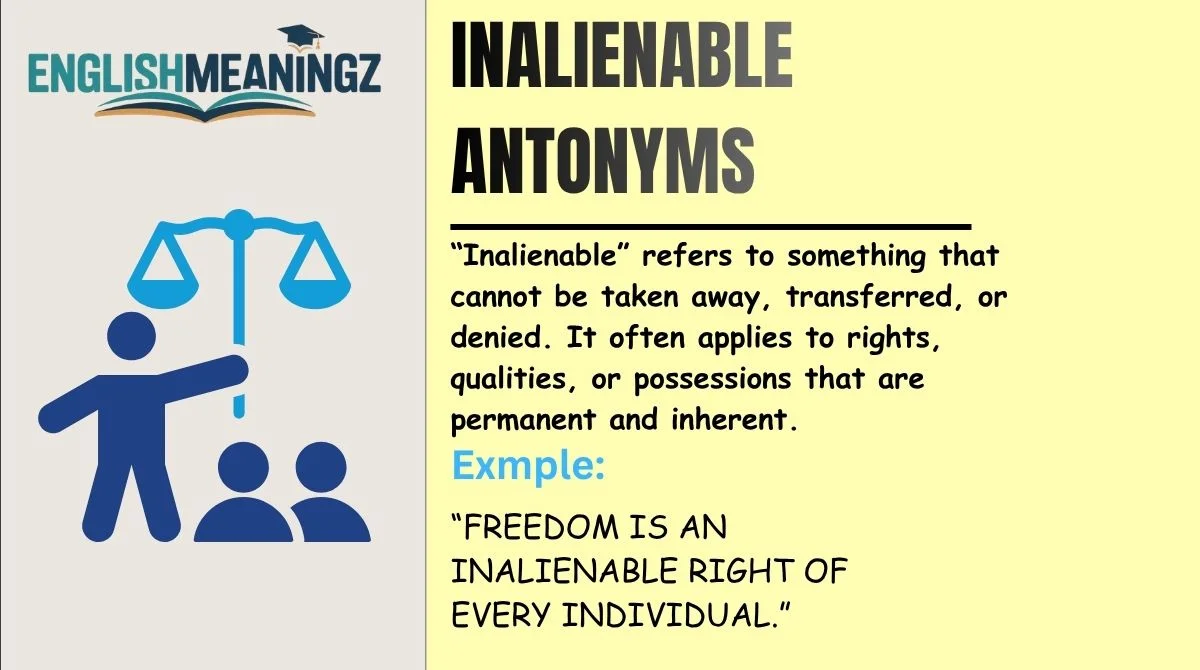
“Inalienable” refers to something that cannot be taken away, transferred, or denied. It often applies to rights, qualities, or possessions that are permanent and inherent.
Tone Explanation:
This word carries a formal and authoritative tone, commonly used in legal, philosophical, and academic contexts.
Emotional or Action Intensity:
“Inalienable” expresses absolute permanence and certainty. It suggests something deeply rooted and beyond external control.
Example:
“Freedom is an inalienable right of every individual.”
19 Best Antonyms for “Inalienable”
Transferable
Meaning: Capable of being moved or passed to another
Tone: Formal
Example: Ownership of the property is transferable.
Why it’s opposite: If something can be transferred, it is not permanent or fixed.
Revocable
Meaning: Able to be canceled or withdrawn
Tone: Formal / Legal
Example: The license is revocable under certain conditions.
Why it’s opposite: Inalienable things cannot be revoked, while revocable ones can.
Temporary
Meaning: Lasting for a limited time
Tone: Neutral
Example: The contract is temporary and expires in six months.
Why it’s opposite: Inalienable implies permanence; temporary suggests the opposite.
Conditional
Meaning: Dependent on certain conditions
Tone: Formal
Example: Access is conditional upon approval.
Why it’s opposite: Inalienable rights are unconditional.
Alienable
Meaning: Capable of being transferred or surrendered
Tone: Academic / Legal
Example: Some assets are legally alienable.
Why it’s opposite: It is the direct opposite in legal terminology.
Forfeitable
Meaning: Capable of being lost due to wrongdoing
Tone: Formal
Example: The deposit is forfeitable if terms are violated.
Why it’s opposite: Inalienable rights cannot be lost; forfeitable ones can.
Removable
Meaning: Able to be taken away
Tone: Neutral
Example: The sticker is removable without damage.
Why it’s opposite: Inalienable things cannot be removed.
Mutable
Meaning: Subject to change
Tone: Academic
Example: Public opinion is mutable over time.
Why it’s opposite: Inalienable implies fixed and unchanging.
Unstable
Meaning: Not firmly fixed or secure
Tone: Neutral
Example: The agreement is unstable due to unclear terms.
Why it’s opposite: Inalienable suggests stability and permanence.
Reversible
Meaning: Capable of being undone
Tone: Neutral
Example: The decision is reversible within 30 days.
Why it’s opposite: Inalienable conditions cannot be reversed.
Negotiable
Meaning: Open to discussion or change
Tone: Professional
Example: Salary expectations are negotiable.
Why it’s opposite: Inalienable things are not subject to negotiation.
Optional
Meaning: Not required; can be chosen
Tone: Neutral
Example: Attendance is optional for this session.
Why it’s opposite: Inalienable rights are mandatory and inherent.
Contingent
Meaning: Dependent on circumstances
Tone: Academic
Example: The offer is contingent on approval.
Why it’s opposite: Inalienable is independent of external factors.
Withdrawable
Meaning: Able to be taken back
Tone: Formal
Example: The funds are withdrawable after maturity.
Why it’s opposite: Inalienable things cannot be withdrawn.
Disposable
Meaning: Designed to be discarded
Tone: Informal
Example: The product is disposable after use.
Why it’s opposite: Inalienable implies lasting value, not disposability.
Changeable
Meaning: Likely to change
Tone: Neutral
Example: Weather patterns are highly changeable.
Why it’s opposite: Inalienable is fixed and constant.
Cancelable
Meaning: Able to be canceled
Tone: Informal / Business
Example: The subscription is cancelable anytime.
Why it’s opposite: Inalienable cannot be canceled.
Flexible
Meaning: Capable of adapting or changing
Tone: Neutral
Example: The schedule is flexible.
Why it’s opposite: Inalienable is rigid and unchangeable.
Unsecured
Meaning: Not protected or guaranteed
Tone: Financial / Formal
Example: The loan is unsecured.
Why it’s opposite: Inalienable suggests guaranteed permanence.
Strong vs Mild Opposites
Not all antonyms carry the same intensity. Some directly oppose “inalienable,” while others contrast it more loosely.
Strong Opposites (Direct Contradiction):
- Revocable
- Alienable
- Transferable
- Forfeitable
These words directly challenge the core idea of permanence and non-transferability.
Mild Opposites (Contextual Contrast):
- Flexible
- Optional
- Changeable
- Temporary
These do not always directly negate the meaning but weaken the sense of permanence.
Understanding this scale helps you choose the most accurate word depending on context.
Context-Based Opposites
Antonyms often depend on how the word is used in a sentence.
- Legal Context:
“Inalienable rights” → Opposite: revocable rights - Ownership Context:
“Inalienable property” → Opposite: transferable property - Philosophical Context:
“Inalienable freedom” → Opposite: conditional freedom - Emotional Context:
“Inalienable bond” → Opposite: fragile relationship
Choosing the right antonym requires understanding the situation, not just the dictionary definition.
Common Mistakes When Using Opposites
1. Using weak opposites
Incorrect: “Inalienable vs. different”
Correct: “Inalienable vs. revocable”
2. Ignoring context
Incorrect: “Inalienable rights are temporary”
Better: “Inalienable rights are permanent, unlike revocable privileges”
3. Mixing tone levels
Incorrect: Formal writing using “disposable” as an antonym in legal context
Better: Use “revocable” or “alienable”
4. Overgeneralization
Not every opposite fits every sentence. Always consider context.
Sentence Transformation Examples
1. Original:
Freedom is an inalienable right.
Rewritten:
Freedom is a revocable privilege in some systems.
2. Original:
Their bond felt inalienable.
Rewritten:
Their bond felt fragile and changeable.
3. Original:
The ownership is inalienable.
Rewritten:
The ownership is fully transferable.
4. Original:
Human dignity is inalienable.
Rewritten:
Human dignity is often treated as conditional.
5. Original:
These rights are inalienable.
Rewritten:
These rights are negotiable under certain conditions.
FAQs
What is the simplest antonym of “inalienable”?
The simplest and most direct antonym is “transferable” or “revocable.”
Is “alienable” a real word?
Yes, “alienable” is a valid legal and academic term meaning something that can be transferred or given away.
Can “temporary” be used as an antonym?
Yes, but it is a mild opposite, not a direct one.
Why is context important when choosing antonyms?
Because the meaning of “inalienable” changes slightly depending on usage—legal, emotional, or philosophical.
Is “revocable” stronger than “changeable”?
Yes, “revocable” is a stronger and more precise antonym.
Are all antonyms exact opposites?
No. Some are partial or contextual opposites depending on usage.
How can I improve my vocabulary using antonyms?
Practice rewriting sentences, compare intensity levels, and study words in context rather than isolation.
Conclusion
Mastering antonyms of “inalienable” is more than a vocabulary exercise—it’s a powerful way to enhance clarity, precision, and impact in your writing.
By understanding both strong and mild opposites, you can choose words that fit your context perfectly, whether you’re writing academically, professionally, or creatively.
The key is not just memorization, but application. Use these antonyms in real sentences, analyze their tone, and adapt them based on context. Over time, your writing will become sharper, more persuasive, and far more expressive.