Understanding opposites is not just a vocabulary exercise—it is a powerful tool for sharper communication. When you know the antonyms of a word like friend, you gain the ability to express contrast, tension, and emotional nuance more effectively in both writing and speech.
In academic writing, antonyms help clarify arguments by showing distinctions. In professional communication, they allow you to describe relationships, conflicts, and dynamics with precision.
Instead of vague language, you can choose exact terms that reflect tone, intent, and context.
This article explores 22 carefully selected antonyms of “friend,” each explained with meaning, tone, examples, and usage insights to help you elevate your vocabulary.
What Does “Friend” Mean?
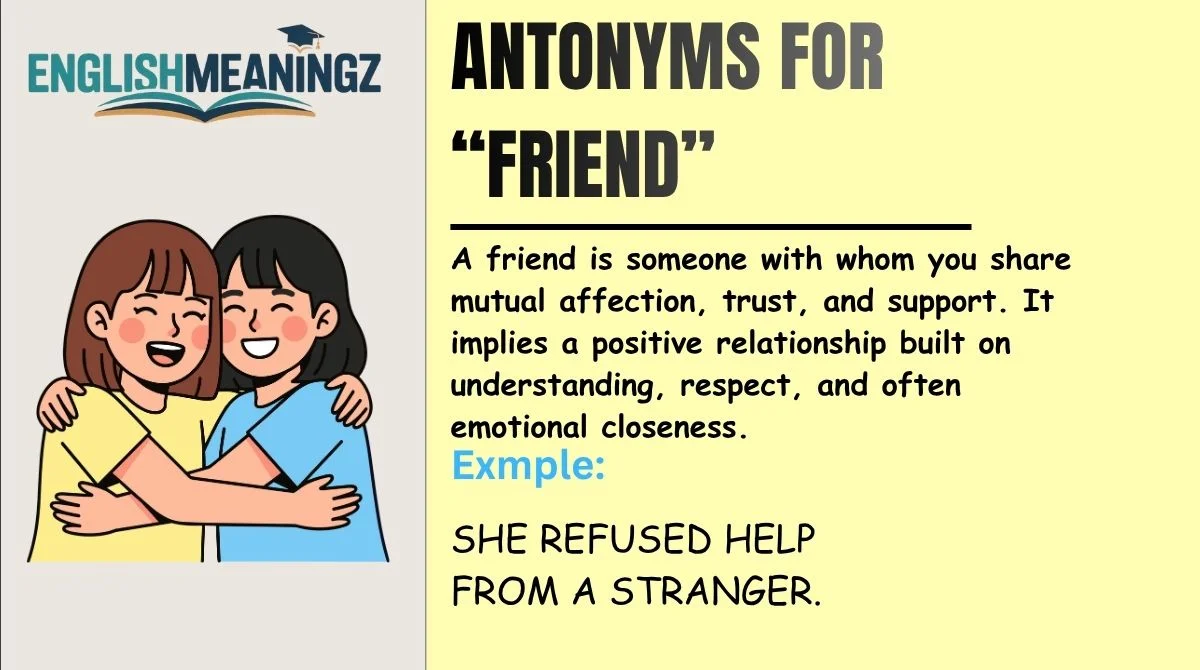
A friend is someone with whom you share mutual affection, trust, and support. It implies a positive relationship built on understanding, respect, and often emotional closeness.
Tone Explanation:
The word carries a warm, positive, and inclusive tone. It can range from casual companionship to deep emotional bonding.
Emotional Intensity:
- Mild: acquaintance-level friendliness
- Moderate: regular companionship
- Strong: deep emotional connection, loyalty, and trust
Because of this range, antonyms of “friend” can vary from mild indifference to intense hostility.
22 Best Antonyms for “Friend”
Enemy
Meaning: A person who actively opposes or hates you
Tone: Strong / Emotional
Example: He considered his former ally an enemy after the betrayal.
Why Opposite: Represents direct hostility instead of support
Foe
Meaning: A formal term for an enemy
Tone: Formal / Literary
Example: The knight prepared to face his foe in battle.
Why Opposite: Emphasizes conflict rather than companionship
Adversary
Meaning: Someone who competes against or opposes you
Tone: Formal / Academic
Example: She respected her adversary despite their rivalry.
Why Opposite: Suggests structured opposition instead of cooperation
Opponent
Meaning: Someone you compete or argue against
Tone: Neutral / Formal
Example: He defeated his opponent in the final round.
Why Opposite: Implies competition rather than alliance
Rival
Meaning: A person competing for the same goal
Tone: Neutral
Example: The two companies are fierce rivals.
Why Opposite: Focuses on competition, not friendship
Stranger
Meaning: Someone you do not know
Tone: Neutral
Example: She refused help from a stranger.
Why Opposite: Indicates lack of relationship entirely
Acquaintance
Meaning: Someone known slightly but not a friend
Tone: Neutral
Example: He is just an acquaintance from work.
Why Opposite: Represents minimal connection instead of closeness
Detractor
Meaning: A person who criticizes or belittles
Tone: Formal
Example: Despite her success, detractors questioned her methods.
Why Opposite: Undermines instead of supports
Opposer
Meaning: Someone who resists or disagrees
Tone: Formal
Example: The bill faced strong opposers in parliament.
Why Opposite: Reflects resistance rather than agreement
Critic
Meaning: One who judges or evaluates negatively
Tone: Neutral / Formal
Example: The critic harshly reviewed the film.
Why Opposite: Focuses on judgment rather than support
Nemesis
Meaning: A long-standing, powerful enemy
Tone: Strong / Dramatic
Example: He finally defeated his lifelong nemesis.
Why Opposite: Suggests deep conflict versus deep connection
Antagonist
Meaning: One who actively opposes
Tone: Academic / Literary
Example: The antagonist created chaos throughout the story.
Why Opposite: Drives conflict instead of harmony
Hater
Meaning: Someone who expresses dislike or negativity
Tone: Informal
Example: Ignore the haters and stay focused.
Why Opposite: Represents negativity instead of encouragement
Backstabber
Meaning: Someone who betrays trust
Tone: Informal / Emotional
Example: He turned out to be a backstabber.
Why Opposite: Breaks trust, unlike a true friend
Traitor
Meaning: Someone who betrays loyalty
Tone: Strong / Formal
Example: The general was labeled a traitor.
Why Opposite: Opposes loyalty, a core element of friendship
Oppressor
Meaning: Someone who treats others unfairly
Tone: Formal
Example: The regime was seen as an oppressor.
Why Opposite: Represents harm instead of support
Competitor
Meaning: Someone striving against you
Tone: Neutral
Example: Every competitor aimed for the top prize.
Why Opposite: Focuses on rivalry instead of cooperation
Alien
Meaning: Someone foreign or unfamiliar
Tone: Formal
Example: The culture felt alien to him.
Why Opposite: Indicates distance instead of closeness
Outsider
Meaning: Someone not part of a group
Tone: Neutral
Example: She always felt like an outsider.
Why Opposite: Suggests exclusion instead of belonging
Oppugner
Meaning: A rare term for someone who attacks or argues against
Tone: Academic
Example: The oppugner challenged every claim.
Why Opposite: Represents intellectual opposition
Disloyal Person
Meaning: Someone lacking loyalty
Tone: Neutral
Example: A disloyal person cannot be trusted.
Why Opposite: Friendship relies on loyalty
Hostile Individual
Meaning: Someone showing aggression or unfriendliness
Tone: Formal
Example: The environment became hostile quickly.
Why Opposite: Reflects aggression instead of warmth
Strong vs Mild Opposites
Not all antonyms carry the same intensity. Understanding this spectrum helps you choose the most appropriate word.
Mild Opposites:
- Stranger
- Acquaintance
- Outsider
These indicate absence of friendship rather than negativity.
Moderate Opposites:
- Rival
- Opponent
- Competitor
These suggest competition without emotional hostility.
Strong Opposites:
- Enemy
- Nemesis
- Traitor
- Antagonist
These imply deep conflict, hostility, or betrayal.
Using the correct intensity ensures your message is accurate and avoids exaggeration.
Context-Based Opposites
Antonyms are not always fixed—they depend on context.
- In social context, “stranger” is the opposite of friend
- In emotional context, “enemy” fits better
- In professional context, “competitor” may be the correct choice
- In literary context, “antagonist” is most suitable
For example:
- “He is not my friend” → could mean stranger
- “He is my enemy” → implies hostility
Choosing the wrong antonym can distort meaning.
Common Mistakes When Using Opposites
1. Using overly strong antonyms
Incorrect: He is not my friend, he is my enemy.
Correct: He is just an acquaintance.
2. Confusing rivalry with hostility
Incorrect: My classmate is my enemy.
Correct: My classmate is my rival.
3. Misusing formal words in casual context
Incorrect: He is my adversary (in casual talk)
Better: He is my competitor
4. Ignoring emotional tone
Words like traitor carry heavy emotional weight and should be used carefully.
5. Using antonyms without context
Always match the situation, not just the dictionary meaning.
Sentence Transformation Examples
Original: She is my friend.
Transformed: She is my rival in this competition.
Original: He trusts his friend.
Transformed: He cannot trust the traitor anymore.
Original: I met a friend yesterday.
Transformed: I met a stranger yesterday.
Original: They supported their friend.
Transformed: They opposed their adversary.
Original: A friend helps you grow.
Transformed: A critic constantly challenges you.
FAQs
What is the strongest antonym of “friend”?
“Enemy” and “nemesis” are considered the strongest antonyms due to their emotional intensity.
Is “stranger” really an antonym of friend?
Yes, in a neutral sense—it represents no relationship rather than hostility.
What is a formal antonym of friend?
“Adversary” and “antagonist” are commonly used in formal or academic contexts.
Can “competitor” be an antonym?
Yes, especially in professional or business settings where rivalry exists.
What is the difference between rival and enemy?
A rival competes, while an enemy involves emotional hostility or conflict.
Is “traitor” an antonym of friend?
Yes, because friendship involves loyalty, and a traitor breaks that trust.
How do I choose the right antonym?
Consider context, tone, and intensity before selecting a word.
Conclusion
Mastering antonyms of “friend” is more than a vocabulary exercise—it’s a gateway to precise and impactful communication.
From mild contrasts like stranger to intense opposites like enemy or nemesis, each word carries a distinct tone and purpose.
By understanding context, emotional intensity, and usage, you can select the perfect word for any situation—whether academic, professional, or everyday conversation.
Expanding your vocabulary in this way enhances clarity, strengthens arguments, and makes your language more expressive and powerful.