
Strong vocabulary is one of the most powerful tools in effective writing. Whether you are a student preparing for academic exams, a blogger creating engaging online content, or a professional crafting persuasive reports, the ability to vary your language significantly improves writing quality.
One common stylistic device used in literature and rhetoric is alliteration. However, repeating the same term in essays, blog posts, or academic writing can make your work feel repetitive. Using appropriate synonyms or closely related rhetorical devices helps writers:
- Increase vocabulary diversity
- Improve readability and flow
- Score higher in academic assessments such as IELTS and university essays
- Maintain audience engagement
Understanding alternative terms and related stylistic techniques allows writers to express similar ideas with precision and creativity.
This guide explores 25 useful synonyms and closely related expressions for “alliteration,” explaining their meanings, contexts, and examples.
By the end, you will have a deeper understanding of stylistic vocabulary and how to apply it effectively in different writing situations.
Definition and Core Meaning of “Alliteration”
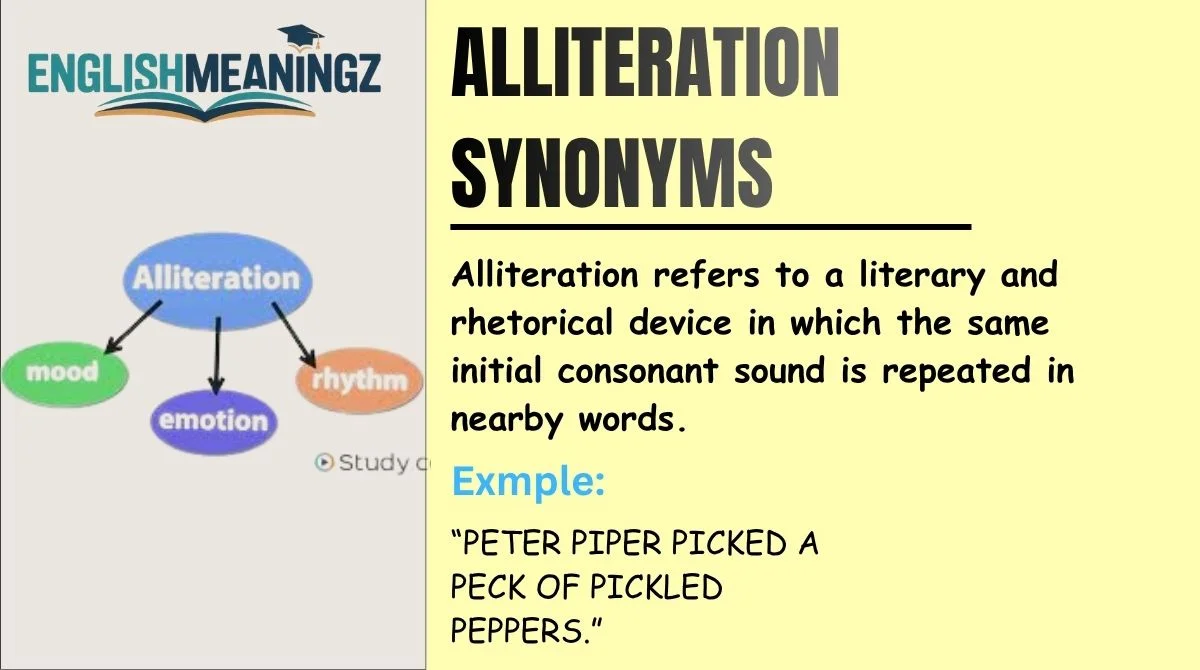
Alliteration refers to a literary and rhetorical device in which the same initial consonant sound is repeated in nearby words.
It is commonly used to create rhythm, emphasis, and memorability in language.
Example:
“Peter Piper picked a peck of pickled peppers.”
In this sentence, the repetition of the “p” sound creates a rhythmic and catchy effect.
Alliteration appears frequently in:
- Poetry
- Advertising slogans
- Brand names
- Speeches
- Literature
- Headlines
Writers use it to make phrases more engaging, musical, and memorable.
Although true synonyms for alliteration are limited, many related stylistic devices and rhetorical techniques perform similar functions in writing. These terms are often used interchangeably or in similar contexts.
25 Synonyms Grouped by Context
General Use
Consonance
Meaning:
Repetition of consonant sounds within nearby words, especially at the end or middle of words.
Context:
Consonance is similar to alliteration but focuses on repeated consonant sounds that may appear anywhere in the word.
Example:
“The blank and think sounds create a subtle echo in the sentence.”
Assonance
Meaning:
Repetition of vowel sounds in nearby words.
Context:
Often used in poetry and prose to create musical rhythm.
Example:
“The light of the sky shined brightly.”
Sound Repetition
Meaning:
General term describing repeated sounds in language.
Context:
Used in writing analysis when discussing stylistic sound patterns.
Example:
“The author uses sound repetition to make the sentence more memorable.”
Phonetic Patterning
Meaning:
Arrangement of similar sounds to create rhythm or emphasis.
Context:
Common in linguistic analysis and literary criticism.
Example:
“The poem relies heavily on phonetic patterning.”
Sonic Echo
Meaning:
Repetition of sounds that create a reflective or echoing effect.
Context:
Often used in literary commentary.
Example:
“The sonic echo enhances the poetic rhythm.”
Sound Harmony
Meaning:
Balanced use of repeated sounds for aesthetic appeal.
Context:
Found in poetry, speeches, and artistic writing.
Example:
“The phrase creates sound harmony through repeated consonants.”
Rhythmic Repetition
Meaning:
Repeated sounds or words that contribute to rhythm.
Context:
Common in speeches and storytelling.
Example:
“The rhythmic repetition makes the line easy to remember.”
Formal & Academic Writing
Phonological Repetition
Meaning:
Repetition of speech sounds from a linguistic perspective.
Context:
Used in academic discussions of language structure.
Example:
“The poem demonstrates phonological repetition.”
Rhetorical Sound Pattern
Meaning:
Intentional arrangement of sounds for rhetorical effect.
Context:
Common in speech analysis.
Example:
“The speaker employs a rhetorical sound pattern to engage the audience.”
Stylistic Sound Device
Meaning:
A general term for sound-based literary techniques.
Context:
Used in literary studies.
Example:
“Alliteration is a stylistic sound device frequently used in poetry.”
Prosodic Repetition
Meaning:
Repetition contributing to rhythm and stress patterns.
Context:
Used in advanced linguistic studies.
Example:
“The speech includes prosodic repetition to maintain flow.”
Acoustic Parallelism
Meaning:
Parallel structure created through similar sounds.
Context:
Used in rhetoric and linguistic analysis.
Example:
“The sentence achieves acoustic parallelism.”
Phonic Pattern
Meaning:
Structured arrangement of sounds in language.
Context:
Literary criticism and stylistic analysis.
Example:
“The poem demonstrates a clear phonic pattern.”
Euphonic Repetition
Meaning:
Repetition of pleasant sounds.
Context:
Common in poetry and lyrical prose.
Example:
“The writer employs euphonic repetition for beauty.”
Informal Usage
Tongue Twister Style
Meaning:
Phrase built around repeated sounds that are difficult to pronounce quickly.
Context:
Often playful or humorous.
Example:
“She wrote the sentence in a tongue-twister style.”
Catchy Sound Pattern
Meaning:
A memorable sound structure.
Context:
Common in marketing or social media writing.
Example:
“The slogan uses a catchy sound pattern.”
Sound Play
Meaning:
Creative experimentation with repeated sounds.
Context:
Used in storytelling and children’s literature.
Example:
“The author enjoys sound play in dialogue.”
Rhyming Effect
Meaning:
Sound similarity that produces a rhyme-like quality.
Context:
Informal description of stylistic repetition.
Example:
“The phrase has a playful rhyming effect.”
Sound Echo
Meaning:
Repeated sounds that resemble an echo.
Context:
Casual explanation of sound repetition.
Example:
“The line contains a clear sound echo.”
Repetitive Sound Style
Meaning:
Writing style emphasizing repeated phonetic elements.
Context:
Used in general discussions about writing.
Example:
“The poet adopts a repetitive sound style.”
Technical or Subject-Specific Use
Consonantal Patterning
Meaning:
Systematic repetition of consonant sounds.
Context:
Used in phonology.
Example:
“The stanza demonstrates consonantal patterning.”
Phonetic Symmetry
Meaning:
Balanced sound arrangement in language.
Context:
Literary and linguistic analysis.
Example:
“The phrase achieves phonetic symmetry.”
Sound Structuring
Meaning:
Deliberate arrangement of sounds for stylistic impact.
Context:
Advanced rhetorical writing.
Example:
“The writer uses sound structuring effectively.”
Auditory Pattern
Meaning:
Recognizable pattern of sounds.
Context:
Used in speech and literary analysis.
Example:
“The speech features a strong auditory pattern.”
Harmonic Sound Repetition
Meaning:
Pleasant repetition creating harmony in sound.
Context:
Poetry and creative writing.
Example:
“The poem demonstrates harmonic sound repetition.”
Word Intensity & Tone Comparison Table
| Term | Formal Level | Emotional Strength | Typical Context |
|---|---|---|---|
| Consonance | Medium | Mild | Poetry analysis |
| Assonance | Medium | Mild | Literary discussion |
| Phonological repetition | Very formal | Neutral | Linguistics |
| Sound repetition | Informal | Low | General writing |
| Sonic echo | Medium | Moderate | Creative criticism |
| Euphonic repetition | Formal | Positive | Poetry |
| Sound play | Informal | Moderate | Creative writing |
| Phonic pattern | Formal | Neutral | Literary studies |
| Catchy sound pattern | Informal | Strong | Marketing |
| Rhythmic repetition | Medium | Moderate | Speeches |
This comparison shows that some terms are better suited for academic essays, while others are more appropriate for creative or casual writing.
Common Mistakes When Using These Synonyms
Many writers misuse these terms because they confuse related sound devices.
Mistake 1: Confusing Alliteration with Assonance
Incorrect:
“The phrase uses assonance because the consonant sounds repeat.”
Correct:
“The phrase uses alliteration because the initial consonant sound repeats.”
Assonance refers specifically to vowel repetition, not consonants.
Mistake 2: Using Consonance as a Direct Replacement
Incorrect:
“This sentence contains consonance at the beginning of every word.”
Correct:
“This sentence contains alliteration, because the repetition occurs at the start.”
Consonance usually occurs within or at the end of words.
Mistake 3: Overusing Technical Terms
Incorrect:
“The author uses phonological repetition and prosodic repetition and acoustic parallelism.”
Correct:
“The author uses repeated sound patterns to strengthen the rhythm.”
Sometimes simple language is clearer.
Synonyms in Academic Writing
Example Paragraph 1
Sound-based literary techniques play an important role in persuasive communication. Writers frequently employ phonological repetition and consonance to create rhythm and emphasis in language. These stylistic devices strengthen memorability and enhance reader engagement. For example, political speeches often rely on carefully constructed sound patterns to highlight key ideas and improve audience recall.
Example Paragraph 2
In literary analysis, identifying phonic patterns and sonic echoes allows scholars to understand how authors structure language artistically. These sound repetitions contribute to the emotional tone of a text while guiding the reader’s attention toward significant themes. As a result, sound devices remain an essential component of stylistic interpretation.
IELTS & Exam Writing Tips
Students preparing for IELTS, TOEFL, or university writing exams should use synonyms carefully.
Avoid Repetition
Instead of repeating alliteration multiple times:
- alliteration
- sound repetition
- consonance
- phonetic pattern
This improves vocabulary range.
Do Not Replace the Word Unnecessarily
In technical discussions, alliteration is often the most accurate term. Replacing it with unrelated words may reduce clarity.
Correct:
“The poem uses alliteration to emphasize rhythm.”
Avoid:
“The poem uses rhythmic repetition to emphasize rhythm.”
Use Context-Appropriate Vocabulary
For academic essays, prefer:
- phonological repetition
- consonance
- assonance
- phonic pattern
Avoid overly casual terms like sound play unless the context allows it.
Similar Words vs True Synonyms
Many terms associated with alliteration are related but not identical.
True Synonyms (or closest equivalents)
- consonantal repetition
- phonological repetition
- sound repetition
These describe repeated sounds similar to alliteration.
Related Literary Devices
- Assonance – vowel repetition
- Consonance – consonant repetition within words
- Rhyme – repetition of ending sounds
These are not exact synonyms, but they share similar stylistic functions.
Why the Difference Matters
Understanding these distinctions helps writers:
- analyze literature more accurately
- avoid terminology errors
- strengthen academic credibility
Practice Sentences
- The poet used ______ to repeat the “b” sound in several words.
- The repeated vowel sounds in the poem demonstrate ______.
- The speech relies on ______ to make phrases memorable.
- The author uses ______ to structure sound patterns in the stanza.
- The advertisement features a ______ that makes the slogan catchy.
Suggested answers:
- alliteration
- assonance
- rhythmic repetition
- phonic pattern
- catchy sound pattern
FAQs
What is another word for alliteration?
Common alternatives include consonance, sound repetition, phonological repetition, and phonic pattern, although each has slightly different meanings.
Is consonance the same as alliteration?
No. Consonance involves repeated consonant sounds anywhere in words, while alliteration specifically repeats sounds at the beginning of words.
Why do writers use alliteration?
Writers use it to:
- create rhythm
- make phrases memorable
- emphasize key ideas
- enhance poetic sound
Is alliteration important in academic writing?
Yes, especially in literary analysis and rhetorical studies, where understanding stylistic devices is essential.
Can alliteration improve SEO content?
Yes. Catchy phrases using sound repetition can improve headline memorability and reader engagement, which benefits digital content.
Conclusion
Expanding vocabulary beyond a single term like alliteration can significantly improve writing quality. By understanding related expressions such as consonance, phonological repetition, phonic patterns, and sonic echoes, writers gain greater control over stylistic language.
For students, mastering these terms strengthens essay analysis and exam performance. Bloggers and professionals benefit by creating more engaging and memorable content. Most importantly, a richer vocabulary allows writers to communicate ideas with precision and creativity.
Developing strong language skills is a gradual process, but learning and practicing synonyms like these is an excellent step toward more powerful and expressive writing.