Understanding opposites is one of the fastest ways to sharpen your vocabulary and improve clarity in writing. When you know not only what a word means but also what it doesn’t mean, you gain control over tone, nuance, and precision.
This is especially useful in academic essays, professional communication, and creative writing, where subtle differences in word choice can completely change meaning.
Antonyms help writers avoid repetition, express contrast, and create stronger arguments. In professional contexts, using the right opposite term can clarify analysis, highlight comparisons, and demonstrate linguistic depth.
This guide explores the most effective antonyms for “glory” and shows how to use them correctly and confidently.
What Does “Glory” Mean?

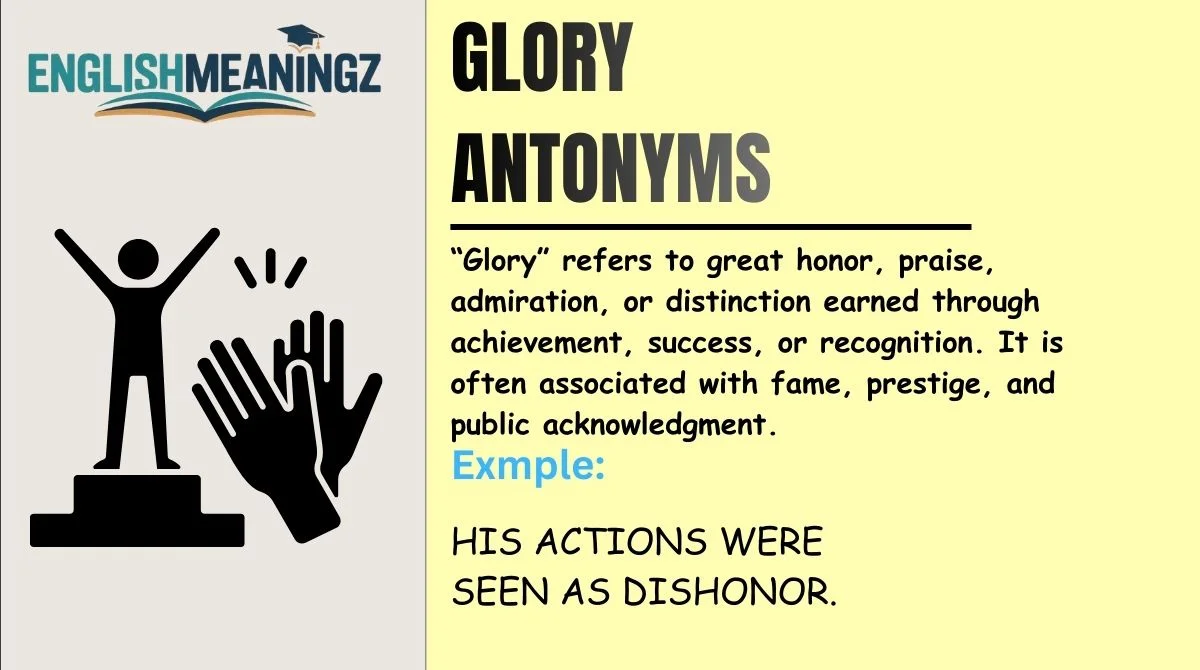
“Glory” refers to great honor, praise, admiration, or distinction earned through achievement, success, or recognition. It is often associated with fame, prestige, and public acknowledgment.
Tone explanation:
The word carries a highly positive and elevated tone. It is commonly used in formal, poetic, or emotional contexts.
Emotional and intensity level:
“Glory” reflects a strong emotional intensity. It suggests not just success, but celebrated success—something admired widely and remembered.
26 Best Antonyms for “Glory”
1. Shame
Meaning: A painful feeling of humiliation
Tone: Emotional
Example: He felt deep shame after the incident.
Why opposite: Glory brings honor; shame brings dishonor.
2. Disgrace
Meaning: Loss of reputation or respect
Tone: Formal
Example: The scandal brought disgrace to the organization.
Why opposite: Glory uplifts status; disgrace destroys it.
3. Humiliation
Meaning: Public embarrassment
Tone: Emotional
Example: The defeat caused humiliation among the team.
Why opposite: Glory celebrates; humiliation degrades.
4. Dishonor
Meaning: Lack of integrity or respect
Tone: Formal
Example: His actions were seen as dishonor.
Why opposite: Glory is respect; dishonor is the absence of it.
5. Failure
Meaning: Lack of success
Tone: Neutral
Example: The project ended in failure.
Why opposite: Glory implies success; failure implies the opposite.
6. Obscurity
Meaning: Being unknown or unnoticed
Tone: Academic
Example: The artist lived in obscurity for years.
Why opposite: Glory is recognition; obscurity is anonymity.
7. Infamy
Meaning: Fame for something bad
Tone: Formal
Example: The criminal gained infamy worldwide.
Why opposite: Glory is positive fame; infamy is negative fame.
8. Defeat
Meaning: Loss in a contest or struggle
Tone: Neutral
Example: The team faced defeat in the finals.
Why opposite: Glory often follows victory; defeat prevents it.
9. Rejection
Meaning: Refusal to accept
Tone: Neutral
Example: His proposal met rejection.
Why opposite: Glory involves acceptance and praise.
10. Mediocrity
Meaning: Average quality
Tone: Academic
Example: The work was criticized for mediocrity.
Why opposite: Glory stands for excellence; mediocrity does not.
11. Neglect
Meaning: Lack of attention or care
Tone: Neutral
Example: The project suffered from neglect.
Why opposite: Glory draws attention; neglect ignores.
12. Contempt
Meaning: Deep disrespect
Tone: Formal
Example: He spoke with contempt about the decision.
Why opposite: Glory earns admiration; contempt denies it.
13. Discredit
Meaning: Loss of trust or credibility
Tone: Formal
Example: The report brought discredit to the firm.
Why opposite: Glory builds credibility; discredit removes it.
14. Insignificance
Meaning: Lack of importance
Tone: Academic
Example: The issue was treated with insignificance.
Why opposite: Glory signifies importance; insignificance denies it.
15. Blame
Meaning: Responsibility for wrongdoing
Tone: Neutral
Example: She took the blame for the mistake.
Why opposite: Glory gives praise; blame assigns fault.
16. Disapproval
Meaning: Negative judgment
Tone: Formal
Example: The plan received public disapproval.
Why opposite: Glory involves approval.
17. Loss
Meaning: Failure to gain or maintain
Tone: Neutral
Example: The company reported a loss.
Why opposite: Glory often accompanies gain.
18. Collapse
Meaning: Sudden failure
Tone: Dramatic
Example: The empire faced total collapse.
Why opposite: Glory suggests strength; collapse shows weakness.
19. Decline
Meaning: Gradual decrease
Tone: Neutral
Example: There was a decline in performance.
Why opposite: Glory indicates rise; decline indicates fall.
20. Disrespect
Meaning: Lack of respect
Tone: Informal
Example: His tone showed disrespect.
Why opposite: Glory is built on respect.
21. Ridicule
Meaning: Mockery
Tone: Informal
Example: The idea became a subject of ridicule.
Why opposite: Glory brings admiration; ridicule brings mockery.
22. Weakness
Meaning: Lack of strength
Tone: Neutral
Example: The strategy revealed weakness.
Why opposite: Glory is tied to strength and success.
23. Anonymity
Meaning: Being unknown
Tone: Academic
Example: She preferred anonymity.
Why opposite: Glory is public recognition.
24. Misfortune
Meaning: Bad luck
Tone: Neutral
Example: Misfortune followed the venture.
Why opposite: Glory suggests success, not bad luck.
25. Disappointment
Meaning: Failure to meet expectations
Tone: Emotional
Example: The results caused disappointment.
Why opposite: Glory fulfills expectations.
26. Ignorance
Meaning: Lack of awareness
Tone: Academic
Example: The decision reflected ignorance.
Why opposite: Glory often comes from excellence and knowledge.
Strong vs Mild Opposites
Not all antonyms carry the same intensity. Some are direct and powerful opposites, while others are softer contrasts.
Strong opposites:
Words like disgrace, infamy, humiliation, and dishonor strongly contrast with glory because they completely reverse its meaning. These terms imply active loss of respect or public shame.
Mild opposites:
Words like obscurity, mediocrity, and insignificance are softer. They don’t imply disgrace but rather the absence of recognition or excellence.
Understanding this intensity scale helps you choose the right word depending on context. For dramatic writing, strong antonyms are effective. For analytical or academic writing, mild opposites often fit better.
Context-Based Opposites
Antonyms change depending on context. “Glory” can refer to fame, success, honor, or beauty, and each meaning has different opposites.
- In fame context: glory vs obscurity or anonymity
- In achievement context: glory vs failure or defeat
- In moral context: glory vs dishonor or disgrace
- In emotional context: glory vs shame or humiliation
Choosing the correct antonym requires understanding the intended meaning of “glory” in your sentence.
Common Mistakes When Using Opposites
1. Using weak opposites incorrectly
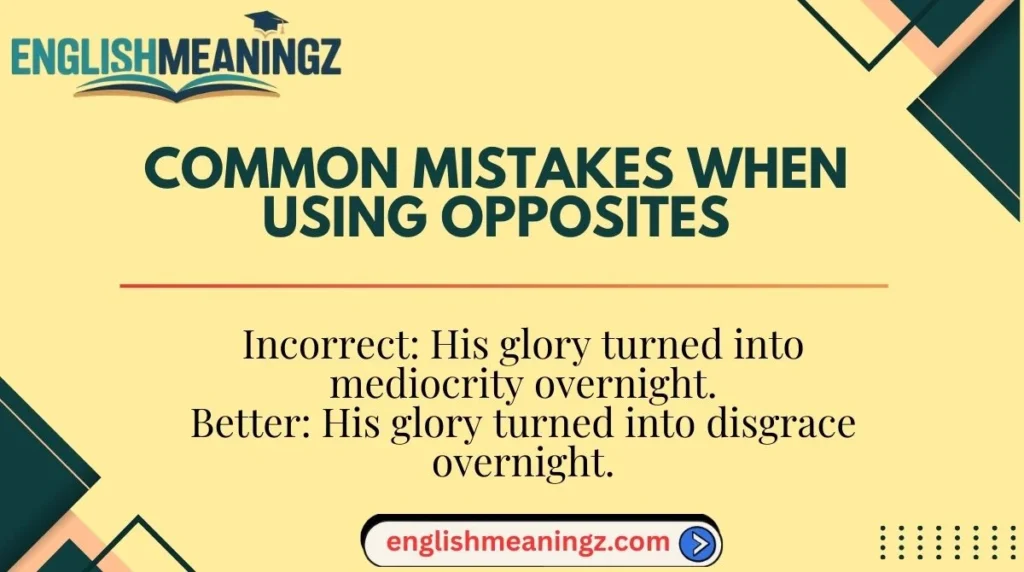
Incorrect: His glory turned into mediocrity overnight.
Better: His glory turned into disgrace overnight.
2. Confusing tone
Incorrect: The hero fell into casual disrespect.
Better: The hero fell into dishonor.
3. Ignoring context
Incorrect: The athlete moved from glory to anonymity after losing one match.
Better: The athlete moved from glory to defeat.
4. Overusing dramatic antonyms
Using strong words like “disgrace” in minor situations can sound exaggerated.
Sentence Transformation Examples
Original: The soldier returned home in glory.
Rewritten: The soldier returned home in disgrace.
Original: She achieved glory through hard work.
Rewritten: She faced failure despite hard work.
Original: The team celebrated their glory.
Rewritten: The team endured humiliation.
Original: His speech brought him glory.
Rewritten: His speech brought him ridicule.
Original: The company enjoyed years of glory.
Rewritten: The company suffered years of decline.
FAQs
What is the strongest antonym of “glory”?
Disgrace and dishonor are among the strongest antonyms because they directly oppose honor and recognition.
Is “failure” a true antonym of glory?
Yes, in contexts related to success and achievement, failure works as a clear opposite.
Can “obscurity” be considered an antonym?
Yes, especially when glory refers to fame or recognition.
What is a formal antonym of glory?
Disgrace, dishonor, and infamy are commonly used in formal writing.
Are all antonyms negative words?
Most antonyms of glory carry negative meanings, but some are neutral, like obscurity.
How do I choose the right antonym?
Focus on context—whether glory refers to fame, success, or honor.
Why is learning antonyms important?
It improves vocabulary, writing clarity, and the ability to express contrast effectively.
Conclusion
Mastering antonyms for “glory” allows you to communicate with precision and impact.
Whether you are writing academically, professionally, or creatively, understanding these opposites helps you control tone, express contrast, and avoid repetition.
From strong contrasts like disgrace and humiliation to softer ones like obscurity and mediocrity, each antonym serves a unique purpose. The key is choosing the right word based on context and intensity.