A strong vocabulary is not just about knowing more words—it’s about knowing the right words. One of the most effective ways to sharpen your language skills is by mastering opposites.
When you understand antonyms deeply, your writing becomes clearer, more expressive, and more precise.
In academic, professional, and creative communication, word choice shapes perception. If you rely on a limited vocabulary, your message can feel flat or repetitive.
However, when you can replace a word like desolate with its exact opposite depending on context, you instantly elevate your tone, clarity, and impact.
This article explores powerful antonyms for desolate, explains their nuances, and shows you how to use them effectively in real-world writing.
What Does “Desolate” Mean?
Desolate describes a state of emptiness, abandonment, or deep loneliness.
Clear Definition
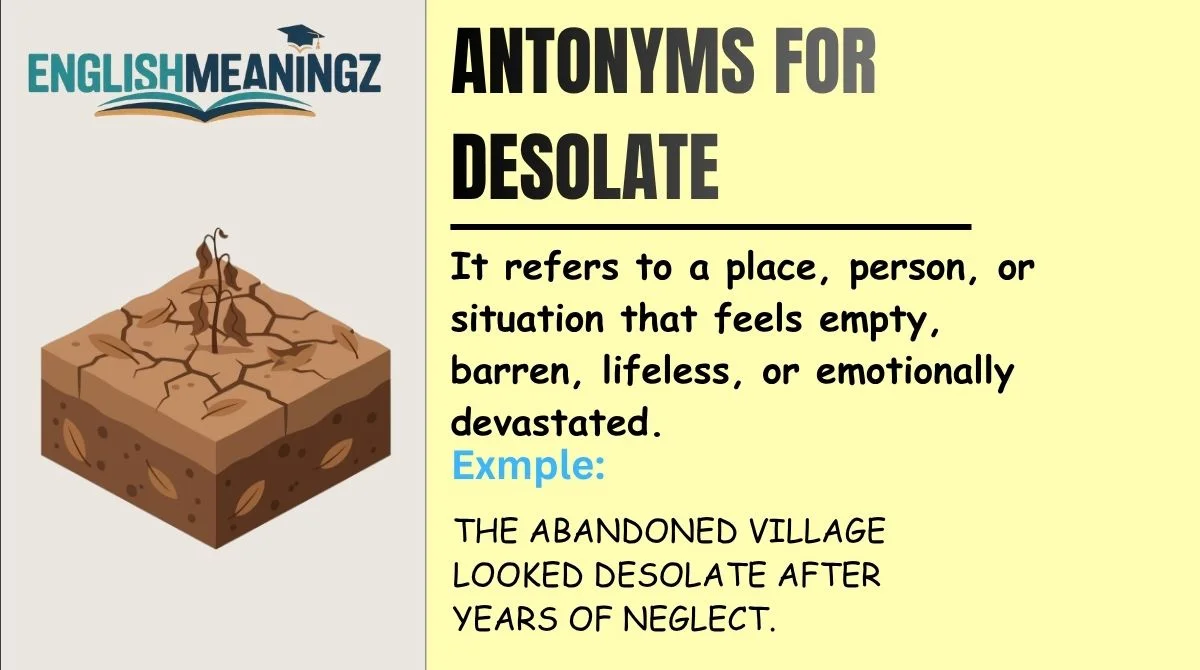
It refers to a place, person, or situation that feels empty, barren, lifeless, or emotionally devastated.
Tone Explanation
The word carries a strong negative and often emotional tone. It can describe both physical environments and emotional states.
Emotional or Action Intensity
- High intensity
- Often implies hopelessness, isolation, or ruin
- Can be both literal (empty land) and figurative (emotional despair)
Example:
The abandoned village looked desolate after years of neglect.
21 Best Antonyms for “Desolate”
1. Lively
Meaning: Full of energy and activity
Tone: Informal / Emotional
Example: The market was lively with music and laughter.
Why it’s opposite: Instead of emptiness, it suggests movement and excitement.
2. Thriving
Meaning: Growing strongly and successfully
Tone: Academic / Professional
Example: The business district is thriving with new investments.
Why it’s opposite: Replaces decline with growth and prosperity.
3. Bustling
Meaning: Full of busy activity
Tone: Informal
Example: The streets were bustling during the festival.
Why it’s opposite: Contrasts stillness with energetic movement.
4. Vibrant
Meaning: Full of life, color, and energy
Tone: Emotional / Descriptive
Example: The city has a vibrant cultural scene.
Why it’s opposite: Opposes dullness and emptiness with vitality.
5. Populated
Meaning: Filled with people
Tone: Formal
Example: The area is densely populated with residents.
Why it’s opposite: Directly contrasts isolation and emptiness.
6. Flourishing
Meaning: Developing rapidly and successfully
Tone: Academic
Example: The garden is flourishing in spring.
Why it’s opposite: Suggests growth instead of decay.
7. Prosperous
Meaning: Financially successful and thriving
Tone: Formal / Professional
Example: The region became prosperous due to trade.
Why it’s opposite: Replaces ruin with success.
8. Animated
Meaning: Full of life and excitement
Tone: Informal
Example: Their animated conversation drew attention.
Why it’s opposite: Counters lifelessness with energy.
9. Crowded
Meaning: Filled with people or things
Tone: Neutral
Example: The train was crowded during rush hour.
Why it’s opposite: Eliminates emptiness entirely.
10. Cheerful
Meaning: Happy and positive
Tone: Emotional
Example: She maintained a cheerful attitude.
Why it’s opposite: Opposes emotional despair.
11. Hopeful
Meaning: Feeling or inspiring optimism
Tone: Emotional
Example: The community remained hopeful about recovery.
Why it’s opposite: Counters hopelessness.
12. Fertile
Meaning: Capable of producing growth
Tone: Academic
Example: The fertile land supported agriculture.
Why it’s opposite: Replaces barrenness with productivity.
13. Blooming
Meaning: Full of flowers or growth
Tone: Descriptive
Example: The garden was blooming beautifully.
Why it’s opposite: Suggests life and renewal.
14. Inhabited
Meaning: Occupied by people or animals
Tone: Formal
Example: The island is inhabited year-round.
Why it’s opposite: Opposes abandonment.
15. Energetic
Meaning: Full of vitality and strength
Tone: Neutral
Example: The team showed energetic performance.
Why it’s opposite: Counters lifelessness.
16. Radiant
Meaning: Bright and full of positive energy
Tone: Emotional
Example: She looked radiant with happiness.
Why it’s opposite: Opposes gloom.
17. Active
Meaning: Engaged in movement or action
Tone: Neutral
Example: The campus is active throughout the day.
Why it’s opposite: Contrasts inactivity.
18. Dynamic
Meaning: Constantly changing and energetic
Tone: Academic
Example: The company operates in a dynamic market.
Why it’s opposite: Opposes stagnation.
19. Welcoming
Meaning: Friendly and inviting
Tone: Emotional
Example: The environment felt warm and welcoming.
Why it’s opposite: Contrasts emotional coldness.
20. Lush
Meaning: Rich in vegetation or abundance
Tone: Descriptive
Example: The valley was lush and green.
Why it’s opposite: Opposes dryness and barrenness.
21. Rejuvenated
Meaning: Restored to life or energy
Tone: Formal / Emotional
Example: The town felt rejuvenated after development.
Why it’s opposite: Reverses decay into renewal.
Strong vs Mild Opposites
Not all antonyms carry the same intensity. Choosing the wrong level can weaken your message.
Strong Opposites
These completely reverse the meaning:
- Thriving
- Bustling
- Flourishing
- Vibrant
They are ideal for dramatic contrast.
Mild Opposites
These soften the contrast:
- Active
- Populated
- Inhabited
They work best in neutral or academic writing.
Key Insight
Use strong antonyms for emotional or persuasive writing, and mild ones for factual or technical contexts.
Context-Based Opposites
The best antonym depends on how “desolate” is used.
Physical Environment
- Desolate desert → Lush valley
- Desolate town → Bustling city
Emotional Context
- Desolate mood → Hopeful attitude
- Desolate life → Cheerful existence
Economic Context
- Desolate economy → Prosperous economy
Social Context
- Desolate community → Welcoming community
Understanding context prevents awkward or inaccurate word choices.
Common Mistakes When Using Opposites
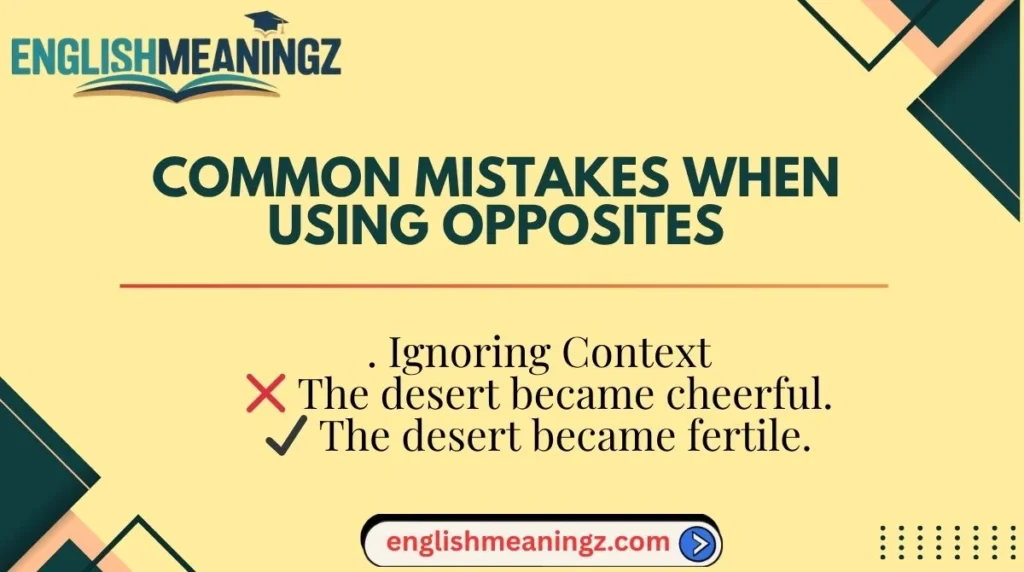
1. Ignoring Context
❌ The desert became cheerful.
✔ The desert became fertile.
Problem: “Cheerful” doesn’t fit a physical setting.
2. Choosing Weak Contrasts
❌ The empty city became active.
✔ The empty city became bustling.
Problem: “Active” is too mild.
3. Mixing Emotional and Physical Meanings
❌ He felt populated after the news.
✔ He felt hopeful after the news.
Problem: “Populated” is not emotional.
4. Overusing One Antonym
Using “lively” repeatedly reduces impact. Variety matters.
Sentence Transformation Examples
Original → Improved
- The village looked desolate.
→ The village looked lively and thriving. - His life felt desolate after failure.
→ His life felt hopeful and renewed. - The land was desolate and dry.
→ The land was lush and fertile. - The streets were desolate at night.
→ The streets were bustling and vibrant. - The atmosphere was desolate and cold.
→ The atmosphere was warm and welcoming.
FAQs
What is the exact opposite of desolate?
There is no single exact opposite. Words like thriving, lively, and lush are commonly used depending on context.
Can desolate refer to emotions?
Yes, it often describes deep loneliness or emotional emptiness.
Which antonym is best for academic writing?
Flourishing, prosperous, and dynamic are strong academic choices.
Is “busy” a good antonym for desolate?
It can work, but bustling is more precise and expressive.
What antonym fits nature descriptions?
Lush, fertile, and blooming are ideal.
Can one antonym work in all contexts?
No. Context determines the most accurate opposite.
How can I improve my vocabulary faster?
Practice using antonyms in sentences and rewrite existing text with varied word choices.
Conclusion
Understanding antonyms for desolate is more than a vocabulary exercise—it’s a tool for precision, clarity, and expressive power.
Whether you’re writing academically, professionally, or creatively, selecting the right opposite can completely transform your message.
From lively and bustling to lush and prosperous, each antonym carries a unique tone and intensity. The key is not just knowing these words, but knowing when and how to use them.
Master this skill, and your writing will instantly feel more dynamic, engaging, and impactful.