Understanding opposites is one of the fastest ways to strengthen vocabulary, sharpen clarity, and elevate writing quality. When you learn how words relate—especially through antonyms and synonyms—you gain precision.
Instead of repeating the same expression, you can adjust tone, intensity, and meaning with confidence.
Opposites, in particular, force the brain to think in contrast. This not only improves comprehension but also enhances your ability to argue, describe, and explain ideas effectively.
Whether you’re writing essays, business emails, or creative content, knowing the right opposite word can completely change how your message is received.
In academic and professional communication, clarity and tone control are essential. Using accurate antonyms helps you:
- Avoid ambiguity
- Express contrast logically
- Strengthen arguments
- Improve readability
This guide focuses on building a strong 21 antonyms and synonyms anchor chart, centered around a powerful root word, so you can master opposites in a structured, practical way.
What Does “Strong” Mean?
Definition:
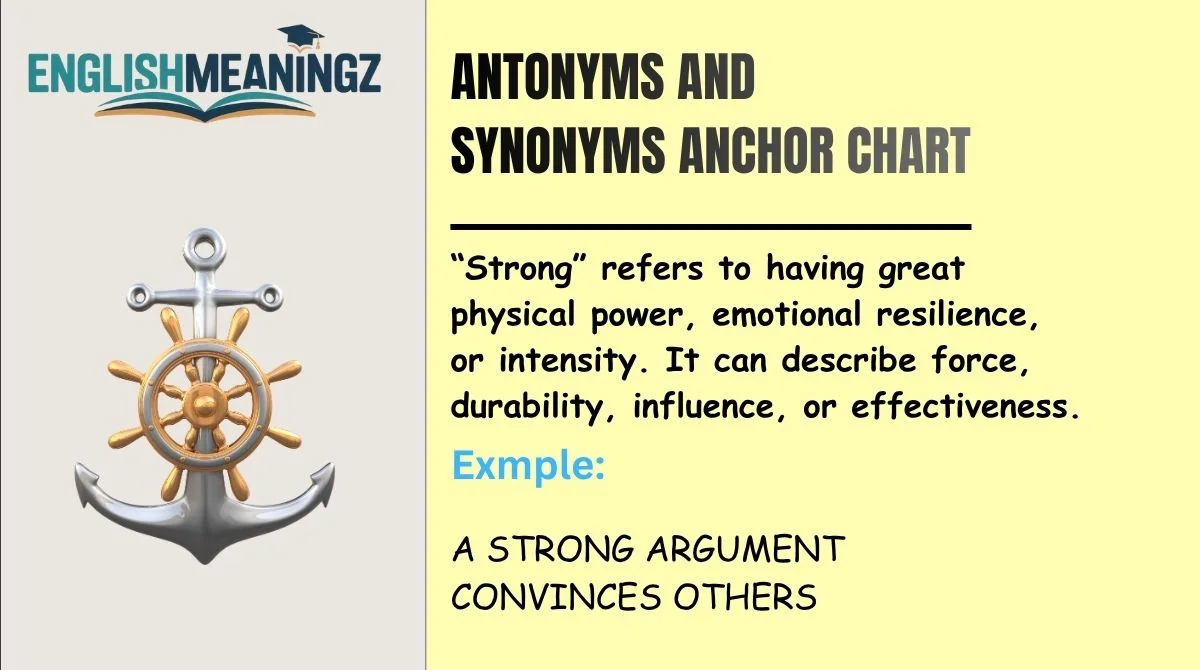
“Strong” refers to having great physical power, emotional resilience, or intensity. It can describe force, durability, influence, or effectiveness.
Tone Explanation:
The word carries a positive and assertive tone. It suggests capability, confidence, and reliability.
Emotional or Action Intensity:
“Strong” sits on the higher end of intensity. It implies firmness, dominance, or effectiveness—whether in physical strength, arguments, or emotions.
Examples:
- A strong argument convinces others
- A strong person resists pressure
- A strong flavor is intense
Because “strong” represents power and intensity, its antonyms often revolve around weakness, softness, fragility, or lack of influence.
21 Best Antonyms for “Strong”
Weak
Meaning: Lacking power or strength
Tone: Neutral / Academic
Example: His argument was too weak to convince the audience.
Why Opposite: Direct contrast in power and effectiveness
Fragile
Meaning: Easily broken or damaged
Tone: Formal
Example: The fragile glass shattered instantly.
Why Opposite: Strong implies durability, fragile implies vulnerability
Feeble
Meaning: Lacking physical or mental strength
Tone: Formal
Example: The patient felt too feeble to stand.
Why Opposite: Indicates extreme weakness
Powerless
Meaning: Without control or influence
Tone: Emotional
Example: She felt powerless in the situation.
Why Opposite: Strong implies control; powerless removes it
Frail
Meaning: Physically weak or delicate
Tone: Formal
Example: The frail man needed assistance walking.
Why Opposite: Opposes physical strength
Soft
Meaning: Not firm or forceful
Tone: Neutral
Example: The pillow was soft and comfortable.
Why Opposite: Strong implies firmness; soft suggests the opposite
Delicate
Meaning: Easily damaged or sensitive
Tone: Formal
Example: Handle the delicate fabric carefully.
Why Opposite: Strong suggests resilience
Helpless
Meaning: Unable to defend oneself
Tone: Emotional
Example: The child looked helpless in the storm.
Why Opposite: Strong implies independence and capability
Ineffective
Meaning: Not producing results
Tone: Academic
Example: The strategy proved ineffective.
Why Opposite: Strong actions create impact; ineffective ones do not
Unstable
Meaning: Not firm or secure
Tone: Formal
Example: The structure was unstable.
Why Opposite: Strong implies stability
Vulnerable
Meaning: Open to harm
Tone: Emotional
Example: The city was vulnerable to attack.
Why Opposite: Strong implies protection
Mild
Meaning: Not intense or forceful
Tone: Neutral
Example: The sauce had a mild flavor.
Why Opposite: Strong indicates high intensity
Gentle
Meaning: Soft and careful
Tone: Positive / Emotional
Example: She gave a gentle smile.
Why Opposite: Strong suggests force; gentle suggests softness
Subtle
Meaning: Not obvious or intense
Tone: Academic
Example: The changes were subtle.
Why Opposite: Strong implies clear and bold presence
Weak-willed
Meaning: Lacking determination
Tone: Informal
Example: He is too weak-willed to resist pressure.
Why Opposite: Strong implies mental firmness
Flimsy
Meaning: Easily broken or poorly made
Tone: Informal
Example: The flimsy chair collapsed.
Why Opposite: Strong implies durability
Inefficient
Meaning: Not effective or productive
Tone: Academic
Example: The system is inefficient.
Why Opposite: Strong systems perform well
Faint
Meaning: Weak or barely noticeable
Tone: Neutral
Example: There was a faint sound in the distance.
Why Opposite: Strong implies clarity and force
Passive
Meaning: Not active or assertive
Tone: Academic
Example: He took a passive role in the discussion.
Why Opposite: Strong implies active engagement
Brittle
Meaning: Hard but easily broken
Tone: Formal
Example: The brittle material cracked quickly.
Why Opposite: Strong implies toughness without breaking
Lethargic
Meaning: Lacking energy
Tone: Formal
Example: She felt lethargic all day.
Why Opposite: Strong implies energy and vitality
Strong vs Mild Opposites
Not all opposites carry the same intensity. Some are direct and powerful contrasts, while others are softer alternatives.
Strong Opposites (High Contrast):
- Strong → Weak
- Strong → Powerless
- Strong → Fragile
These create a clear and dramatic difference.
Mild Opposites (Low Contrast):
- Strong → Mild
- Strong → Gentle
- Strong → Subtle
These shift tone rather than completely reverse meaning.
Why This Matters:
Choosing the right level of contrast allows you to control how dramatic or subtle your message feels. In professional writing, mild opposites often sound more refined, while strong opposites create emphasis.
Context-Based Opposites
Antonyms are not always fixed. The opposite of a word can change depending on context.
Examples:
- Strong coffee → Weak coffee
- Strong personality → Passive personality
- Strong structure → Unstable structure
- Strong argument → Ineffective argument
This shows that the correct antonym depends on what aspect of “strong” is being used:
- Power
- Influence
- Intensity
- Stability
Understanding context prevents incorrect word choices.
Common Mistakes When Using Opposites
1. Choosing the wrong intensity
Incorrect: The argument was soft.
Correct: The argument was weak.
2. Ignoring context
Incorrect: The building is gentle.
Correct: The building is unstable.
3. Using emotional words in formal writing
Incorrect: The system is helpless.
Correct: The system is ineffective.
4. Confusing synonyms with antonyms
Incorrect: Strong → Hard (not always opposite)
5. Overusing basic words
Instead of repeating “weak,” use:
- Fragile
- Ineffective
- Vulnerable
Sentence Transformation Examples
Original: The team showed strong performance.
Rewritten: The team showed weak performance.
Original: She has a strong personality.
Rewritten: She has a passive personality.
Original: The structure is strong.
Rewritten: The structure is unstable.
Original: He made a strong argument.
Rewritten: He made an ineffective argument.
Original: The coffee is strong.
Rewritten: The coffee is mild.
FAQs
What is an antonym?
An antonym is a word that has the opposite meaning of another word.
Why are antonyms important?
They improve clarity, expand vocabulary, and help express contrast effectively.
Can a word have multiple antonyms?
Yes, depending on context, a word can have several opposites.
What is the difference between strong and mild antonyms?
Strong antonyms create a clear contrast, while mild antonyms show a softer difference.
Are antonyms always exact opposites?
No, some are approximate and depend on context.
How can I learn antonyms faster?
Use anchor charts, practice sentence rewriting, and group words by intensity.
What is an anchor chart?
An anchor chart is a visual tool that organizes related words, helping with memory and understanding.
Conclusion
Mastering opposites through a structured 21 antonyms and synonyms anchor chart is one of the most effective ways to elevate your vocabulary.
Instead of relying on basic word choices, you gain flexibility, precision, and control over tone.
By understanding intensity levels, context-based meanings, and common mistakes, you can confidently use antonyms in academic, professional, and everyday writing. The key is not just memorizing words, but knowing when and how to use them correctly.
With consistent practice, your writing will become sharper, clearer, and far more impactful.