Understanding opposites is one of the most effective ways to sharpen your language skills. When you learn antonyms, you don’t just memorize words—you gain control over tone, nuance, and precision.
This is especially useful in academic writing, professional communication, and content creation, where clarity and variation matter.
In modern communication, overusing a single term like workaholic can make writing repetitive and dull. Knowing its opposites allows you to express balance, relaxation, moderation, and even disengagement with accuracy.
Whether you are writing essays, crafting business reports, or optimizing SEO content, mastering antonyms improves readability and authority.
This guide explores 25 powerful antonyms of workaholic, along with meanings, tone classifications, examples, and contextual usage.
What Does “Workaholic” Mean?
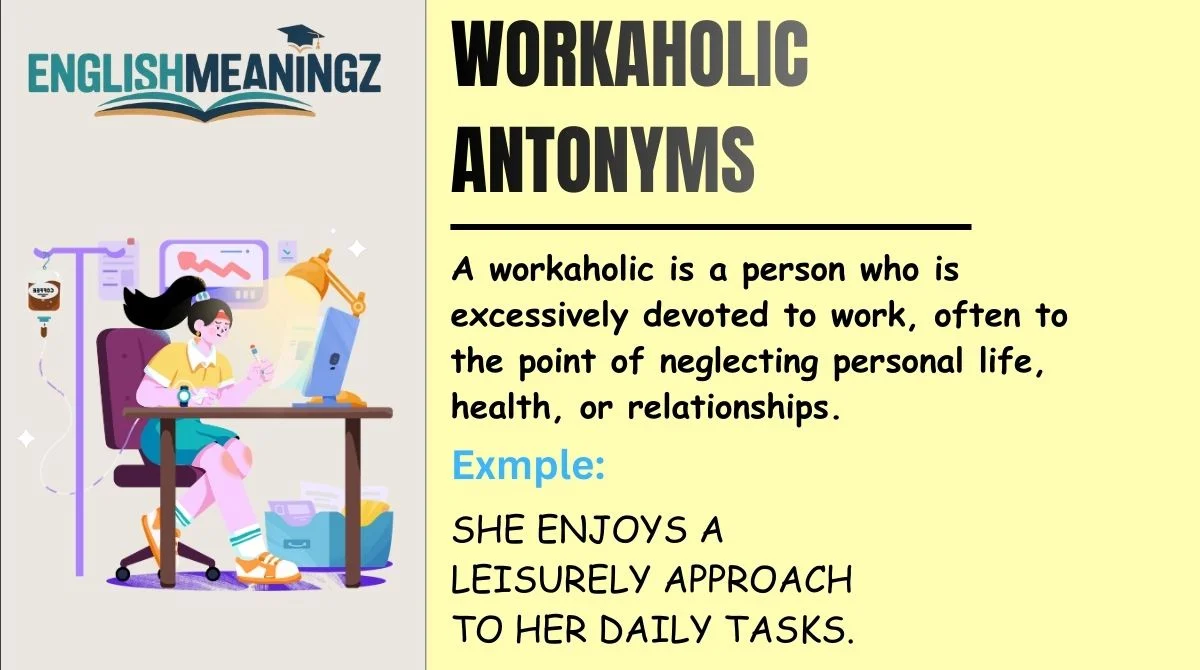
A workaholic is a person who is excessively devoted to work, often to the point of neglecting personal life, health, or relationships.
Tone Explanation:
The word carries a slightly negative or cautionary tone. While it can imply dedication, it often suggests imbalance or obsession.
Emotional / Action Intensity:
High intensity. A workaholic is not just hardworking—they are compulsively engaged in work, often beyond healthy limits.
25 Best Antonyms for “Workaholic”
Relaxed
Meaning: Calm and free from stress or urgency
Tone: Informal / Neutral
Example: He prefers a relaxed lifestyle with minimal work pressure.
Why it’s opposite: It reflects ease rather than overwork.
Leisurely
Meaning: Done at a slow, unhurried pace
Tone: Formal
Example: She enjoys a leisurely approach to her daily tasks.
Why it’s opposite: Emphasizes slow pace versus constant hustle.
Laid-back
Meaning: Easygoing and not overly concerned with work
Tone: Informal
Example: His laid-back attitude keeps him stress-free.
Why it’s opposite: Shows lack of urgency or obsession.
Idle
Meaning: Not active or working
Tone: Neutral
Example: He remained idle during the weekend.
Why it’s opposite: Indicates absence of work.
Unmotivated
Meaning: Lacking drive or ambition
Tone: Emotional
Example: She felt unmotivated after burnout.
Why it’s opposite: Opposes excessive motivation.
Balanced
Meaning: Maintaining equal focus on work and life
Tone: Academic / Professional
Example: A balanced routine improves productivity.
Why it’s opposite: Represents healthy moderation.
Carefree
Meaning: Free from worries and responsibilities
Tone: Informal
Example: They lived a carefree life by the beach.
Why it’s opposite: Lacks the pressure associated with workaholism.
Easygoing
Meaning: Relaxed and tolerant
Tone: Informal
Example: Her easygoing nature helps her avoid stress.
Why it’s opposite: Suggests flexibility, not rigidity.
Unambitious
Meaning: Having little desire for achievement
Tone: Neutral
Example: He remained unambitious about career growth.
Why it’s opposite: Opposes high ambition linked to workaholics.
Restful
Meaning: Providing relaxation and peace
Tone: Formal
Example: A restful weekend restored his energy.
Why it’s opposite: Focuses on rest, not work.
Sluggish
Meaning: Slow-moving or lacking energy
Tone: Negative
Example: He felt sluggish after staying inactive.
Why it’s opposite: Contrasts high energy and activity.
Indifferent
Meaning: Showing no interest or concern
Tone: Formal
Example: She remained indifferent toward office tasks.
Why it’s opposite: Lack of engagement vs over-engagement.
Passive
Meaning: Accepting rather than actively pursuing
Tone: Academic
Example: His passive approach limited his success.
Why it’s opposite: Workaholics are highly active.
Detached
Meaning: Emotionally uninvolved
Tone: Formal
Example: He felt detached from workplace goals.
Why it’s opposite: Opposes emotional investment in work.
Unproductive
Meaning: Not achieving much
Tone: Neutral
Example: The day turned out unproductive.
Why it’s opposite: Workaholics are typically productive (though excessively).
Casual
Meaning: Relaxed and unconcerned
Tone: Informal
Example: She has a casual attitude toward deadlines.
Why it’s opposite: Shows low intensity.
Free-spirited
Meaning: Independent and unconstrained
Tone: Emotional
Example: He chose a free-spirited lifestyle over a strict career.
Why it’s opposite: Rejects rigid work patterns.
Uncommitted
Meaning: Not dedicated
Tone: Neutral
Example: He seemed uncommitted to the project.
Why it’s opposite: Lack of dedication vs extreme dedication.
Recreational
Meaning: Related to enjoyment or leisure
Tone: Formal
Example: She focuses on recreational activities.
Why it’s opposite: Prioritizes leisure.
Rest-seeking
Meaning: Looking for relaxation
Tone: Descriptive
Example: After years of work, he became rest-seeking.
Why it’s opposite: Focus shifts to rest.
Nonchalant
Meaning: Calm and unconcerned
Tone: Formal
Example: His nonchalant attitude surprised his boss.
Why it’s opposite: Lack of urgency.
Inactive
Meaning: Not engaging in activity
Tone: Neutral
Example: He remained inactive for months.
Why it’s opposite: Opposes constant activity.
Slow-paced
Meaning: Moving at a gentle speed
Tone: Neutral
Example: She prefers a slow-paced career.
Why it’s opposite: Contrasts intense work pace.
Content
Meaning: Satisfied with what one has
Tone: Emotional
Example: He felt content without chasing promotions.
Why it’s opposite: Workaholics often seek more.
Relaxation-focused
Meaning: Prioritizing rest over work
Tone: Descriptive
Example: His lifestyle is relaxation-focused.
Why it’s opposite: Direct contrast to work obsession.
Strong vs Mild Opposites
Not all antonyms carry the same intensity. Some directly oppose workaholic, while others offer softer contrast.
Strong opposites:
Idle, inactive, unproductive, indifferent
These words show complete disengagement from work.
Moderate opposites:
Balanced, relaxed, easygoing
These suggest a healthy middle ground.
Mild opposites:
Leisurely, casual, slow-paced
These indicate reduced intensity rather than complete opposition.
Understanding this scale helps you choose the right word depending on context. For academic writing, moderate opposites are often more appropriate, while strong ones may sound exaggerated.
Context-Based Opposites
Antonyms vary depending on context. A single word may not fit all situations.
- Work-life balance context: Balanced, relaxed
- Emotional context: Carefree, content
- Professional context: Unambitious, passive
- Behavioral context: Idle, inactive
For example:
In a corporate report, “balanced” works better than “lazy.”
In storytelling, “carefree” adds emotional depth.
Common Mistakes When Using Opposites
1. Confusing “lazy” with all antonyms
Not every opposite implies laziness. “Balanced” is often a better choice.
2. Ignoring tone
Using informal words like “laid-back” in academic writing reduces credibility.
3. Overgeneralization
Assuming one antonym fits every sentence leads to awkward phrasing.
4. Misusing intensity
Calling someone “inactive” when they are simply relaxed creates exaggeration.
Example Mistake:
Incorrect: He is inactive because he works normal hours.
Correct: He maintains a balanced work routine.
Sentence Transformation Examples
Original: She is a workaholic who never rests.
Rewritten: She prefers a balanced lifestyle with regular breaks.
Original: He works obsessively every day.
Rewritten: He takes a relaxed approach to his schedule.
Original: They are extremely dedicated to work.
Rewritten: They are more leisure-oriented and value free time.
Original: She spends all her time working.
Rewritten: She enjoys a carefree life with minimal work stress.
Original: He prioritizes work over everything.
Rewritten: He focuses on a relaxation-centered lifestyle.
FAQs
What is the exact opposite of a workaholic?
There is no single exact opposite, but “idle” and “inactive” are the closest strong antonyms.
Is “lazy” a good antonym for workaholic?
It can be, but it carries a negative tone and is not always appropriate.
What is a positive opposite of workaholic?
“Balanced” is the most positive and widely accepted opposite.
Can antonyms change based on context?
Yes, context determines whether you use mild, moderate, or strong opposites.
Which antonym is best for professional writing?
“Balanced,” “moderate,” or “measured” are ideal in formal contexts.
Are all antonyms negative?
No. Words like “carefree” and “content” have positive connotations.
Why should I learn multiple antonyms?
It improves vocabulary flexibility, writing clarity, and SEO performance.
Conclusion
Mastering antonyms of workaholic allows you to communicate with precision, balance, and variety. Instead of relying on one-dimensional descriptions, you can tailor your language to match tone, context, and intent.
From strong opposites like inactive to nuanced alternatives like balanced and carefree, each word offers a unique perspective.
Whether you’re writing academically, professionally, or creatively, understanding these distinctions enhances both clarity and impact.
Expanding your vocabulary is not just about learning new words—it’s about gaining control over expression.