Mastering opposites is one of the fastest ways to sharpen your language skills. When you understand not just a word but also its contrast, your thinking becomes more precise and your expression more dynamic.
Antonyms help you communicate nuance, argue effectively, and avoid repetition in both writing and speech.
In academic and professional communication, clarity is everything. Using the right opposite word allows you to highlight contrast, strengthen arguments, and convey intention with accuracy.
Whether you’re writing essays, reports, or marketing content, knowing the antonyms of “sponsor” gives you greater control over tone and meaning.
This guide explores 25 high-quality antonyms for “sponsor,” along with clear explanations, tone labels, and practical examples—all crafted to elevate your vocabulary in 2026 and beyond.
What Does “Sponsor” Mean?
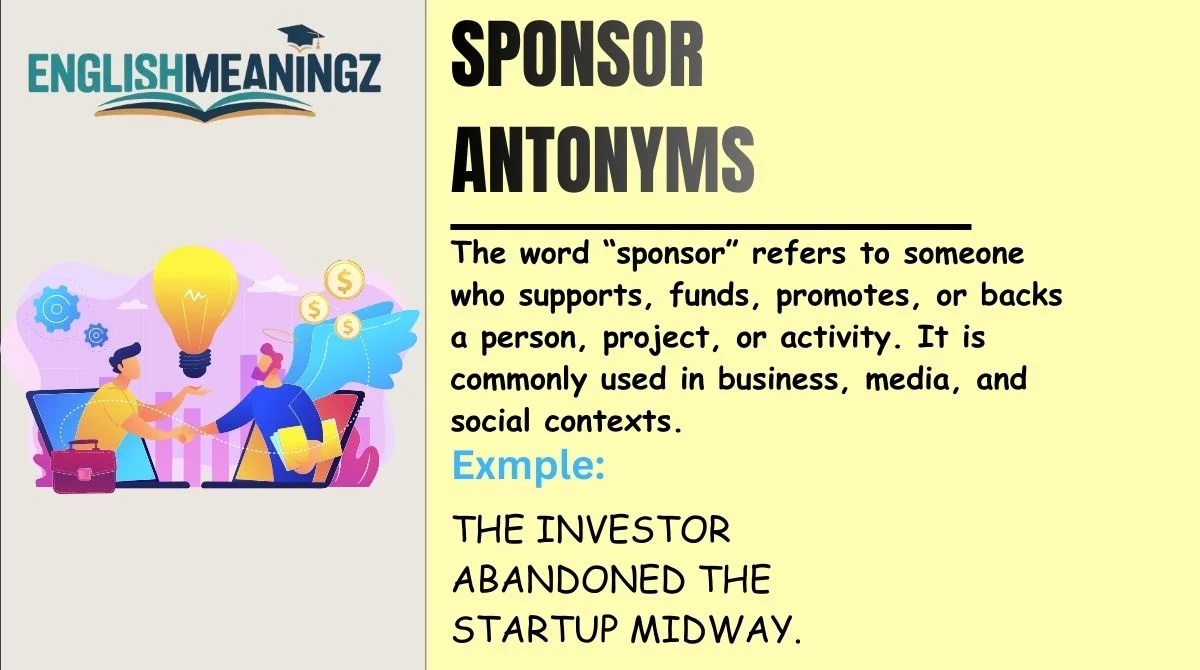
The word “sponsor” refers to someone who supports, funds, promotes, or backs a person, project, or activity. It is commonly used in business, media, and social contexts.
Definition:
A sponsor is an individual or organization that provides financial or moral support to an initiative, event, or person.
Tone Explanation:
“Sponsor” carries a positive and supportive tone. It implies encouragement, approval, and active involvement.
Emotional / Action Intensity:
The word reflects strong involvement. A sponsor is not passive—they actively contribute resources, credibility, or influence.
25 Best Antonyms for “Sponsor”
Oppose
Meaning: To actively resist or disagree
Tone: Formal
Example: The board decided to oppose the proposal.
Why it’s opposite: Instead of supporting, it directly resists.
Reject
Meaning: To refuse acceptance or approval
Tone: Formal
Example: The company rejected the partnership offer.
Why it’s opposite: A sponsor accepts and supports, while rejection denies.
Block
Meaning: To prevent progress
Tone: Informal
Example: The committee blocked the funding request.
Why it’s opposite: Sponsorship enables; blocking stops.
Withhold
Meaning: To hold back support or resources
Tone: Formal
Example: They withheld financial backing for the project.
Why it’s opposite: Sponsorship gives; withholding denies.
Abandon
Meaning: To leave without support
Tone: Emotional
Example: The investor abandoned the startup midway.
Why it’s opposite: A sponsor stays involved, not leaves.
Neglect
Meaning: To ignore or fail to care for
Tone: Neutral
Example: The organization neglected the initiative.
Why it’s opposite: Sponsorship requires attention; neglect ignores.
Undermine
Meaning: To weaken or sabotage
Tone: Formal
Example: His actions undermined the campaign.
Why it’s opposite: Sponsors strengthen, not weaken.
Dismiss
Meaning: To treat as unworthy of consideration
Tone: Formal
Example: The idea was quickly dismissed.
Why it’s opposite: Sponsorship values; dismissal disregards.
Discourage
Meaning: To reduce confidence or enthusiasm
Tone: Emotional
Example: Critics discouraged the young entrepreneur.
Why it’s opposite: Sponsors motivate; discouragement demotivates.
Opponent
Meaning: One who competes against
Tone: Neutral
Example: He acted as an opponent to the initiative.
Why it’s opposite: Opponents challenge instead of support.
Criticize
Meaning: To point out faults
Tone: Neutral
Example: The project was heavily criticized.
Why it’s opposite: Sponsors promote, critics question.
Disapprove
Meaning: To express unfavorable opinion
Tone: Formal
Example: Management disapproved of the plan.
Why it’s opposite: Sponsorship shows approval.
Boycott
Meaning: To withdraw support deliberately
Tone: Formal
Example: The brand faced a public boycott.
Why it’s opposite: Sponsors provide support; boycotts remove it.
Hinder
Meaning: To create obstacles
Tone: Neutral
Example: Bureaucracy hindered progress.
Why it’s opposite: Sponsors facilitate growth.
Sabotage
Meaning: To intentionally damage
Tone: Strong/Emotional
Example: The rival tried to sabotage the launch.
Why it’s opposite: Sponsorship builds; sabotage destroys.
Ignore
Meaning: To pay no attention
Tone: Informal
Example: The proposal was ignored completely.
Why it’s opposite: Sponsors engage; ignoring disengages.
Defund
Meaning: To remove financial support
Tone: Formal
Example: The program was defunded last year.
Why it’s opposite: Sponsors fund; defunding removes support.
Oppressor
Meaning: One who suppresses
Tone: Strong
Example: The regime acted as an oppressor.
Why it’s opposite: Sponsors empower; oppressors restrict.
Detractor
Meaning: Someone who speaks against
Tone: Formal
Example: Detractors questioned the initiative.
Why it’s opposite: Sponsors advocate; detractors criticize.
Resist
Meaning: To withstand or fight against
Tone: Formal
Example: The group resisted the change.
Why it’s opposite: Sponsorship aligns with support, not resistance.
Suppress
Meaning: To forcefully put an end to
Tone: Strong
Example: Authorities suppressed the movement.
Why it’s opposite: Sponsors promote visibility; suppression hides it.
Deny
Meaning: To refuse to grant
Tone: Formal
Example: Funding was denied by the board.
Why it’s opposite: Sponsors grant support.
Withdraw
Meaning: To pull back support
Tone: Neutral
Example: The company withdrew its backing.
Why it’s opposite: Sponsorship maintains involvement.
Opponent Entity
Meaning: A competing or opposing group
Tone: Neutral
Example: The opponent entity challenged the proposal.
Why it’s opposite: Opposes rather than supports.
Counteract
Meaning: To act against something
Tone: Formal
Example: Measures were taken to counteract the campaign.
Why it’s opposite: Sponsors reinforce; counteraction reduces impact.
Strong vs Mild Opposites
Not all antonyms carry the same intensity. Some directly contradict “sponsor,” while others only partially oppose it.
Strong opposites: sabotage, suppress, boycott, defund
These completely reverse the idea of support and often involve active harm.
Moderate opposites: oppose, reject, resist
These show disagreement but not necessarily destruction.
Mild opposites: ignore, neglect, withdraw
These reflect passive absence of support rather than direct opposition.
Understanding this scale helps you choose the right word depending on context. For academic writing, moderate terms often work best. For persuasive or emotional writing, stronger antonyms add impact.
Context-Based Opposites
The best antonym depends on how “sponsor” is used.
Financial context:
- Sponsor → Defund, Withhold
Example: The organization sponsored the event → The organization withheld funding.
Emotional support context:
- Sponsor → Discourage, Neglect
Example: She sponsored his growth → She discouraged his efforts.
Promotional context:
- Sponsor → Suppress, Ignore
Example: The brand sponsored the campaign → The brand ignored the campaign.
Competitive context:
- Sponsor → Oppose, Counteract
Example: They sponsored the policy → They opposed the policy.
Choosing contextually accurate antonyms ensures clarity and professionalism.
Common Mistakes When Using Opposites
Using unrelated words
Incorrect: Sponsor → Attack
While “attack” is negative, it is not always a direct opposite.
Ignoring context
Incorrect: Sponsor (financial) → Ignore
Better: Sponsor → Defund
Overusing strong antonyms
Using words like “sabotage” in neutral situations can sound exaggerated.
Confusing tone
Formal writing requires precise words like “reject” instead of informal ones like “block.”
Misplacing intensity
Saying “ignore” when “oppose” is needed weakens your argument.
Sentence Transformation Examples
Original: The company sponsored the event.
Rewritten: The company withdrew its support for the event.
Original: She sponsored his education.
Rewritten: She refused to fund his education.
Original: The brand sponsored the campaign.
Rewritten: The brand boycotted the campaign.
Original: They sponsored innovation.
Rewritten: They resisted innovation.
Original: The organization sponsored the initiative.
Rewritten: The organization rejected the initiative.
FAQs
What is the exact opposite of sponsor?
There is no single perfect antonym, but “oppose,” “reject,” and “defund” are the closest depending on context.
Can “ignore” be an antonym of sponsor?
Yes, in a mild sense. It reflects absence of support rather than active opposition.
Which antonym is strongest?
“Sabotage” and “suppress” are among the strongest because they imply active harm.
Are antonyms context-dependent?
Yes. The correct opposite depends on whether sponsorship is financial, emotional, or promotional.
Is “criticize” a true antonym?
Partially. It contrasts with support but doesn’t fully replace it.
Which antonym is best for academic writing?
“Reject,” “oppose,” and “withhold” are most appropriate due to their formal tone.
How can I remember antonyms easily?
Group them by intensity and context. Practice using them in sentences for better retention.
Conclusion
Understanding antonyms for “sponsor” goes beyond memorizing vocabulary—it enhances your ability to communicate with precision and impact.
From mild contrasts like “ignore” to powerful opposites like “sabotage,” each word offers a unique way to express lack of support or active resistance.
By mastering these 25 antonyms, you gain flexibility in writing, stronger argumentation skills, and improved clarity in both academic and professional communication.
The key is to choose the right word based on tone, context, and intensity.