Understanding opposites is one of the fastest ways to elevate your writing. When you know not just what a word means—but what it doesn’t mean—you gain precision, control, and stylistic flexibility.
In both academic and professional communication, clarity is everything. Using the right antonym allows you to refine arguments, avoid ambiguity, and express contrast with confidence.
Whether you’re crafting essays, reports, or SEO content, mastering antonyms like those for “expand” helps you communicate ideas with sharper intent and better structure.
What Does “Expand” Mean?
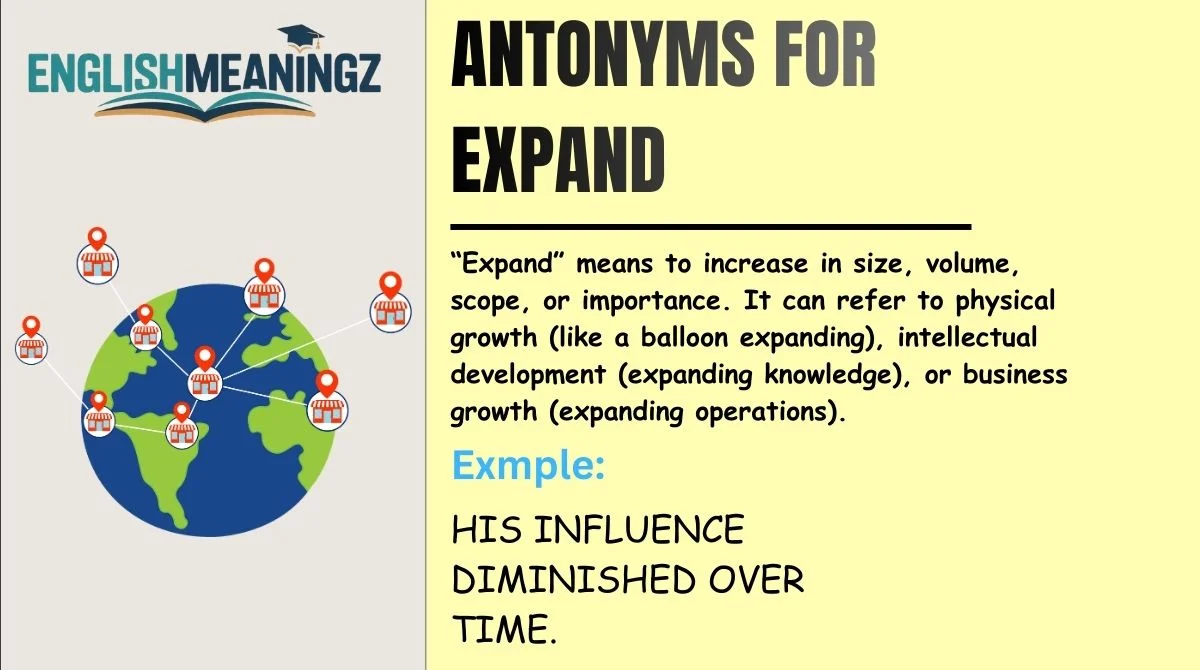
“Expand” means to increase in size, volume, scope, or importance. It can refer to physical growth (like a balloon expanding), intellectual development (expanding knowledge), or business growth (expanding operations).
Tone Explanation:
The word “expand” carries a positive and progressive tone. It suggests growth, improvement, or advancement.
Emotional / Action Intensity:
- Mild: extend, grow
- Strong: amplify, enlarge significantly
- Emotional tone: often optimistic and forward-looking
25 Best Antonyms for “Expand”
Contract
Meaning: To shrink or become smaller
Tone: Formal / Academic
Example: The material contracts in cold temperatures.
Why Opposite: It directly reverses the idea of growing larger.
Shrink
Meaning: To reduce in size
Tone: Informal
Example: His sweater shrank after washing.
Why Opposite: Focuses on physical reduction instead of growth.
Reduce
Meaning: To make smaller or less
Tone: Formal
Example: The company reduced its workforce.
Why Opposite: Opposes increase in size or number.
Decrease
Meaning: To become less
Tone: Academic
Example: Sales decreased last quarter.
Why Opposite: Opposes upward expansion.
Diminish
Meaning: To lessen in importance or size
Tone: Formal / Emotional
Example: His influence diminished over time.
Why Opposite: Suggests gradual reduction instead of growth.
Compress
Meaning: To press together
Tone: Technical
Example: The file was compressed to save space.
Why Opposite: Opposes spreading out or enlarging.
Condense
Meaning: To make more compact
Tone: Academic
Example: The report was condensed into a summary.
Why Opposite: Removes excess instead of adding.
Narrow
Meaning: To make smaller in width or scope
Tone: Neutral
Example: The road narrows ahead.
Why Opposite: Limits rather than broadens.
Limit
Meaning: To restrict growth
Tone: Formal
Example: Budget constraints limited expansion.
Why Opposite: Prevents increase.
Restrict
Meaning: To confine within boundaries
Tone: Formal
Example: Access was restricted to members only.
Why Opposite: Stops outward growth.
Decline
Meaning: To decrease gradually
Tone: Academic
Example: The population declined over decades.
Why Opposite: Opposes upward movement.
Curtail
Meaning: To reduce or cut short
Tone: Formal
Example: Spending was curtailed significantly.
Why Opposite: Halts expansion.
Constrict
Meaning: To tighten or compress
Tone: Formal
Example: The passage constricted suddenly.
Why Opposite: Physically or metaphorically reduces space.
Downsize
Meaning: To reduce scale
Tone: Business
Example: The company downsized its operations.
Why Opposite: Opposes business expansion.
Deplete
Meaning: To use up resources
Tone: Formal
Example: Natural resources are being depleted.
Why Opposite: Removes rather than adds.
Shorten
Meaning: To reduce length
Tone: Neutral
Example: The meeting was shortened.
Why Opposite: Opposes extending.
Tighten
Meaning: To make more compact
Tone: Neutral
Example: Security measures were tightened.
Why Opposite: Restricts instead of expanding.
Collapse
Meaning: To fall inward
Tone: Dramatic / Emotional
Example: The structure collapsed suddenly.
Why Opposite: Extreme opposite of expansion.
Lessen
Meaning: To make smaller
Tone: Formal
Example: Efforts were made to lessen the impact.
Why Opposite: Reduces scale.
Declutter
Meaning: To remove excess
Tone: Informal
Example: She decluttered her workspace.
Why Opposite: Simplifies instead of enlarging.
Shrivel
Meaning: To wither or shrink
Tone: Emotional
Example: The plant shriveled in the heat.
Why Opposite: Suggests loss of size and vitality.
Contractualize (contextual)
Meaning: To define narrowly
Tone: Academic
Example: The scope was contractualized.
Why Opposite: Limits instead of broadens.
Recede
Meaning: To move backward
Tone: Formal
Example: The floodwaters receded.
Why Opposite: Opposes outward growth.
Minimize
Meaning: To reduce to the smallest amount
Tone: Formal
Example: Risks were minimized.
Why Opposite: Focuses on making smaller.
Abbreviate
Meaning: To shorten
Tone: Academic
Example: The text was abbreviated.
Why Opposite: Opposes extending or enlarging.
Strong vs Mild Opposites
Not all antonyms carry the same intensity. Understanding this helps you choose the most accurate word.
Mild Opposites:
- Lessen
- Shorten
- Narrow
These suggest slight or gradual reduction.
Moderate Opposites:
- Reduce
- Decrease
- Limit
These imply noticeable but controlled reduction.
Strong Opposites:
- Collapse
- Shrivel
- Constrict
These indicate dramatic or extreme reversal of expansion.
Choosing the correct intensity ensures your message matches the situation.
Context-Based Opposites
Antonyms for “expand” change depending on context:
Business Context:
- Expand → Downsize, Reduce
Physical Space:
- Expand → Contract, Shrink
Ideas or Writing:
- Expand → Condense, Summarize
Emotional Context:
- Expand (feelings) → Suppress, Contain
Understanding context prevents misuse and improves clarity.
Common Mistakes When Using Opposites
1. Using the wrong intensity
Incorrect: The company collapsed its workforce.
Correct: The company reduced its workforce.
2. Confusing context
Incorrect: The essay shrank its arguments.
Correct: The essay condensed its arguments.
3. Overusing generic antonyms
Words like “reduce” are useful but can sound repetitive. Mix in precise alternatives.
4. Ignoring tone
“Shrink” may sound informal in academic writing. Use “decrease” or “diminish” instead.
Sentence Transformation Examples
Original: The company expanded its operations globally.
Rewritten: The company downsized its operations globally.
Original: The essay expands on the topic in detail.
Rewritten: The essay condenses the topic into key points.
Original: The balloon expanded quickly.
Rewritten: The balloon shrank rapidly.
Original: His influence expanded over time.
Rewritten: His influence diminished over time.
Original: The project expanded beyond expectations.
Rewritten: The project was curtailed unexpectedly.
FAQs
What is the most direct antonym of “expand”?
“Contract” is the most direct and commonly used opposite.
Can “reduce” always replace “expand”?
Not always. “Reduce” is general, while others like “condense” or “shrink” are context-specific.
Is “shrink” formal or informal?
It is mostly informal and better suited for casual contexts.
What is the academic opposite of “expand”?
“Diminish,” “decrease,” and “condense” are strong academic choices.
Are all antonyms interchangeable?
No. Context, tone, and intensity determine the correct choice.
What antonym works best in business writing?
“Downsize,” “reduce,” and “limit” are commonly used.
How can I improve my vocabulary using antonyms?
Practice rewriting sentences and learning opposites in context rather than memorizing lists.
Conclusion
Mastering antonyms for “expand” gives you greater control over language, tone, and clarity.
From formal words like “diminish” to everyday terms like “shrink,” each alternative offers a nuanced way to express reduction or limitation.
By understanding context, intensity, and tone, you can transform your writing into something precise, professional, and impactful.