Understanding opposites is more than a vocabulary exercise—it’s a strategic tool that sharpens your writing. When you know not only what a word means but also what it doesn’t mean, your ability to communicate becomes more precise, persuasive, and nuanced. Antonyms create contrast, and contrast brings clarity.
In academic and professional communication, this skill becomes even more valuable. Whether you’re drafting a research paper, writing a business report, or crafting SEO content, using the right opposite word can transform vague statements into impactful ones.
For example, replacing “data-driven” with its conceptual opposite can shift tone, intention, and meaning instantly.
This article explores the best antonyms for “data,” not just as dictionary opposites, but as practical alternatives you can actually use in real-world writing.
What Does “Data” Mean?
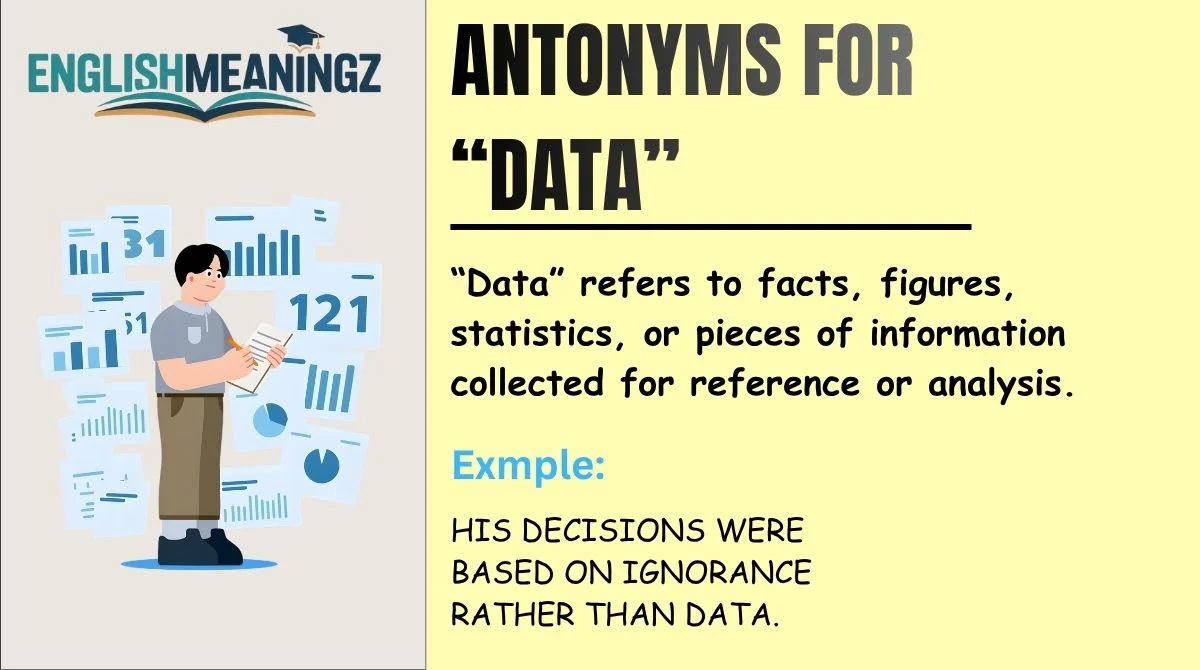
“Data” refers to facts, figures, statistics, or pieces of information collected for reference or analysis. It is commonly used in academic, scientific, technological, and business contexts.
Tone Explanation
The word “data” carries a neutral to formal tone. It is widely used in professional and academic environments and often signals objectivity and evidence-based reasoning.
Emotional or Action Intensity
“Data” has low emotional intensity. It is analytical rather than expressive. It represents raw input rather than interpretation or feeling.
14 Best Antonyms for “Data”
1. Ignorance
Meaning: Lack of knowledge or information
Tone: Formal / Academic
Example: His decisions were based on ignorance rather than data.
Why It’s Opposite: Data represents knowledge; ignorance represents its absence.
2. Guess
Meaning: An estimate without evidence
Tone: Informal
Example: That conclusion is just a guess, not supported by data.
Why It’s Opposite: Data is factual; a guess is speculative.
3. Assumption
Meaning: Something accepted without proof
Tone: Academic
Example: The report relies on assumptions instead of data.
Why It’s Opposite: Data is verified; assumptions are unverified.
4. Opinion
Meaning: A personal belief or judgment
Tone: Neutral
Example: The article reflects opinion rather than data.
Why It’s Opposite: Data is objective; opinions are subjective.
5. Fiction
Meaning: Imaginary or invented content
Tone: Literary
Example: The narrative blends fiction with minimal data.
Why It’s Opposite: Data is real; fiction is imagined.
6. Speculation
Meaning: The act of forming theories without evidence
Tone: Academic
Example: The theory is pure speculation without supporting data.
Why It’s Opposite: Data confirms; speculation questions.
7. Myth
Meaning: A widely held but false belief
Tone: Informal / Cultural
Example: That idea is a myth, not based on data.
Why It’s Opposite: Data reveals truth; myths distort it.
8. Emotion
Meaning: Feelings rather than logical reasoning
Tone: Emotional
Example: The decision was driven by emotion, not data.
Why It’s Opposite: Data is logical; emotion is subjective.
9. Bias
Meaning: Prejudice in favor of or against something
Tone: Academic
Example: The study shows bias instead of objective data.
Why It’s Opposite: Data aims for neutrality; bias distorts it.
10. Intuition
Meaning: Understanding without conscious reasoning
Tone: Neutral
Example: She relied on intuition rather than data.
Why It’s Opposite: Data is analytical; intuition is instinctive.
11. Rumor
Meaning: Unverified information spread among people
Tone: Informal
Example: The claim is a rumor, not supported by data.
Why It’s Opposite: Data is verified; rumors are unreliable.
12. Chaos
Meaning: Complete disorder or lack of structure
Tone: Emotional
Example: Without data, the process becomes chaos.
Why It’s Opposite: Data organizes; chaos disrupts.
13. Misinformation
Meaning: False or inaccurate information
Tone: Formal
Example: The report spreads misinformation instead of data.
Why It’s Opposite: Data is accurate; misinformation is incorrect.
14. Belief
Meaning: Acceptance without proof
Tone: Neutral
Example: His argument is based on belief rather than data.
Why It’s Opposite: Data requires evidence; belief does not.
Strong vs Mild Opposites
Not all antonyms carry the same intensity. Some are direct contradictions, while others are softer alternatives.
Strong Opposites
These completely contrast with “data”:
- Ignorance
- Fiction
- Misinformation
- Chaos
These words represent a total absence or distortion of factual information.
Mild Opposites
These are situational or partial opposites:
- Opinion
- Intuition
- Belief
- Assumption
They don’t completely reject information but lack empirical support.
Why This Matters
Choosing the right intensity helps you control tone. For academic writing, “assumption” may be more appropriate than “ignorance,” which can sound harsh.
Context-Based Opposites
The opposite of “data” can change depending on context.
In Science
- Data vs. Speculation
Used when distinguishing proven facts from theories.
In Business
- Data vs. Intuition
Highlights analytical vs instinctive decision-making.
In Media
- Data vs. Opinion
Separates factual reporting from editorial content.
In Technology
- Data vs. Noise (implied concept)
Refers to useful information vs irrelevant input.
Key Insight
There is no single universal antonym for “data.” The best choice depends on the situation, tone, and intent.
Common Mistakes When Using Opposites
Mistake 1: Using “Information” as an Antonym
Incorrect: Data vs Information
Why Wrong: Data is a form of information, not its opposite.
Mistake 2: Confusing Emotion with Falsehood
Incorrect: Emotion always equals incorrect
Correction: Emotion is not necessarily false—it’s just non-analytical.
Mistake 3: Overusing Harsh Antonyms
Incorrect: Calling every unsupported idea “ignorance”
Better: Use “assumption” or “opinion” for balance.
Mistake 4: Ignoring Context
Incorrect: Using “fiction” in a business report
Better: Use “speculation” or “guess”
Mistake 5: Mixing Tone Levels
Combining formal and informal words incorrectly reduces clarity.
Sentence Transformation Examples
Original Sentence 1
The strategy is based on data.
Rewritten: The strategy is based on intuition.
Original Sentence 2
This conclusion relies on data analysis.
Rewritten: This conclusion relies on speculation.
Original Sentence 3
The report includes accurate data.
Rewritten: The report includes misinformation.
Original Sentence 4
Their decisions are data-driven.
Rewritten: Their decisions are driven by emotion.
Original Sentence 5
The argument is supported by data.
Rewritten: The argument is based on opinion.
FAQs
What is the exact opposite of “data”?
There is no single exact opposite. Words like “ignorance,” “guess,” and “speculation” serve as contextual antonyms.
Is “opinion” a true antonym of data?
Yes, in many contexts. Data is objective, while opinion is subjective.
Can “intuition” replace data in writing?
Yes, but it changes tone. It shifts from analytical to instinctive reasoning.
Why are there multiple antonyms for one word?
Because meaning depends on context, tone, and usage.
Is “misinformation” stronger than “assumption”?
Yes. Misinformation implies false data, while assumption implies lack of evidence.
Should I use formal antonyms in academic writing?
Yes. Words like “speculation” and “assumption” are more appropriate than “guess.”
How do antonyms improve SEO writing?
They add semantic variety, improve readability, and help target related search queries.
Conclusion
Mastering antonyms for “data” is not just about expanding your vocabulary—it’s about gaining control over meaning, tone, and clarity.
Whether you’re writing academically, professionally, or for SEO, understanding the contrast between factual information and its opposites allows you to communicate with precision.
From strong contrasts like “ignorance” and “misinformation” to softer alternatives like “opinion” and “intuition,” each antonym serves a unique purpose. The key is choosing the right one based on context and intent.
When used effectively, these opposites don’t just replace words—they reshape your message.