Understanding opposites is one of the most powerful ways to sharpen your vocabulary. When you learn not just a word but also its contrast, your language becomes more precise, expressive, and adaptable.
This is especially useful in academic writing, content creation, and professional communication where clarity matters.
Antonyms help you:
- Express contrast effectively
- Avoid repetition
- Add depth and nuance to writing
In academic and professional environments, using the right opposite word can completely change the tone of a sentence.
For example, describing a place as a “lush arboretum” versus a “barren wasteland” creates entirely different imagery.
This article explores the best antonyms for arboretum—not just as dictionary opposites, but as practical vocabulary tools you can use confidently in real-world writing.
What Does “Arboretum” Mean?
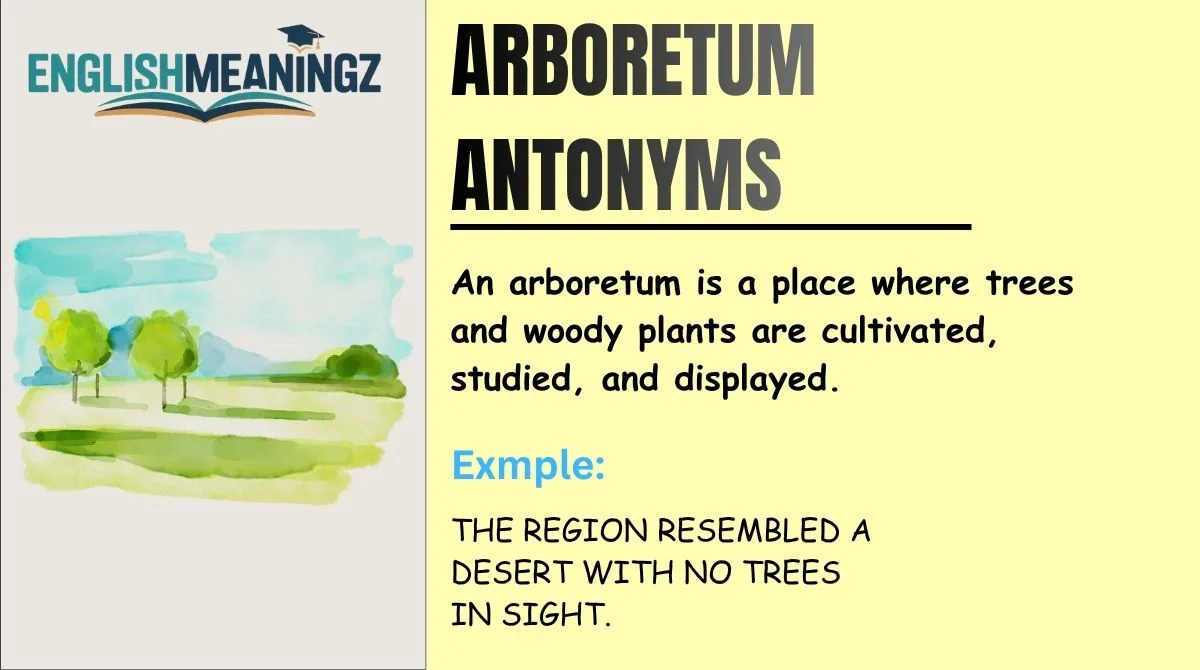
An arboretum is a place where trees and woody plants are cultivated, studied, and displayed. It is often a curated botanical space designed for research, education, or aesthetic enjoyment.
Tone Explanation
The word carries a formal and academic tone. It is commonly used in scientific, environmental, and educational contexts.
Emotional and Visual Intensity
An arboretum evokes:
- Growth
- Order
- Natural beauty
- Careful cultivation
It suggests a space that is lush, green, organized, and thriving.
Because of this, its antonyms typically reflect:
- Lack of vegetation
- Disorder or neglect
- Artificial or industrial environments
- Harsh or lifeless conditions
14 Best Antonyms for “Arboretum”
Barren Land
Meaning: Land without vegetation
Tone: Academic
Example: The once fertile valley turned into barren land after years of drought.
Why Opposite: An arboretum is full of life, while barren land represents the complete absence of plant growth.
Desert
Meaning: Dry, sandy area with minimal vegetation
Tone: Neutral
Example: The region resembled a desert with no trees in sight.
Why Opposite: Arboretums thrive on moisture and biodiversity; deserts lack both.
Wasteland
Meaning: An area that is empty, unused, or destroyed
Tone: Emotional
Example: The abandoned site became a wasteland after the factory closed.
Why Opposite: A wasteland suggests decay and neglect, the opposite of careful cultivation.
Concrete Jungle
Meaning: Urban area dominated by buildings and roads
Tone: Informal
Example: Living in a concrete jungle can feel overwhelming without green spaces.
Why Opposite: Arboretums are natural and green; concrete jungles are artificial and dense.
Industrial Zone
Meaning: Area dedicated to factories and machine
Tone: Formal
Example: The land was converted into an industrial zone for economic development.
Why Opposite: Arboretums promote nature; industrial zones prioritize machinery and production.
Empty Field
Meaning: Open land with little or no vegetation
Tone: Neutral
Example: The empty field stretched endlessly with no trees around.
Why Opposite: Arboretums are structured and planted, while empty fields lack intentional growth.
Urban Sprawl
Meaning: Unplanned city expansion
Tone: Academic
Example: Urban sprawl has reduced natural habitats significantly.
Why Opposite: Arboretums are organized natural spaces; urban sprawl is chaotic and machine-made.
Scrubland
Meaning: Land covered with sparse vegetation
Tone: Academic
Example: The area consisted mostly of dry scrubland.
Why Opposite: Arboretums feature diverse, healthy trees, unlike sparse scrubland.
Deforested Area
Meaning: Land where trees have been removed
Tone: Formal
Example: The deforested area showed clear signs of environmental damage.
Why Opposite: Arboretums grow trees; deforested areas lose them.
Ruins
Meaning: Remains of destroyed structures
Tone: Emotional
Example: The ruins stood as a reminder of past destruction.
Why Opposite: Arboretums symbolize growth and life; ruins symbolize decay.
Vacant Lot
Meaning: Unused, empty piece of land
Tone: Neutral
Example: The vacant lot was left unattended for years.
Why Opposite: Arboretums are actively maintained; vacant lots are neglected.
Dry Plain
Meaning: Flat land with little moisture
Tone: Academic
Example: The dry plain lacked any significant vegetation.
Why Opposite: Arboretums require moisture and care, unlike dry plains.
Artificial Landscape
Meaning: machine-made environment with little natural growth
Tone: Formal
Example: The artificial landscape lacked the charm of natural greenery.
Why Opposite: Arboretums focus on natural ecosystems, not synthetic designs.
Lifeless Terrain
Meaning: Area without biological activity
Tone: Emotional
Example: The lifeless terrain appeared bleak and uninviting.
Why Opposite: Arboretums are vibrant and full of life.
Strong vs Mild Opposites
Not all antonyms carry the same intensity. Some are extreme contrasts, while others are softer alternatives.
Strong Opposites
These create a dramatic contrast:
- Desert
- Wasteland
- Lifeless terrain
- Deforested area
These words emphasize complete absence of life or vegetation.
Mild Opposites
These offer less intense contrast:
- Empty field
- Vacant lot
- Scrubland
They suggest reduced or limited vegetation, not total absence.
Why This Matters
Choosing the right intensity helps match your tone:
- Academic writing → precise and moderate
- Creative writing → vivid and extreme
- Professional writing → balanced and clear
Context-Based Opposites
Antonyms depend heavily on context. The best opposite for arboretum changes based on usage.
Environmental Context
- Arboretum → Deforested area
- Focus: ecological contrast
Urban Context
- Arboretum → Concrete jungle
- Focus: natural vs artificial
Emotional Context
- Arboretum → Lifeless terrain
- Focus: mood and imagery
Development Context
- Arboretum → Industrial zone
- Focus: land usage
Understanding context ensures your writing feels natural and accurate.
Common Mistakes When Using Opposites
Using Weak Opposites
❌ Arboretum → Garden
✔ Better: Arboretum → Barren land
A garden is similar, not opposite.
Ignoring Context
❌ Arboretum → City (too vague)
✔ Better: Concrete jungle
Be specific for stronger contrast.
Overusing Dramatic Terms
❌ Every opposite = wasteland
✔ Use variety depending on tone
Balance is key in professional writing.
Confusing Related Words
❌ Arboretum → Forest
✔ These are not opposites
Both involve trees, so they are related, not contrasting.
Sentence Transformation Examples
Original Sentence
The arboretum was filled with rare and beautiful trees.
Rewritten Versions:
- The barren land had no trees at all.
- The area resembled a desert with minimal vegetation.
- The site turned into a wasteland after years of neglect.
- The space became a concrete jungle dominated by buildings.
- The land transformed into an industrial zone with no greenery.
FAQs
What is the exact opposite of arboretum?
There is no single exact opposite, but “barren land” or “wasteland” are the closest conceptual antonyms.
Is desert the best antonym for arboretum?
It is one of the strongest opposites, especially in environmental contexts.
Can “city” be an antonym of arboretum?
Not precisely. “Concrete jungle” is a more accurate and expressive alternative.
Are antonyms always exact opposites?
No, machine antonyms are contextual, not absolute.
Why are there multiple antonyms for arboretum?
Because the word relates to nature, growth, and structure—each aspect can have a different opposite.
Is “forest” an antonym of arboretum?
No, both involve trees, so they are related rather than opposite.
How can I choose the best antonym?
Focus on:
- Context
- Tone
- Intensity
Conclusion
Mastering antonyms like those for arboretum can dramatically improve your writing. By understanding not just the meanings but also the tone and intensity of each opposite, you gain control over how your message is perceived.
Whether you’re writing academically, professionally, or creatively, choosing the right antonym allows you to:
- Create vivid contrasts
- Communicate more clearly
- Engage your audience effectively
The key is not memorizing words—but understanding when and how to use them.