Language becomes significantly more precise when you understand not just what a word means—but what it does not mean. Mastering antonyms helps you communicate contrast, nuance, and intention with clarity.
Whether you’re writing an academic essay, a business proposal, or creative content, knowing the right opposite word allows you to express ideas more dynamically and avoid vague or repetitive language.
Understanding opposites is particularly valuable in professional and academic communication. It helps you:
- Present balanced arguments
- Strengthen critical analysis
- Improve clarity in decision-making contexts
- Avoid ambiguity
In this article, we explore 13 powerful antonyms of “policy”, along with their meanings, tones, usage, and contextual differences—so you can apply them confidently and correctly.
What Does “Policy” Mean?
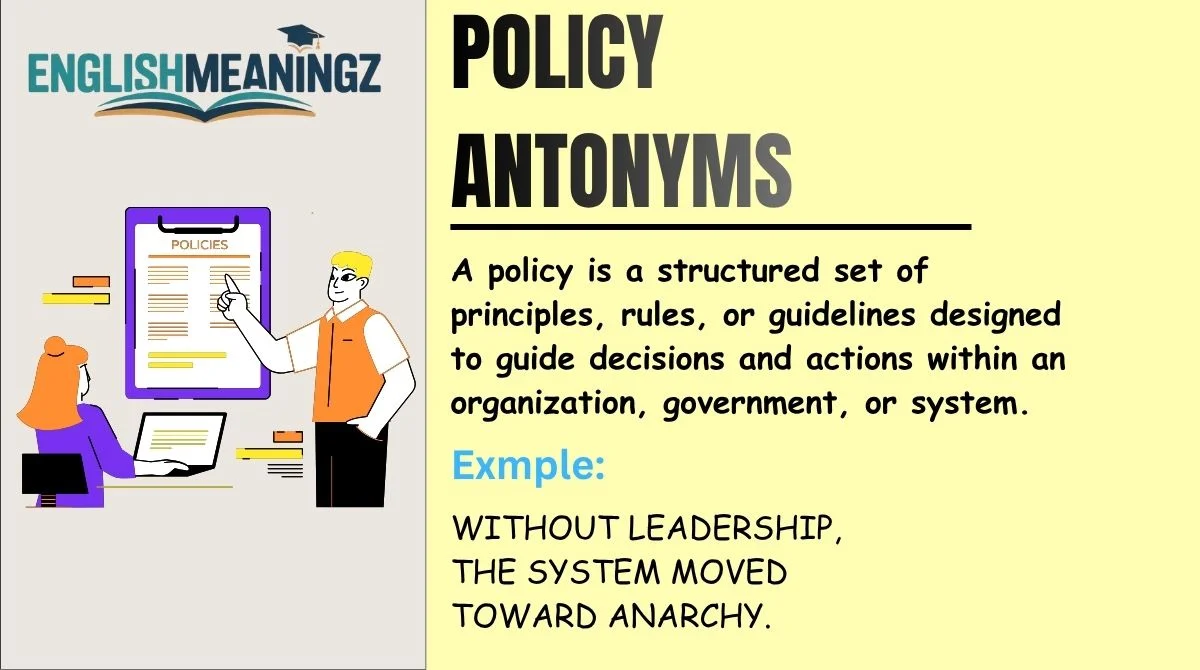
A policy is a structured set of principles, rules, or guidelines designed to guide decisions and actions within an organization, government, or system.
Tone Explanation
The word “policy” carries a formal and institutional tone. It is commonly used in:
- Government frameworks
- Corporate environments
- Academic discussions
Emotional or Action Intensity
“Policy” implies:
- Deliberate planning
- Stability
- Consistency
- Authority
It suggests a controlled, rule-based approach rather than spontaneous or emotional action.
13 Best Antonyms for “Policy”
Spontaneity
Meaning: Acting without planning or premeditation
Tone: Informal / Emotional
Example: Her decision was driven by spontaneity rather than any structured approach.
Why It’s Opposite: Policy relies on planning, while spontaneity rejects structure and predictability.
Impulse
Meaning: A sudden urge to act without thinking
Tone: Emotional / Informal
Example: He made the purchase on impulse instead of following company guidelines.
Why It’s Opposite: Policies prevent impulsive behavior by enforcing rules.
Chaos
Meaning: Complete disorder and lack of organization
Tone: Strong / Dramatic
Example: Without clear direction, the project descended into chaos.
Why It’s Opposite: Policy ensures order; chaos represents the absence of it.
Disorganization
Meaning: Lack of structure or proper arrangement
Tone: Neutral
Example: Disorganization in management led to repeated failures.
Why It’s Opposite: Policy establishes structure, while disorganization eliminates it.
Improvisation
Meaning: Creating or acting without preparation
Tone: Neutral / Creative
Example: The team relied on improvisation instead of following established procedures.
Why It’s Opposite: Policy requires predefined rules, whereas improvisation adapts on the spot.
Negligence
Meaning: Failure to take proper care or responsibility
Tone: Formal / Negative
Example: The accident was caused by negligence, not by any official guideline.
Why It’s Opposite: Policy enforces responsibility; negligence ignores it.
Freedom
Meaning: The power to act without restrictions
Tone: Positive / Neutral
Example: Employees were given freedom instead of strict regulations.
Why It’s Opposite: Policy imposes limits, while freedom removes constraints.
Anarchy
Meaning: Absence of authority or governing rules
Tone: Strong / Political
Example: Without leadership, the system moved toward anarchy.
Why It’s Opposite: Policy depends on authority; anarchy rejects it entirely.
Disorder
Meaning: Lack of order or control
Tone: Neutral
Example: The absence of planning resulted in total disorder.
Why It’s Opposite: Policy creates order; disorder reflects its absence.
Carelessness
Meaning: Lack of attention or concern
Tone: Informal / Negative
Example: Carelessness replaced structured planning in the project.
Why It’s Opposite: Policy requires careful thought and responsibility.
Instinct
Meaning: Natural, automatic reaction without conscious reasoning
Tone: Neutral / Psychological
Example: She acted on instinct rather than following any formal rule.
Why It’s Opposite: Policy is logical and planned; instinct is automatic and reactive.
Flexibility
Meaning: Willingness to adapt or change easily
Tone: Positive / Professional
Example: The company chose flexibility over rigid guidelines.
Why It’s Opposite: Policy often implies rigidity, while flexibility allows variation.
Randomness
Meaning: Lack of pattern or predictability
Tone: Neutral
Example: Decisions were made with randomness instead of structured planning.
Why It’s Opposite: Policy ensures consistency; randomness eliminates predictability.
Strong vs Mild Opposites
Not all antonyms carry the same intensity. Some completely contradict “policy,” while others only partially oppose it.
Strong Opposites
These directly conflict with the idea of structured rules:
- Anarchy
- Chaos
- Disorder
- Randomness
These suggest total absence of control or structure.
Mild Opposites
These contrast with policy but may still coexist in certain contexts:
- Flexibility
- Improvisation
- Freedom
- Instinct
These indicate reduced structure rather than complete absence.
Why This Matters
Choosing the right intensity helps avoid exaggeration. For example:
- Saying “chaos” instead of “flexibility” can make your argument overly dramatic
- Using “improvisation” may better reflect a balanced, real-world scenario
Context-Based Opposites
Antonyms change depending on how “policy” is used in context.
In Government Context
Policy → Anarchy / Lawlessness
Example: A lack of policy can lead to governance failure.
In Business Context
Policy → Flexibility / Improvisation
Example: Startups often prefer flexibility over rigid policies.
In Personal Behavior
Policy → Impulse / Instinct
Example: Emotional decisions often replace structured thinking.
In Academic Writing
Policy → Randomness / Disorganization
Example: Research requires method, not randomness.
Understanding context ensures you choose the most accurate opposite, not just a general one.
Common Mistakes When Using Opposites
Using Weak Opposites
Incorrect: Policy vs Idea
Correct: Policy vs Chaos or Improvisation
“Idea” is not an opposite—it’s unrelated.
Confusing Flexibility with Disorder
Incorrect: Flexibility means no rules
Correct: Flexibility means adaptable rules
Flexibility still operates within a system.
Overusing Extreme Words
Incorrect: Every lack of policy = Anarchy
Correct: Use “disorganization” or “improvisation” when appropriate
Not every situation is extreme.
Ignoring Tone
Using “chaos” in formal writing may sound exaggerated.
Instead, use:
- Disorganization
- Lack of structure
Sentence Transformation Examples
Original → With Antonym
- The company followed a strict policy.
→ The company operated with flexibility. - Government policy ensures stability.
→ The absence of rules led to instability and chaos. - His decisions were based on policy.
→ His decisions were driven by impulse. - The organization relies on clear policies.
→ The organization suffers from disorganization. - Policy guides employee behavior.
→ Instinct often drives employee behavior in unstructured environments.
FAQs
What is the simplest antonym of “policy”?
The simplest antonym is impulse, as it represents unplanned action.
Is “freedom” always an opposite of policy?
Not always. Freedom can exist within policies, but in extreme cases, it contrasts with strict rules.
Which antonym is best for academic writing?
Disorganization or lack of structure are the most appropriate.
Can “flexibility” be an antonym of policy?
Yes, especially when contrasting rigid rules with adaptable approaches.
What is the strongest opposite of policy?
Anarchy is the strongest, as it represents complete absence of rules.
Is improvisation negative?
Not necessarily. It can be positive in creative contexts but contrasts with structured planning.
Why is it important to learn antonyms?
They improve clarity, strengthen arguments, and enhance vocabulary depth.
Conclusion
Understanding the antonyms of “policy” goes beyond memorizing words—it equips you with the ability to express contrast with precision and purpose.
From strong opposites like anarchy and chaos to milder contrasts like flexibility and improvisation, each term carries its own tone, intensity, and contextual relevance.
When used correctly, these opposites can transform your writing—making it sharper, clearer, and more persuasive.
Whether you’re crafting academic essays, professional documents, or everyday communication, mastering these antonyms will elevate both your vocabulary and your thinking.