Precision in language is what separates average writing from compelling communication. One of the most effective ways to sharpen your expression is by mastering opposites—words that contrast in meaning and tone.
When you understand antonyms deeply, you gain control over nuance, allowing you to adjust intensity, emotion, and clarity with purpose.
In academic and professional settings, this skill becomes even more valuable. Whether you are writing reports, essays, or persuasive content, choosing the exact opposite of a strong word like “surge” helps avoid exaggeration, improves balance, and enhances credibility.
Instead of overusing dramatic expressions, you can present ideas with accuracy and sophistication.
This guide explores 25 carefully selected antonyms for “surge,” along with their meanings, tones, and real-world usage.
What Does “Surge” Mean?
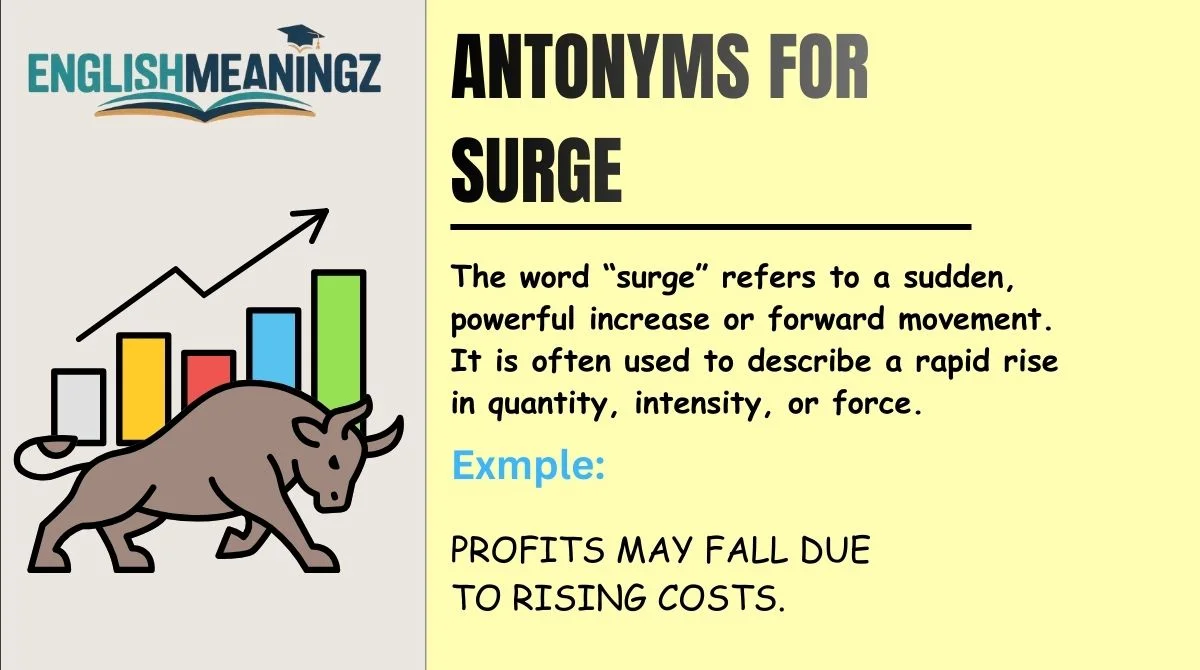
The word “surge” refers to a sudden, powerful increase or forward movement. It is often used to describe a rapid rise in quantity, intensity, or force.
Definition: A sudden and strong increase, rise, or forward motion.
Tone Explanation:
“Surge” carries a dynamic and energetic tone. It implies momentum, urgency, and often unpredictability. It is commonly used in contexts like markets, emotions, crowds, or natural forces.
Intensity Insight:
The word suggests a high level of intensity—something that doesn’t just increase, but does so quickly and forcefully. This is why its antonyms often revolve around decline, stability, or controlled reduction.
25 Best Antonyms for “Surge”
Decline
Meaning: A gradual decrease
Tone: Formal / Academic
Example: Sales showed a steady decline over the quarter.
Why it’s opposite: It reflects a downward trend instead of a sudden increase.
Decrease
Meaning: To become smaller in amount
Tone: Neutral / Academic
Example: The temperature began to decrease after sunset.
Why it’s opposite: It directly contrasts with the idea of rising.
Drop
Meaning: A sudden fall
Tone: Informal / Neutral
Example: There was a sharp drop in attendance.
Why it’s opposite: It mirrors surge but in a downward direction.
Fall
Meaning: To move downward
Tone: Neutral
Example: Profits may fall due to rising costs.
Why it’s opposite: Indicates reduction rather than growth.
Plunge
Meaning: A steep and rapid fall
Tone: Dramatic / Emotional
Example: The stock market took a plunge.
Why it’s opposite: It matches surge in intensity but reverses direction.
Dip
Meaning: A slight decrease
Tone: Informal
Example: There was a dip in performance last month.
Why it’s opposite: Represents a mild downward shift.
Reduction
Meaning: The act of making something smaller
Tone: Formal
Example: The company announced a reduction in staff.
Why it’s opposite: Focuses on decreasing quantity.
Shrink
Meaning: To become smaller
Tone: Informal
Example: The budget began to shrink unexpectedly.
Why it’s opposite: Indicates contraction rather than expansion.
Contract
Meaning: To reduce in size or scope
Tone: Academic
Example: The economy started to contract.
Why it’s opposite: Opposes the expansion implied by surge.
Recede
Meaning: To move back or diminish
Tone: Formal
Example: The floodwaters began to recede.
Why it’s opposite: Suggests retreat instead of forward motion.
Subside
Meaning: To become less intense
Tone: Formal
Example: The storm eventually subsided.
Why it’s opposite: Indicates calming after intensity.
Lessen
Meaning: To reduce in degree
Tone: Neutral
Example: Efforts were made to lessen the impact.
Why it’s opposite: Implies lowering intensity.
Diminish
Meaning: To decrease gradually
Tone: Academic
Example: Resources began to diminish over time.
Why it’s opposite: Focuses on gradual reduction.
Wane
Meaning: To decrease slowly
Tone: Literary / Formal
Example: Interest in the topic began to wane.
Why it’s opposite: Opposes the rise in intensity.
Decline sharply
Meaning: A sudden fall
Tone: Formal
Example: Prices declined sharply after the announcement.
Why it’s opposite: Combines speed and downward movement.
Stabilize
Meaning: To remain steady
Tone: Academic
Example: The market began to stabilize.
Why it’s opposite: Contrasts with sudden fluctuation.
Plateau
Meaning: To level off
Tone: Academic
Example: Growth plateaued after initial success.
Why it’s opposite: Indicates no further increase.
Stagnate
Meaning: To stop growing
Tone: Formal
Example: The industry began to stagnate.
Why it’s opposite: Opposes active growth.
Slow
Meaning: To reduce speed
Tone: Neutral
Example: The pace of work slowed significantly.
Why it’s opposite: Reduces momentum.
Halt
Meaning: To stop completely
Tone: Formal
Example: Production came to a halt.
Why it’s opposite: Eliminates movement entirely.
Cease
Meaning: To stop
Tone: Formal
Example: Operations will cease by midnight.
Why it’s opposite: Opposes ongoing increase.
Withdraw
Meaning: To pull back
Tone: Formal
Example: The company withdrew its investment.
Why it’s opposite: Suggests retreat.
Drain
Meaning: To reduce gradually
Tone: Informal
Example: Energy levels began to drain.
Why it’s opposite: Indicates loss rather than gain.
Collapse
Meaning: A sudden failure or fall
Tone: Dramatic
Example: The structure collapsed unexpectedly.
Why it’s opposite: Opposes upward force.
Fade
Meaning: To gradually disappear
Tone: Emotional / Literary
Example: The excitement slowly faded.
Why it’s opposite: Represents a gentle decline.
Strong vs Mild Opposites
Not all antonyms carry the same intensity. Understanding this difference helps you choose the most accurate word.
Strong Opposites:
Plunge, collapse, halt, cease — These convey dramatic or complete reversal.
Moderate Opposites:
Decline, drop, contract, diminish — These show noticeable but controlled decrease.
Mild Opposites:
Dip, lessen, fade, slow — These suggest subtle or gradual reduction.
Choosing the right intensity ensures your writing matches the situation. For example, using “collapse” in a minor situation would sound exaggerated, while “dip” may feel too weak in serious contexts.
Context-Based Opposites
The best antonym often depends on context rather than strict definition.
- Economic context: surge → decline / contract
- Emotional context: surge → fade / subside
- Physical movement: surge → recede / withdraw
- Performance metrics: surge → drop / plateau
For example:
“Demand surged” could become “Demand plateaued” rather than “Demand collapsed,” depending on accuracy.
Common Mistakes When Using Opposites
Using mismatched intensity:
Incorrect: The crowd surged, then slightly collapsed.
Correct: The crowd surged, then slightly subsided.
Confusing stability with decline:
Incorrect: Sales surged and then stabilized (as an opposite).
Explanation: Stabilize is not a direct opposite—it indicates balance, not decline.
Overusing dramatic antonyms:
Words like “collapse” or “plunge” should be reserved for extreme cases.
Ignoring context:
Using “fade” in a financial report may sound unprofessional compared to “decline.”
Sentence Transformation Examples
Original: Demand surged during the holiday season.
Rewritten: Demand declined after the holiday season.
Original: Energy levels surged after the break.
Rewritten: Energy levels faded after extended work hours.
Original: Prices surged unexpectedly.
Rewritten: Prices dropped unexpectedly.
Original: Interest in the product surged.
Rewritten: Interest in the product waned.
Original: The crowd surged forward.
Rewritten: The crowd receded slowly.
FAQs
What is the simplest antonym for “surge”?
“Decline” or “decrease” are the most straightforward opposites.
Is “stabilize” an antonym of surge?
Not exactly. It suggests balance, not a decrease.
Which antonym is the strongest opposite?
“Collapse” and “plunge” are among the strongest due to their intensity.
Can “fade” be used as an antonym?
Yes, especially in emotional or abstract contexts.
What is a formal antonym for surge?
“Contract,” “decline,” and “diminish” work well in formal writing.
Are all antonyms negative?
Not necessarily. Some, like “stabilize,” are neutral rather than negative.
How do I choose the right antonym?
Consider context, intensity, and tone before selecting the word.
Conclusion
Mastering antonyms for a powerful word like “surge” allows you to communicate with precision and adaptability.
Instead of relying on generic vocabulary, you can select words that reflect exact intensity, tone, and context.
Whether you are writing academically, professionally, or creatively, understanding these opposites helps you avoid exaggeration, improve clarity, and elevate your overall language skills.
The key is not just knowing these words, but knowing when to use each one effectively.