Understanding opposites is one of the fastest ways to sharpen your language skills.
When you learn antonyms deeply—not just as word pairs but as nuanced contrasts—you gain precision, clarity, and flexibility in expression.
This is especially valuable in academic writing, professional communication, and persuasive content creation.
In real-world communication, word choice shapes perception. Using the right opposite can shift tone from casual to formal, from neutral to emotional, or from vague to highly specific.
That’s why mastering antonyms is not just about vocabulary—it’s about control over meaning.
This guide explores powerful antonyms for the word “common”, helping you express rarity, uniqueness, and distinction with confidence.
What Does “Common” Mean?
Definition:
“Common” refers to something that is ordinary, widespread, frequently encountered, or shared by many people.
Tone Explanation:
The word “common” generally carries a neutral tone. However, in certain contexts, it may imply lack of uniqueness or even inferiority.
Emotional or Action Intensity:
“Common” suggests low distinction and high frequency. It sits on the lower end of the uniqueness spectrum—used for things that are expected, typical, or unremarkable.
13 Best Antonyms for “Common”
Rare
Meaning: Not frequently found or seen
Tone: Neutral / Academic
Example: This gemstone is extremely rare.
Why It’s an Opposite: “Rare” directly contrasts “common” by emphasizing scarcity.
Uncommon
Meaning: Not usual; infrequent
Tone: Neutral
Example: It’s uncommon to see snow in this region.
Why It’s an Opposite: It simply negates “common,” making it a straightforward contrast.
Unique
Meaning: One of a kind; unlike anything else
Tone: Positive / Emotional
Example: Her artistic style is truly unique.
Why It’s an Opposite: “Unique” represents absolute individuality, the opposite of widespread sameness.
Exceptional
Meaning: Unusually good or outstanding
Tone: Formal
Example: He showed exceptional talent in mathematics.
Why It’s an Opposite: It elevates something beyond the ordinary.
Extraordinary
Meaning: Very unusual or remarkable
Tone: Emotional / Formal
Example: The performance was extraordinary.
Why It’s an Opposite: It highlights deviation from normal expectations.
Distinctive
Meaning: Clearly different and recognizable
Tone: Formal
Example: The building has a distinctive design.
Why It’s an Opposite: It emphasizes noticeable uniqueness.
Singular
Meaning: Unique or exceptional
Tone: Academic
Example: Her achievement was singular in its impact.
Why It’s an Opposite: It suggests exclusivity and individuality.
Scarce
Meaning: In short supply
Tone: Neutral / Academic
Example: Clean water is scarce in some areas.
Why It’s an Opposite: It contrasts the abundance implied by “common.”
Unusual
Meaning: Not typical or expected
Tone: Neutral
Example: That’s an unusual approach to solving the problem.
Why It’s an Opposite: It highlights deviation from the norm.
Exceptional
Meaning: Better than average
Tone: Formal
Example: She delivered an exceptional presentation.
Why It’s an Opposite: It replaces ordinariness with excellence.
Rarefied
Meaning: Limited to a select group
Tone: Academic / Formal
Example: He operates in rarefied intellectual circles.
Why It’s an Opposite: It implies exclusivity instead of widespread presence.
Infrequent
Meaning: Not occurring often
Tone: Neutral
Example: Power outages here are infrequent.
Why It’s an Opposite: It directly opposes frequency.
Exclusive
Meaning: Restricted to a few
Tone: Formal
Example: This club is highly exclusive.
Why It’s an Opposite: It limits access, unlike “common,” which implies openness.
Strong vs Mild Opposites
Not all antonyms carry equal intensity. Some are mild contrasts, while others completely reverse the meaning.
Mild Opposites:
- Uncommon
- Infrequent
- Unusual
These suggest “less common” rather than completely opposite.
Strong Opposites:
- Unique
- Rare
- Exclusive
- Singular
These eliminate any sense of ordinariness and emphasize complete distinction.
Understanding this scale helps you choose the right word depending on how strong you want your contrast to be.
Context-Based Opposites
Antonyms change depending on context. The opposite of “common” in one situation may not fit another.
Frequency Context:
- Common → Rare / Infrequent
Quality Context:
- Common → Exceptional / Extraordinary
Identity Context:
- Common → Unique / Singular
Access Context:
- Common → Exclusive
Choosing the correct antonym requires understanding what aspect of “common” you are contrasting.
Common Mistakes When Using Opposites
1. Using “unique” for minor differences
Incorrect: This design is slightly unique.
Correct: This design is slightly unusual.
(“Unique” should be absolute.)
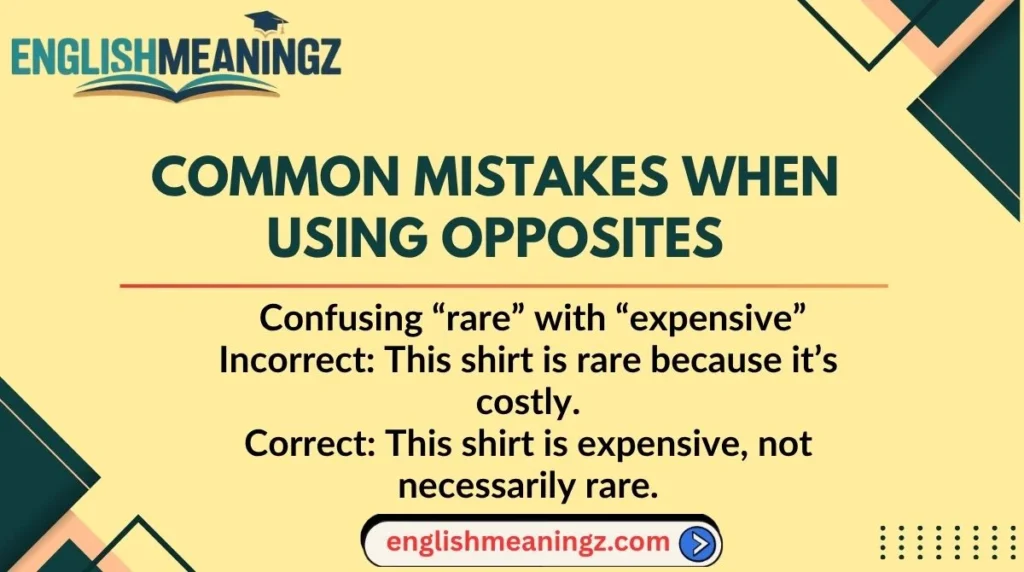
2. Confusing “rare” with “expensive”
Incorrect: This shirt is rare because it’s costly.
Correct: This shirt is expensive, not necessarily rare.
3. Overusing “extraordinary”
Incorrect: Every good performance is extraordinary.
Correct: Use it only for truly remarkable cases.
4. Misusing “exclusive”
Incorrect: This product is exclusive (when widely available).
Correct: Use only when access is limited.
Sentence Transformation Examples
1. Original: This is a common problem.
Rewritten: This is a rare problem.
2. Original: He has a common style.
Rewritten: He has a distinctive style.
3. Original: That idea is very common.
Rewritten: That idea is unusual.
4. Original: This is a common occurrence.
Rewritten: This is an infrequent occurrence.
5. Original: She gave a common response.
Rewritten: She gave an exceptional response.
FAQs
What is the best antonym for “common”?
The best antonym depends on context, but “rare” and “unique” are the most widely used.
Is “unique” always the opposite of “common”?
Yes, in many contexts, but it implies absolute distinction, not just rarity.
Can “uncommon” be used formally?
Yes, it works well in both formal and informal settings.
What is a stronger word than “rare”?
“Exceptional” or “extraordinary” can be stronger depending on context.
Is “exclusive” a true antonym of “common”?
Yes, especially when referring to access or availability.
How do I choose the right antonym?
Focus on context—frequency, quality, or uniqueness.
Are antonyms always exact opposites?
No, many are contextual and vary in intensity.
Conclusion
Mastering antonyms for “common” allows you to communicate with clarity and precision. Whether you want to describe rarity, highlight uniqueness, or emphasize excellence, the right opposite word can transform your message.
Instead of relying on basic vocabulary, using nuanced antonyms like “distinctive,” “exceptional,” or “exclusive” adds depth and professionalism to your writing.
As language evolves in 2k26 and beyond, strong vocabulary remains one of the most powerful tools for clear and impactful communication.