Language becomes sharper, more persuasive, and more precise when you understand not just what a word means—but what it doesn’t mean.
Learning antonyms is one of the fastest ways to improve clarity, emotional depth, and expression in writing. When you replace vague phrasing with intentional opposites, your ideas become more vivid and impactful.
Understanding opposites is especially valuable in academic and professional communication. Whether you are writing essays, reports, or persuasive content, using the right contrasting word can completely shift tone, strengthen arguments, and eliminate ambiguity.
For example, replacing “not afraid” with “confident” or “fearless” instantly makes your writing stronger and more authoritative.
This guide explores 24 carefully selected antonyms for “fear,” helping you expand your vocabulary with precision and confidence.
What Does “Fear” Mean?
Fear is a powerful emotional response triggered by perceived danger, threat, or uncertainty. It can range from mild unease to intense panic and often influences behavior, decision-making, and reactions.
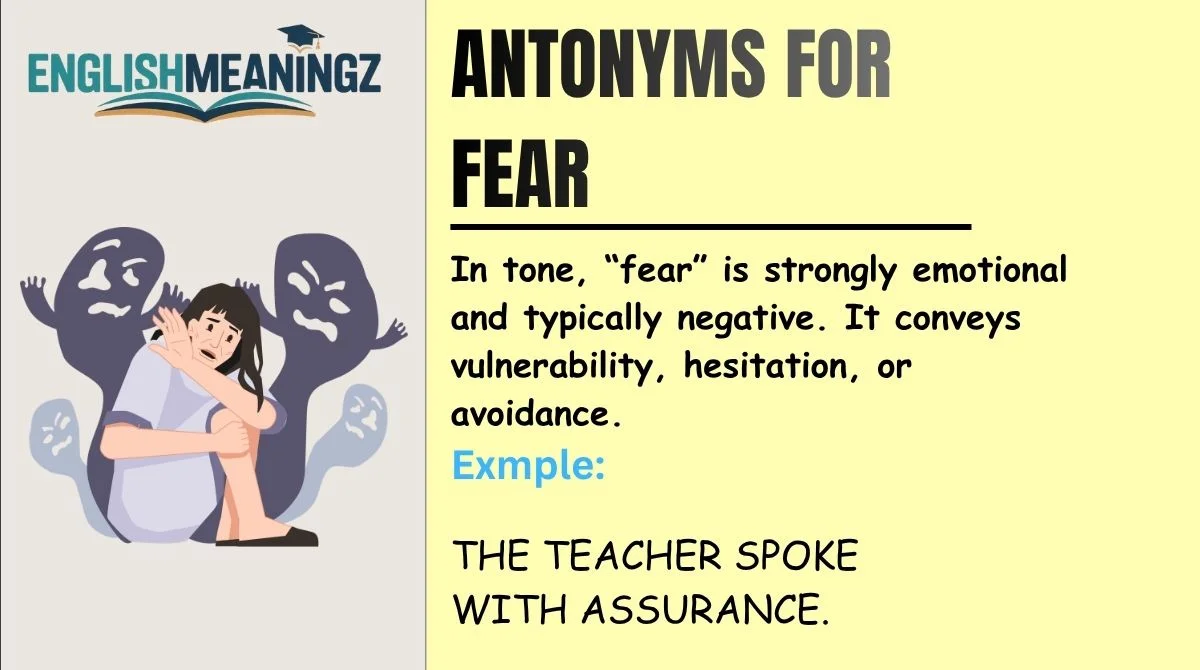
In tone, “fear” is strongly emotional and typically negative. It conveys vulnerability, hesitation, or avoidance. In academic contexts, it may describe psychological states, while in everyday language, it often reflects instinctive reactions.
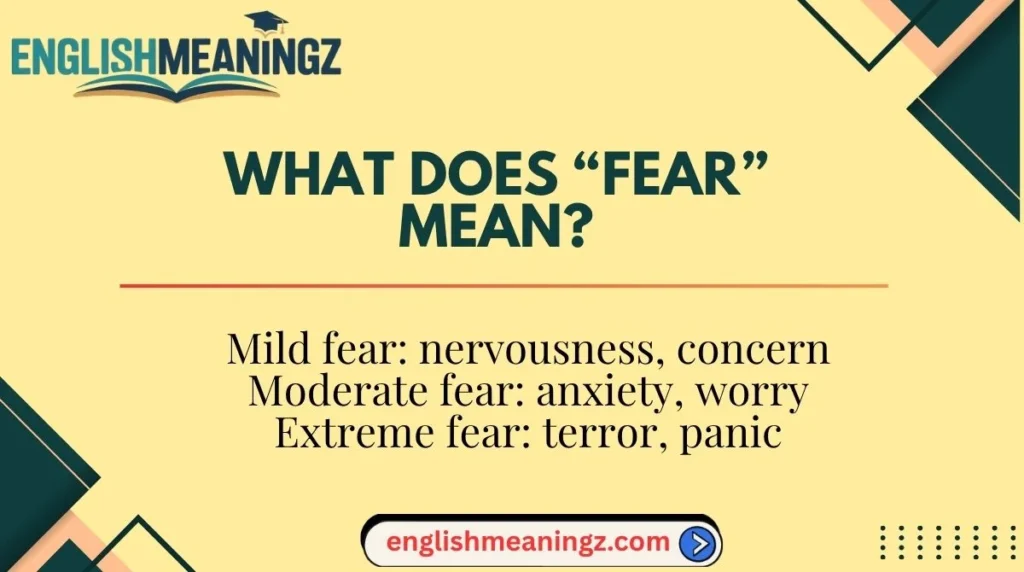
The intensity of fear varies:
- Mild fear: nervousness, concern
- Moderate fear: anxiety, worry
- Extreme fear: terror, panic
Understanding this spectrum helps in selecting the most accurate opposite depending on context.
24 Best Antonyms for “Fear”
Courage
- Meaning: The ability to face danger or difficulty with bravery
- Tone: Formal / Academic / Emotional
- Example: She showed courage by speaking in front of a critical audience.
- Why it’s opposite: Courage directly counters fear by enabling action despite risk.
Bravery
- Meaning: Fearless behavior in challenging situations
- Tone: Emotional / Informal
- Example: His bravery during the crisis inspired everyone.
- Why it’s opposite: Bravery eliminates hesitation caused by fear.
Confidence
- Meaning: Belief in one’s abilities or judgment
- Tone: Formal / Professional
- Example: She answered every question with confidence.
- Why it’s opposite: Confidence replaces doubt and fear with certainty.
Fearlessness
- Meaning: Complete absence of fear
- Tone: Emotional / Strong
- Example: His fearlessness led him to explore dangerous terrains.
- Why it’s opposite: It represents the total opposite state of fear.
Boldness
- Meaning: Willingness to take risks
- Tone: Professional / Informal
- Example: Her boldness helped her succeed in business.
- Why it’s opposite: Boldness pushes action where fear would prevent it.
Assurance
- Meaning: A feeling of certainty and security
- Tone: Formal / Academic
- Example: The teacher spoke with assurance.
- Why it’s opposite: Assurance removes uncertainty, a core element of fear.
Calmness
- Meaning: A peaceful and composed state
- Tone: Neutral / Emotional
- Example: He maintained calmness during the emergency.
- Why it’s opposite: Calmness neutralizes the emotional agitation of fear.
Composure
- Meaning: Self-control and emotional stability
- Tone: Formal
- Example: She handled criticism with composure.
- Why it’s opposite: Composure replaces panic with control.
Confidence in Action (Self-Assurance)
- Meaning: Trust in oneself during action
- Tone: Professional
- Example: His self-assurance made him a strong leader.
- Why it’s opposite: It removes hesitation linked to fear.
Daring
- Meaning: Adventurous and risk-taking behavior
- Tone: Informal / Emotional
- Example: The daring athlete attempted a risky move.
- Why it’s opposite: Daring embraces risk rather than avoiding it.
Valor
- Meaning: Great courage in the face of danger
- Tone: Formal / Literary
- Example: The soldier was honored for his valor.
- Why it’s opposite: Valor directly opposes fear in extreme situations.
Determination
- Meaning: Firmness of purpose
- Tone: Academic / Professional
- Example: Her determination helped her overcome obstacles.
- Why it’s opposite: Determination suppresses fear-driven hesitation.
Resilience
- Meaning: Ability to recover from difficulties
- Tone: Academic
- Example: Resilience helped him bounce back after failure.
- Why it’s opposite: Resilience resists the weakening effect of fear.
Optimism
- Meaning: Hopefulness about the future
- Tone: Neutral / Academic
- Example: His optimism kept the team motivated.
- Why it’s opposite: Optimism removes the negative anticipation tied to fear.
Security
- Meaning: Feeling safe and protected
- Tone: Formal
- Example: The system provides financial security.
- Why it’s opposite: Security eliminates the threat that causes fear.
Trust
- Meaning: Reliance on someone or something
- Tone: Neutral
- Example: Trust builds strong relationships.
- Why it’s opposite: Trust removes suspicion and fear.
Faith
- Meaning: Strong belief without doubt
- Tone: Emotional / Religious
- Example: She had faith in her abilities.
- Why it’s opposite: Faith replaces uncertainty with belief.
Serenity
- Meaning: Peaceful and untroubled state
- Tone: Literary
- Example: The lake reflected complete serenity.
- Why it’s opposite: Serenity contrasts emotional disturbance caused by fear.
Ease
- Meaning: Freedom from worry or difficulty
- Tone: Informal
- Example: He completed the task with ease.
- Why it’s opposite: Ease removes tension associated with fear.
Relaxation
- Meaning: State of being free from stress
- Tone: Neutral
- Example: Relaxation improves mental health.
- Why it’s opposite: Relaxation replaces tension with comfort.
Stability
- Meaning: Steady and secure condition
- Tone: Academic
- Example: Economic stability is essential.
- Why it’s opposite: Stability prevents fear caused by uncertainty.
Heroism
- Meaning: Exceptional bravery
- Tone: Emotional / Literary
- Example: His heroism saved lives.
- Why it’s opposite: Heroism is fear overcome through action.
Fortitude
- Meaning: Strength in adversity
- Tone: Formal
- Example: She showed fortitude during hardship.
- Why it’s opposite: Fortitude resists fear under pressure.
Confidence Under Pressure (Nerve)
- Meaning: Ability to stay steady in stress
- Tone: Informal
- Example: He kept his nerve during the match.
- Why it’s opposite: Maintaining nerve prevents fear from taking control.
Strong vs Mild Opposites
Not all antonyms carry the same intensity. Some completely eliminate fear, while others simply reduce it.
- Strong opposites: Fearlessness, bravery, valor, heroism
These words imply complete dominance over fear. - Moderate opposites: Confidence, courage, determination
These suggest fear may exist but is controlled. - Mild opposites: Calmness, ease, relaxation
These reduce the emotional impact rather than eliminate fear entirely.
Choosing the right intensity ensures your writing remains accurate and natural.
Context-Based Opposites
Antonyms change depending on the situation. A single word cannot replace “fear” in every context.
- In leadership: Confidence or assurance
- In danger: Courage or bravery
- In emotional writing: Serenity or calmness
- In psychology: Security or trust
Context determines the most effective opposite. Using the wrong antonym can distort meaning.
Common Mistakes When Using Opposites
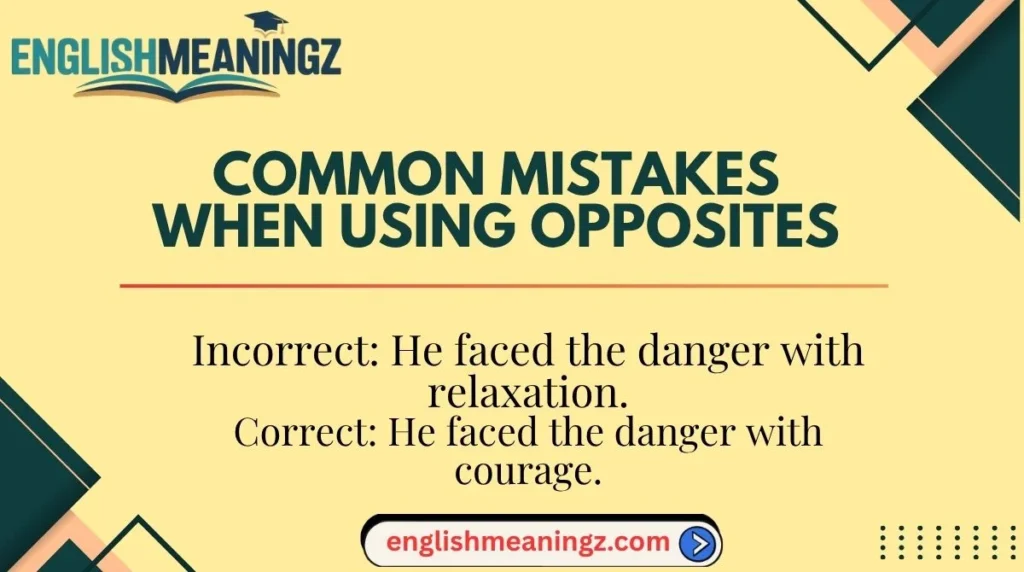
One frequent mistake is assuming all antonyms are interchangeable.
Incorrect: He faced the danger with relaxation.
Correct: He faced the danger with courage.
Another mistake is ignoring tone.
Incorrect: The scientist approached the experiment with bravery.
Better: The scientist approached the experiment with confidence.
Also, avoid exaggeration.
Incorrect: She showed heroism while answering a simple question.
Better: She showed confidence while answering a simple question.
Precision matters more than complexity.
Sentence Transformation Examples
Original: She was filled with fear before the presentation.
Rewritten: She approached the presentation with confidence.
Original: His fear stopped him from speaking.
Rewritten: His courage allowed him to speak.
Original: They acted out of fear during the crisis.
Rewritten: They acted with determination during the crisis.
Original: Fear controlled his decisions.
Rewritten: Confidence guided his decisions.
Original: The child reacted with fear.
Rewritten: The child responded with calmness.
FAQs
What is the strongest antonym for fear?
Fearlessness is the strongest because it represents a complete absence of fear.
Is confidence always the opposite of fear?
Not always. Confidence reduces fear but does not always eliminate it completely.
Can calmness replace fear in all contexts?
No. Calmness works best in emotional or stress-related situations, not in high-risk scenarios.
What is a formal antonym for fear?
Courage, assurance, and fortitude are commonly used in formal writing.
Are bravery and courage the same?
They are similar, but bravery is more emotional, while courage is slightly more formal and broad.
How do I choose the right antonym?
Focus on context, tone, and intensity rather than just meaning.
Why is it important to learn antonyms?
They improve clarity, strengthen arguments, and make writing more engaging.
Conclusion
Mastering antonyms for fear is more than a vocabulary exercise—it is a strategic tool for stronger communication.
Whether you are writing academically, professionally, or creatively, selecting the right opposite allows you to express ideas with precision and emotional impact.
By understanding intensity, context, and tone, you can move beyond basic word substitution and use language with purpose.
The 24 antonyms covered in this guide give you a powerful range of options, from subtle calmness to bold fearlessness.
Use them wisely, and your writing will instantly become clearer, sharper, and more compelling.