Strong vocabulary plays a crucial role in effective writing and professional communication. One of the most common ways to improve the quality of academic essays, research papers, blog posts, and professional reports is by using synonyms thoughtfully.
When writers repeatedly use the same phrase, such as communication skills, their work may appear repetitive and less sophisticated. Using alternative expressions allows writers to maintain clarity while enhancing readability and style.
For students, especially those preparing for academic exams or writing assignments, vocabulary variety can significantly improve writing scores.
Examiners often evaluate lexical range, and repeated words can reduce the overall impression of linguistic competence.
For bloggers and content creators, varied wording improves reader engagement and helps optimize articles for search engines. Diverse terminology signals depth and expertise in a topic.
For professionals, especially in resumes, presentations, and reports, using different terms for communication abilities can make descriptions more precise and impactful.
This guide explores 26 synonyms for communication skills, explaining their meanings, contexts, and examples. It also provides practical advice for academic writing, exam preparation, and professional use.
Definition and Core Meaning of “Communication Skills”
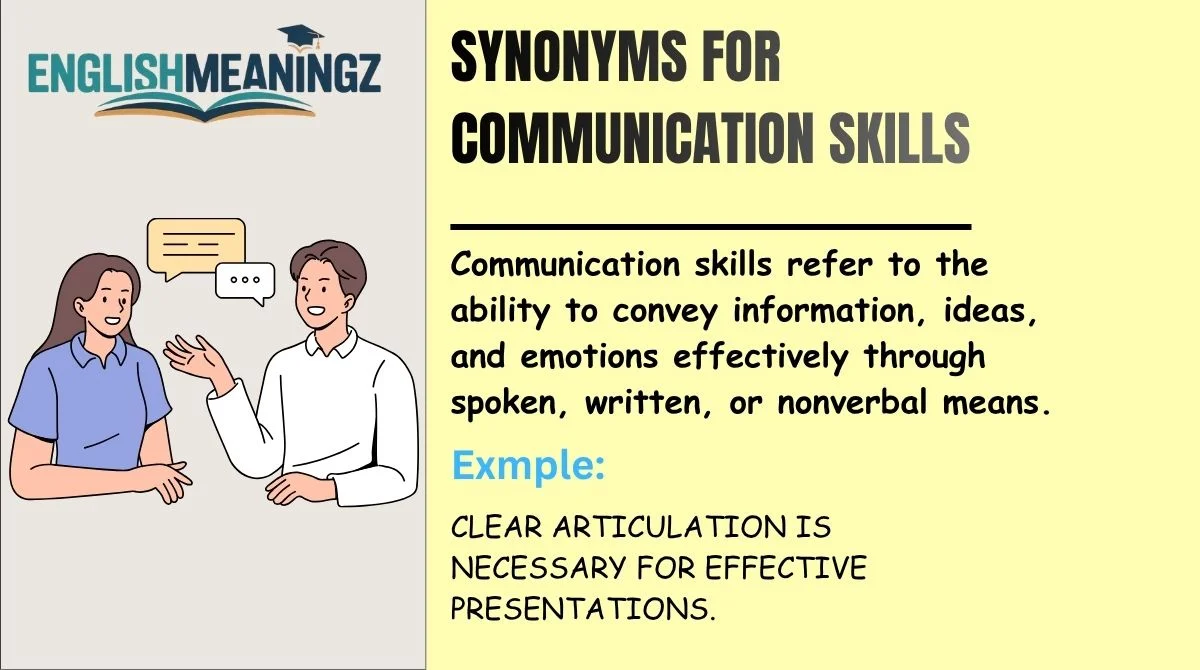
Communication skills refer to the ability to convey information, ideas, and emotions effectively through spoken, written, or nonverbal means. These skills involve not only expressing thoughts clearly but also understanding others through active listening, interpretation, and feedback.
In academic and professional contexts, communication skills include several components:
- Verbal communication – expressing ideas through speech
- Written communication – conveying information through written text
- Nonverbal communication – body language, gestures, and tone
- Listening skills – understanding and interpreting information
- Interpersonal interaction – building relationships through dialogue
Strong communication abilities allow individuals to share knowledge, resolve conflicts, collaborate in teams, and present ideas persuasively. Because communication occurs in different settings—academic, professional, social, and technical—various synonyms highlight different aspects of these abilities.
26 Synonyms Grouped by Context
General Use
Verbal Skills
Meaning: Ability to express thoughts clearly through speech.
Context: Common in resumes, education, and workplace evaluations.
Example: Her strong verbal skills allow her to explain complex ideas clearly during meetings.
Language Skills
Meaning: Ability to use language effectively in speaking and writing.
Context: Frequently used in education and language learning contexts.
Example: Students develop language skills through reading, discussion, and writing activities.
Speaking Ability
Meaning: Capacity to communicate clearly when speaking.
Context: Often used in presentations or public speaking evaluation.
Example: His speaking ability improved after participating in debate competitions.
Expression Skills
Meaning: Ability to convey ideas, thoughts, and emotions effectively.
Context: Used in both academic and creative contexts.
Example: Writing workshops help students strengthen their expression skills.
Interaction Skills
Meaning: Ability to communicate effectively with others in conversations.
Context: Often used in teamwork and collaborative environments.
Example: Strong interaction skills are essential for successful group projects.
Conversational Skills
Meaning: Ability to participate naturally and effectively in discussions.
Context: Common in social and workplace communication.
Example: Customer service employees must possess excellent conversational skills.
Interpersonal Communication
Meaning: Communication between individuals that builds relationships.
Context: Common in psychology, education, and business.
Example: Interpersonal communication helps managers maintain positive team relationships.
Formal & Academic Writing
Rhetorical Ability
Meaning: Skill in persuasive or effective language use.
Context: Used in academic writing and public speaking analysis.
Example: The politician’s rhetorical ability helped convince the audience.
Articulation
Meaning: Clear and precise expression of ideas.
Context: Common in education and speech evaluation.
Example: Clear articulation is necessary for effective presentations.
Linguistic Competence
Meaning: Knowledge and ability to use language structures correctly.
Context: Often used in linguistics and language education.
Example: Linguistic competence develops through exposure to diverse texts.
Discourse Skills
Meaning: Ability to organize language in meaningful communication.
Context: Used in academic linguistics and communication studies.
Example: Discourse skills allow writers to structure ideas logically.
Communicative Competence
Meaning: Ability to use language appropriately in different contexts.
Context: Common in language learning theory.
Example: Communicative competence includes grammar, vocabulary, and social understanding.
Written Communication Ability
Meaning: Skill in conveying ideas through writing.
Context: Academic writing, research, and professional documentation.
Example: Strong written communication ability is essential for academic success.
Informal Usage
People Skills
Meaning: Ability to interact positively with others.
Context: Common in everyday language and job interviews.
Example: Employees with strong people skills often succeed in leadership roles.
Social Skills
Meaning: Ability to communicate effectively in social situations.
Context: Used in psychology and everyday conversation.
Example: Social skills help individuals form meaningful relationships.
Talk Skills
Meaning: Informal expression for the ability to communicate verbally.
Context: Casual conversations or informal writing.
Example: His talk skills improved after practicing public speaking.
Chatting Ability
Meaning: Skill in maintaining casual conversation.
Context: Informal contexts and social settings.
Example: Networking events require good chatting ability.
Networking Skills
Meaning: Ability to build professional relationships through conversation.
Context: Business, career development, and professional growth.
Example: Networking skills help professionals expand career opportunities.
Technical or Subject-Specific Use
Presentation Skills
Meaning: Ability to deliver structured information to an audience.
Context: Academic presentations, business meetings, and conferences.
Example: Effective presentation skills are essential for research conferences.
Negotiation Skills
Meaning: Ability to communicate strategically to reach agreements.
Context: Business, diplomacy, and conflict resolution.
Example: Negotiation skills are important in international trade discussions.
Persuasive Communication
Meaning: Communication aimed at influencing opinions or decisions.
Context: Marketing, politics, and advertising.
Example: Persuasive communication techniques are widely used in advertising.
Active Listening
Meaning: Ability to listen attentively and respond thoughtfully.
Context: Counseling, education, and teamwork.
Example: Active listening strengthens professional relationships.
Public Speaking Skills
Meaning: Ability to communicate effectively to large audiences.
Context: Education, leadership, and public events.
Example: Public speaking skills improve through regular practice.
Information Sharing Ability
Meaning: Skill in transferring knowledge clearly and efficiently.
Context: Workplace collaboration and project management.
Example: Information sharing ability improves team productivity.
Dialogue Management
Meaning: Skill in guiding conversations toward productive outcomes.
Context: Conflict resolution and mediation.
Example: Managers often rely on dialogue management to resolve disputes.
Word Intensity & Tone Comparison Table
| Synonym | Formality Level | Emotional Strength | Typical Context |
|---|---|---|---|
| Verbal Skills | Medium | Neutral | Workplace |
| Linguistic Competence | High | Neutral | Academic |
| People Skills | Low | Friendly | Informal |
| Rhetorical Ability | High | Strong | Political or academic |
| Social Skills | Medium | Mild | Psychology |
| Negotiation Skills | High | Strategic | Business |
| Presentation Skills | Medium | Neutral | Professional |
| Conversational Skills | Medium | Friendly | Social |
| Persuasive Communication | High | Strong | Marketing |
| Interpersonal Communication | High | Neutral | Business and psychology |
Common Mistakes When Using These Synonyms
Mistake 1: Using informal terms in academic writing
Incorrect:
The researcher had great people skills during the conference presentation.
Correct:
The researcher demonstrated strong interpersonal communication during the conference presentation.
Mistake 2: Confusing speaking skills with communication skills
Incorrect:
Communication skills only refer to speaking ability.
Correct:
Communication skills include speaking, listening, writing, and nonverbal interaction.
Mistake 3: Overusing complex synonyms unnecessarily
Incorrect:
Every sentence replaces communication skills with a different complicated phrase.
Correct:
Use synonyms strategically while maintaining clarity and consistency.
Synonyms in Academic Writing
Example Paragraph 1
Effective interpersonal communication plays a critical role in collaborative learning environments. Students who demonstrate strong articulation and active listening are better able to exchange ideas and understand diverse perspectives. As a result, classrooms that emphasize discussion often improve both academic understanding and social development.
Example Paragraph 2
Modern workplaces require employees with advanced presentation skills, negotiation skills, and written communication ability. Professionals who master these competencies can explain complex information, resolve conflicts, and contribute effectively to organizational goals.
IELTS & Exam Writing Tips
Avoid Repetition
Repeated vocabulary can lower scores in exams such as IELTS or academic writing assessments. Instead of repeating the phrase communication skills, writers can alternate between terms such as:
- interpersonal communication
- verbal skills
- presentation skills
- linguistic competence
Maintain Clarity
Although synonyms are useful, they should not change the intended meaning. For example, negotiation skills represent a specific type of communication ability and cannot replace the phrase in every context.
Use Formal Vocabulary in Essays
In formal exam essays, better alternatives include:
- interpersonal communication
- communicative competence
- articulation
- discourse skills
When Not to Replace the Word
Sometimes the original phrase communication skills is the clearest and most appropriate option, especially in introductory sentences or definitions.
Similar Words vs True Synonyms
Not all related terms are true synonyms. Some words represent specific aspects of communication rather than the entire concept.
For example:
- Public speaking skills focus only on speaking to an audience.
- Active listening refers specifically to listening ability.
- Negotiation skills involve strategic communication during conflict resolution.
True synonyms should maintain a similar general meaning. Words like interpersonal communication or verbal skills closely represent the original concept.
Understanding these differences helps writers choose the most precise term for their context.
Practice Sentences
- Strong __________ are necessary for effective teamwork in organizations.
- The professor praised the student’s clear __________ during the presentation.
- Successful leaders often rely on excellent __________ to resolve conflicts.
- Developing __________ helps professionals build meaningful workplace relationships.
- Academic success often depends on strong __________ and writing ability.
Possible answers include: communication skills, articulation, negotiation skills, interpersonal communication, or presentation skills.
FAQs
What are synonyms for communication skills?
Some common synonyms include verbal skills, interpersonal communication, linguistic competence, presentation skills, conversational skills, and rhetorical ability.
Why should writers use synonyms for communication skills?
Using synonyms helps avoid repetition, improves vocabulary range, and makes writing more engaging and professional.
Which synonym is best for academic writing?
Formal alternatives such as interpersonal communication, communicative competence, articulation, and discourse skills are suitable for academic contexts.
Are communication skills the same as speaking skills?
No. Communication skills include speaking, listening, writing, and nonverbal interaction, while speaking skills refer only to verbal expression.
How can students improve communication vocabulary?
Students can improve vocabulary by reading academic texts, practicing writing exercises, learning synonyms, and applying them in essays or presentations.
Conclusion
Expanding vocabulary is one of the most effective ways to improve writing quality and communication clarity. Instead of repeatedly using the phrase communication skills, writers can choose from a wide range of alternatives that highlight specific aspects of interaction, expression, or persuasion.
For students, this vocabulary variety enhances academic writing and exam performance. Bloggers and content creators benefit from improved readability and stronger SEO optimization. Professionals can present themselves more effectively in resumes, reports, and presentations.
By understanding the subtle differences between these 26 synonyms for communication skills, writers can communicate ideas more precisely, demonstrate linguistic competence, and develop stronger overall language abilities.
Continuous vocabulary improvement leads to clearer thinking, stronger arguments, and more impactful communication.