A strong vocabulary plays a crucial role in effective writing. One of the most common mistakes writers make is repeating the same descriptive words throughout an essay, blog post, or professional document. Using varied synonyms helps improve clarity, tone, and readability.
In academic environments, vocabulary diversity can significantly influence grading criteria, particularly in standardized exams and formal assignments.
For students preparing essays, bloggers creating engaging content, and professionals drafting reports or articles, knowing multiple alternatives to commonly used words enhances expression.
Instead of repeatedly using a single adjective, writers can choose context-appropriate synonyms that convey subtle variations in meaning.
The word serene is often used to describe calmness, peaceful environments, composed personalities, or tranquil states of mind.
However, relying on only one term can make writing repetitive. Understanding synonyms allows writers to match tone, formality, and emotional intensity more precisely.
This comprehensive guide presents 26 carefully selected synonyms of “serene”, explains their meanings, clarifies contexts where they work best, and demonstrates how to use them effectively in sentences.
Definition and Core Meaning of “Serene”
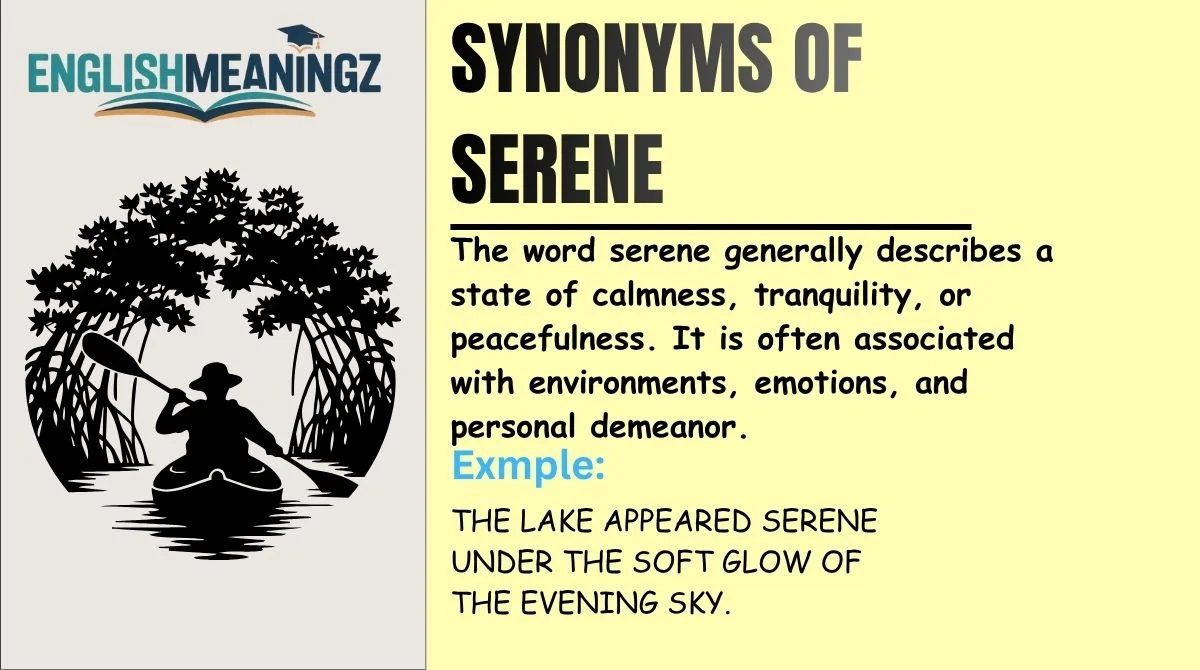
The word serene generally describes a state of calmness, tranquility, or peacefulness. It is often associated with environments, emotions, and personal demeanor.
In its simplest form, serene means:
- Free from disturbance
- Calm and peaceful
- Emotionally balanced
- Quiet and tranquil
For example:
The lake appeared serene under the soft glow of the evening sky.
In writing, serene frequently describes:
- Natural landscapes
- Emotional states
- Atmospheres
- Personal attitudes or expressions
In academic contexts, the term may also be used metaphorically to describe stability, mental clarity, or composure.
26 Synonyms of Serene Grouped by Context
General Use
Calm
Meaning: Free from agitation or strong emotion.
Context: Used in everyday writing to describe people, weather, or environments.
Example:
Despite the stressful situation, the teacher remained calm and composed.
Peaceful
Meaning: Characterized by tranquility and absence of conflict.
Context: Often used for environments or states of mind.
Example:
The countryside offers a peaceful escape from the noise of the city.
Tranquil
Meaning: Quiet and undisturbed; emotionally steady.
Context: Common in descriptive writing about landscapes.
Example:
The garden felt tranquil during the early hours of the morning.
Placid
Meaning: Calm and not easily disturbed.
Context: Used for personalities or still water surfaces.
Example:
The placid lake reflected the surrounding mountains perfectly.
Still
Meaning: Completely quiet or motionless.
Context: Often used to describe peaceful natural scenes.
Example:
The forest was still as the sun began to rise.
Quiet
Meaning: Free from noise or disturbance.
Context: A flexible synonym used in both literal and figurative descriptions.
Example:
She preferred a quiet place to concentrate on her research.
Formal & Academic Writing
Composed
Meaning: Emotionally controlled and self-assured.
Context: Often used in academic discussions about behavior or psychological states.
Example:
The leader remained composed during the crisis.
Untroubled
Meaning: Not worried or affected by difficulties.
Context: Suitable for describing emotional calmness.
Example:
His expression remained untroubled despite the intense debate.
Poised
Meaning: Calm, dignified, and confident.
Context: Frequently used in professional or formal descriptions.
Example:
The speaker appeared poised and confident throughout the presentation.
Equanimous
Meaning: Maintaining mental calmness even in difficult situations.
Context: Advanced academic vocabulary used in psychology or philosophy.
Example:
A skilled negotiator must remain equanimous during conflict.
Balanced
Meaning: Emotionally stable and rational.
Context: Used when discussing personality or mental states.
Example:
A balanced perspective helps resolve complex problems effectively.
Collected
Meaning: Calm and in control of emotions.
Context: Suitable for formal narrative writing.
Example:
She stayed collected while addressing the audience.
Informal Usage
Relaxed
Meaning: Free from tension or anxiety.
Context: Common in casual communication.
Example:
He looked relaxed after finishing the difficult exam.
Chill
Meaning: Informally calm and stress-free.
Context: Used mainly in conversational language.
Example:
The beach had a chill atmosphere during the evening.
Easygoing
Meaning: Not easily upset or worried.
Context: Used to describe personalities.
Example:
Her easygoing nature makes her pleasant to work with.
Mellow
Meaning: Calm, soft, and gentle in mood.
Context: Often used for music, personalities, or atmospheres.
Example:
The café had a mellow vibe late at night.
Laid-back
Meaning: Informally calm and unbothered.
Context: Common in casual speech.
Example:
The manager maintained a laid-back attitude toward minor mistakes.
Technical or Subject-Specific Use
Pacific
Meaning: Peaceful and free from disturbance.
Context: Sometimes used in literary or formal writing.
Example:
The pacific valley remained untouched by urban development.
Harmonious
Meaning: Balanced and pleasing, often in emotional or social contexts.
Context: Used in sociology or cultural discussions.
Example:
A harmonious community promotes cooperation and trust.
Restful
Meaning: Providing relaxation and peace.
Context: Used in wellness, healthcare, or environmental writing.
Example:
The quiet library offered a restful place for study.
Idyllic
Meaning: Extremely peaceful and picturesque.
Context: Common in literature and travel writing.
Example:
The village presented an idyllic setting surrounded by hills.
Undisturbed
Meaning: Not interrupted or affected by external forces.
Context: Used in environmental or scientific descriptions.
Example:
The wildlife thrived in the undisturbed forest habitat.
Content
Meaning: Quietly satisfied and peaceful.
Context: Often used in psychological or emotional descriptions.
Example:
She felt content after completing her research project.
Zen-like
Meaning: Deeply calm and meditative.
Context: Inspired by philosophical or mindfulness discussions.
Example:
The meditation hall had a Zen-like atmosphere.
Smooth
Meaning: Free from tension or conflict.
Context: Often used metaphorically.
Example:
The meeting proceeded in a smooth and serene manner.
Gentle
Meaning: Soft, calm, and mild.
Context: Used in both emotional and environmental descriptions.
Example:
A gentle breeze moved through the quiet valley.
Soothing
Meaning: Producing a calming effect.
Context: Often used in healthcare, psychology, or wellness contexts.
Example:
The therapist used soothing words to comfort the patient.
Word Intensity & Tone Comparison Table
| Synonym | Formality Level | Emotional Strength | Best Context |
|---|---|---|---|
| Calm | Neutral | Moderate | General writing |
| Peaceful | Neutral | Strong | Environment descriptions |
| Tranquil | Semi-formal | Strong | Nature writing |
| Composed | Formal | Moderate | Professional behavior |
| Poised | Formal | Moderate | Professional or public situations |
| Relaxed | Informal | Mild | Casual conversation |
| Mellow | Informal | Mild | Social or lifestyle writing |
| Idyllic | Formal | Strong | Travel or literature |
| Harmonious | Formal | Moderate | Social or academic discussions |
| Soothing | Neutral | Mild | Emotional or wellness contexts |
Common Mistakes When Using These Synonyms
Mistake 1: Using informal synonyms in academic writing
Incorrect:
The professor remained chill during the meeting.
Correct:
The professor remained composed during the meeting.
Mistake 2: Confusing emotional calm with environmental calm
Incorrect:
The forest looked composed at sunset.
Correct:
The forest looked tranquil at sunset.
Mistake 3: Using overly strong synonyms in neutral contexts
Incorrect:
She felt idyllic after drinking tea.
Correct:
She felt relaxed after drinking tea.
Synonyms in Academic Writing
Example Paragraph 1
Environmental psychologists often emphasize the importance of tranquil natural spaces in maintaining mental health. A calm environment allows individuals to recover from cognitive fatigue and emotional stress. Urban planners therefore recommend incorporating peaceful green areas into city design.
Example Paragraph 2
Leaders who maintain a composed and balanced demeanor during crises often inspire greater confidence among their teams. Emotional stability promotes rational decision-making and prevents unnecessary escalation of conflict.
IELTS & Exam Writing Tips
Avoid Repetition
Examiners often penalize repetitive vocabulary. Instead of repeating one word, rotate synonyms strategically.
Example:
Repetitive version:
The park was serene. The serene environment helped people relax.
Improved version:
The park was serene. The tranquil atmosphere helped visitors relax.
Match Context Carefully
Not every synonym fits every sentence. For instance:
- Relaxed fits casual situations
- Composed suits formal or academic writing
When NOT to Replace the Word
Sometimes replacing a word reduces clarity. If the sentence specifically requires serene, keep it.
Example:
The serene expression on the statue symbolizes spiritual peace.
Replacing it may weaken the meaning.
Similar Words vs True Synonyms
Some words appear similar to serene but have slightly different meanings.
| Word | Difference |
|---|---|
| Quiet | Focuses on lack of noise |
| Calm | Refers to emotional control |
| Peaceful | Often relates to absence of conflict |
| Tranquil | Emphasizes deep natural calm |
| Relaxed | Indicates relief from stress |
Understanding these differences ensures precise communication.
Practice Sentences
Fill in the blanks with an appropriate synonym of serene.
- The mountain lake looked completely ______ at sunrise.
- Despite the heated discussion, she remained ______ and professional.
- The countryside provided a ______ retreat from urban stress.
- After meditation, he felt calm and ______.
- The village had an ______ charm that attracted travelers.
Suggested answers: tranquil, composed, peaceful, relaxed, idyllic.
FAQs
What is the best synonym for serene in academic writing?
Words like tranquil, composed, balanced, and harmonious are often suitable for academic or formal contexts.
Is “peaceful” the same as “serene”?
They are very similar, but serene often implies deeper emotional calm, while peaceful typically refers to environments or situations without conflict.
Which synonym is most formal?
Words such as equanimous, composed, and harmonious are considered more formal and suitable for academic writing.
Can serene describe a person?
Yes. It can describe someone’s expression, personality, or emotional state. For example: She maintained a serene smile.
Why should writers use synonyms?
Using synonyms prevents repetition, improves readability, and demonstrates stronger vocabulary skills, especially in academic assessments.
Conclusion
Developing a rich vocabulary is essential for effective writing. Words such as serene are powerful descriptors, but relying on a single term can limit expression.
By understanding the nuances of synonyms like tranquil, composed, peaceful, relaxed, and harmonious, writers gain greater control over tone and clarity.
Students preparing essays, bloggers crafting engaging articles, and professionals writing reports all benefit from expanding their vocabulary.
Strategic synonym use improves readability, strengthens arguments, and enhances the overall quality of communication.
Continuous vocabulary learning ultimately leads to more confident and persuasive writing.