Strong vocabulary plays a central role in effective writing. Whether a person is preparing an academic essay, writing a research paper, managing a professional report, or publishing blog content, word choice directly affects clarity, credibility, and reader engagement.
One of the most common issues in writing is word repetition. When the same word appears repeatedly—especially common adjectives such as important, essential, or vital—the writing can appear weak and repetitive. This is why mastering synonyms is a valuable skill.
Using varied vocabulary improves writing in several ways:
- It enhances readability and keeps readers engaged.
- It improves academic writing scores, particularly in exams such as IELTS, TOEFL, and university assessments.
- It strengthens professional communication, making reports and articles sound more polished.
- It helps writers express subtle differences in meaning and tone.
Students, bloggers, researchers, and professionals all benefit from learning alternatives to frequently used words. One such word is “vital,” which commonly appears in academic, scientific, and everyday writing.
This guide explores 15 powerful synonyms of “vital,” explaining their meanings, contexts, and correct usage so writers can expand their vocabulary and improve the quality of their writing.
Definition and Core Meaning of “Vital”
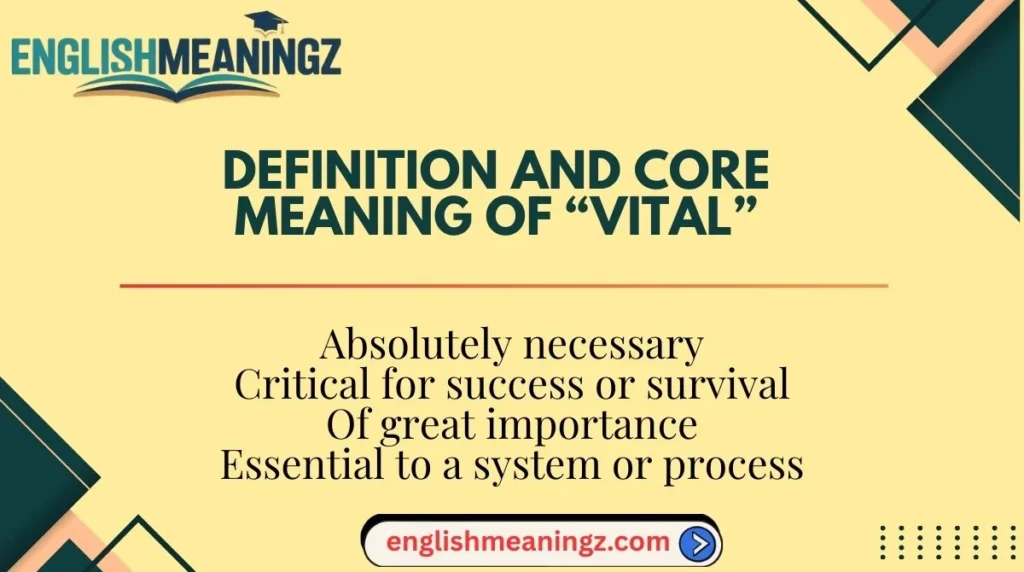
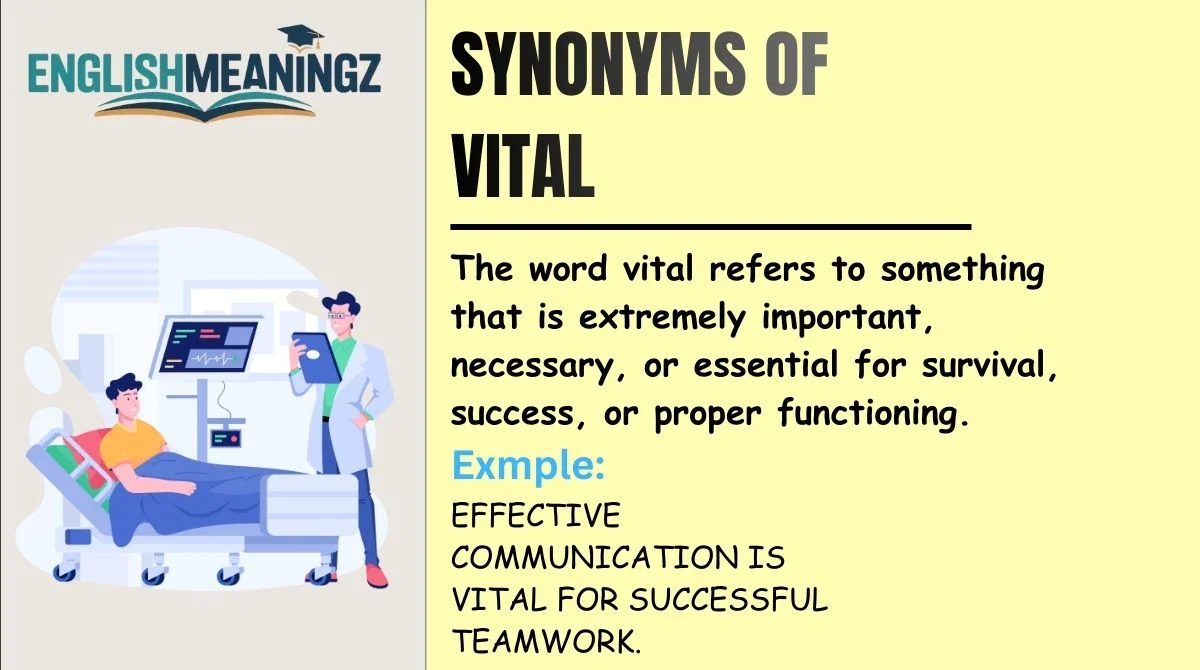
The word vital refers to something that is extremely important, necessary, or essential for survival, success, or proper functioning.
In general usage, the term emphasizes that something cannot be ignored because it plays a crucial role in achieving a particular outcome.
Core Meaning
The central meaning of vital includes:
- Absolutely necessary
- Critical for success or survival
- Of great importance
- Essential to a system or process
Academic and Subject-Specific Use
In different fields, the word vital may carry slightly different meanings:
Medicine:
“Vital signs” refer to critical measurements such as heart rate, blood pressure, and body temperature.
Biology:
A “vital function” describes a process necessary for sustaining life.
Business and Management:
A “vital strategy” refers to an action required for achieving organizational goals.
Academic Writing:
The word is commonly used to highlight key factors in research discussions.
Example:
Effective communication is vital for successful teamwork.
15 Synonyms Grouped by Context
Different synonyms work best in different contexts. Below are 15 strong alternatives to “vital,” organized by writing style and usage.
General Use Synonyms
Crucial
Meaning: Extremely important or decisive in determining an outcome.
Context Explanation:
“Crucial” emphasizes a moment or factor that strongly influences success or failure.
Example Sentence:
Early intervention is crucial for improving patient recovery.
Essential
Meaning: Absolutely necessary; something that cannot be removed.
Context Explanation:
Often used in both academic and everyday writing to describe fundamental requirements.
Example Sentence:
Regular exercise is essential for maintaining good health.
Critical
Meaning: Of the highest importance or urgency.
Context Explanation:
Frequently used in science, medicine, and professional reports.
Example Sentence:
Access to clean water is critical for public health.
Indispensable
Meaning: Impossible to replace or do without.
Context Explanation:
Used when something plays an irreplaceable role.
Example Sentence:
Data analysis tools are indispensable in modern research.
Necessary
Meaning: Required for a particular purpose or result.
Context Explanation:
A widely used synonym suitable for both formal and informal communication.
Example Sentence:
Proper training is necessary before operating the equipment.
Formal & Academic Writing Synonyms
Fundamental
Meaning: Forming the foundation or basic structure of something.
Context Explanation:
Common in academic discussions involving theories, principles, and systems.
Example Sentence:
Ethical considerations are fundamental to scientific research.
Imperative
Meaning: Extremely urgent or mandatory.
Context Explanation:
Often used in formal writing, policies, or strategic recommendations.
Example Sentence:
It is imperative that governments address climate change.
Pivotal
Meaning: Serving as a central turning point.
Context Explanation:
Used when describing events or decisions that significantly change outcomes.
Example Sentence:
The discovery played a pivotal role in medical advancement.
Integral
Meaning: Necessary to make something complete.
Context Explanation:
Frequently used in academic and professional writing.
Example Sentence:
Technology has become an integral part of education.
Paramount
Meaning: More important than anything else.
Context Explanation:
Used in formal discussions emphasizing priority.
Example Sentence:
Safety is paramount in engineering design.
Informal Usage Synonyms
Key
Meaning: Very important or central to understanding something.
Context Explanation:
Widely used in everyday speech and writing.
Example Sentence:
Communication is the key to resolving conflicts.
Major
Meaning: Significant or highly influential.
Context Explanation:
Often used in discussions involving events or developments.
Example Sentence:
Education plays a major role in social development.
Big
Meaning: Important or significant.
Context Explanation:
Informal but common in casual conversation.
Example Sentence:
This decision will have a big impact on the company.
Technical or Subject-Specific Synonyms
Central
Meaning: Located at the core of something.
Context Explanation:
Used in academic, analytical, and scientific discussions.
Example Sentence:
Trust is central to effective leadership.
Life-Sustaining
Meaning: Necessary for survival.
Context Explanation:
Common in medical and biological contexts.
Example Sentence:
Oxygen is a life-sustaining element for human survival.
Word Intensity & Tone Comparison Table
| Synonym | Formal Level | Emotional Strength | Typical Context |
|---|---|---|---|
| Crucial | High | Strong | Academic, business |
| Essential | Medium | Moderate | General writing |
| Critical | High | Strong | Medical, research |
| Fundamental | High | Moderate | Education, theory |
| Imperative | Very High | Strong | Policies, formal reports |
| Pivotal | High | Moderate | Historical or strategic discussion |
| Integral | High | Moderate | Academic writing |
| Paramount | Very High | Strong | Legal or safety discussions |
| Key | Medium | Mild | Everyday writing |
| Major | Medium | Mild | General discussion |
Common Mistakes When Using These Synonyms
Even though many words appear similar to vital, they cannot always be used interchangeably. Writers often misuse synonyms because they ignore differences in tone and context.
Mistake 1: Using Informal Words in Academic Writing
Incorrect:
Big factors influence economic growth.
Correct:
Major factors influence economic growth.
Mistake 2: Confusing “Critical” With “Negative”
Incorrect:
The project was critical of the team’s success.
Correct:
The project was critical to the team’s success.
Mistake 3: Overusing Strong Synonyms
Incorrect:
Every detail is imperative.
Correct:
Certain details are essential.
Overusing strong terms weakens the writing and makes arguments sound exaggerated.
Synonyms in Academic Writing
Example Paragraph 1
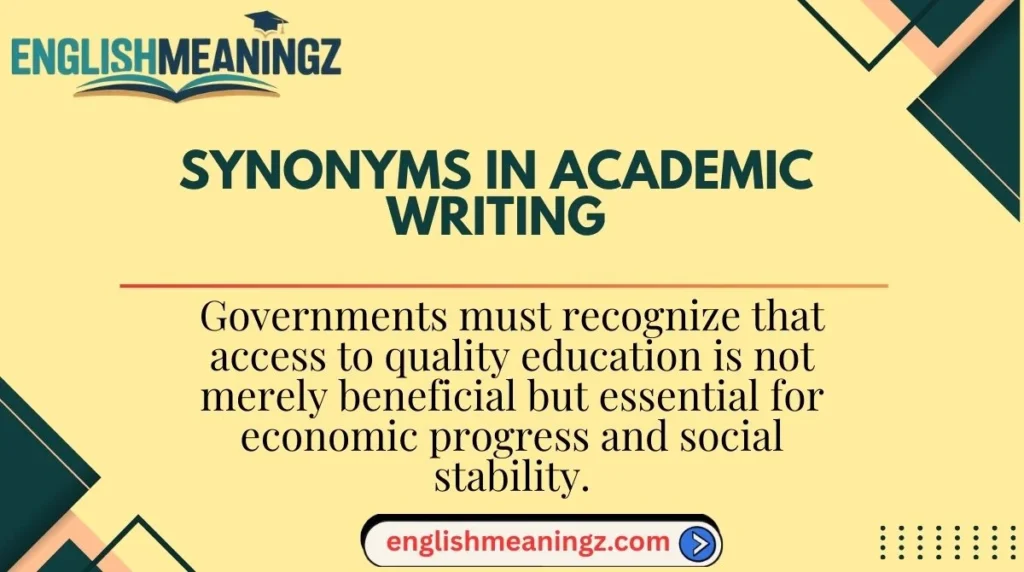
Effective education policies are crucial for long-term national development. Governments must recognize that access to quality education is not merely beneficial but essential for economic progress and social stability. In many countries, investment in educational infrastructure remains a fundamental priority for improving literacy rates and workforce skills.
Example Paragraph 2
Environmental protection has become a paramount concern in modern policy discussions. Scientists emphasize that sustainable resource management is integral to preventing ecological collapse. Without critical intervention, environmental damage may produce long-term consequences for global ecosystems.
IELTS & Exam Writing Tips
Vocabulary variety is especially important in international language exams such as IELTS.
Tip 1: Avoid Repetition
If the word important or vital appears multiple times, replace it with synonyms such as:
- crucial
- essential
- fundamental
- significant
Example:
Repetitive:
Education is vital. It is vital for development.
Improved:
Education is vital for national progress. It is also essential for social mobility.
Tip 2: Maintain Natural Flow
Not every instance should be replaced with a synonym. Excessive variation can make writing unnatural.
Example:
Awkward:
Education is crucial, pivotal, paramount, and indispensable.
Better:
Education is crucial for economic growth.
Tip 3: Match the Formal Level
Academic essays require formal vocabulary such as:
- crucial
- fundamental
- integral
- imperative
Avoid informal options like big or huge.
Similar Words vs True Synonyms
Some words appear similar to vital but carry different meanings.
Important vs Vital
- Important: significant but not necessarily essential
- Vital: absolutely necessary
Example:
Sleep is vital for health.
Significant vs Crucial
- Significant: noticeable or meaningful
- Crucial: decisive or critical
Example:
The discovery was crucial for medical research.
Necessary vs Indispensable
- Necessary: required
- Indispensable: impossible to replace
Example:
Computers are indispensable tools in data analysis.
Understanding these subtle differences improves precision in writing.
Practice Sentences
Choose the correct synonym of vital to complete each sentence.
- Clean drinking water is ______ for human survival.
- Communication skills are ______ for effective leadership.
- The research played a ______ role in scientific discovery.
- Ethics are ______ principles in academic research.
- Data accuracy is ______ for reliable conclusions.
Possible answers: essential, crucial, pivotal, fundamental, critical.
Practicing exercises like these helps reinforce vocabulary understanding.
FAQs
What is the best synonym for “vital”?
Some of the strongest synonyms include crucial, essential, critical, and indispensable, depending on context.
Which synonym is most formal?
Words such as imperative, paramount, and integral are considered highly formal and commonly appear in academic or professional writing.
Can “important” replace “vital”?
Sometimes, but not always. Important is weaker and does not always convey the same level of necessity.
Are “crucial” and “critical” interchangeable?
Often yes, but critical is more common in scientific or medical contexts.
How can I improve vocabulary for essays?
Reading academic texts, practicing synonym exercises, and reviewing vocabulary lists regularly can significantly improve writing quality.
Conclusion
Expanding vocabulary is one of the most effective ways to improve writing quality. Words like vital often appear repeatedly in essays, reports, and articles, but relying on a single term limits clarity and stylistic variety.
Learning synonyms such as crucial, essential, pivotal, imperative, and integral allows writers to communicate ideas more precisely.
It also enhances academic writing, improves exam performance, and strengthens professional communication.
Students, bloggers, and professionals who actively develop vocabulary gain a significant advantage in written communication.
By practicing synonym usage and understanding subtle differences in meaning, writers can produce clearer, more engaging, and more persuasive content.
Consistent vocabulary development ultimately leads to stronger writing, clearer arguments, and more impactful communication.