Vocabulary variety is one of the most effective ways to strengthen writing quality. Whether someone is preparing for academic exams, writing blog content, or producing professional reports, repeated use of the same word can reduce clarity and impact.
Synonyms help writers express the same idea in different ways while maintaining reader engagement and improving linguistic sophistication.
For students, especially those preparing for standardized tests such as academic language exams, varied vocabulary often contributes directly to higher writing scores.
Examiners evaluate lexical range, and replacing repeated words with appropriate alternatives demonstrates language proficiency.
Bloggers and content creators also benefit from synonym usage. Search engines value content that uses natural language variation rather than repetitive wording. This improves readability and search engine optimization simultaneously.
Professionals—including researchers, journalists, and business writers—rely on precise language to convey subtle differences in meaning. In these contexts, choosing the right synonym can change the tone from casual to formal or from descriptive to technical.
The word “gold” is commonly used in multiple contexts: describing precious metal, highlighting excellence, or referring to valuable opportunities.
Because of its broad use, knowing suitable alternatives allows writers to maintain clarity while enhancing stylistic depth.
This article explores 26 powerful synonyms for “gold,” explains their meanings, and demonstrates how to use them effectively in different contexts.
Definition and Core Meaning of “Gold”
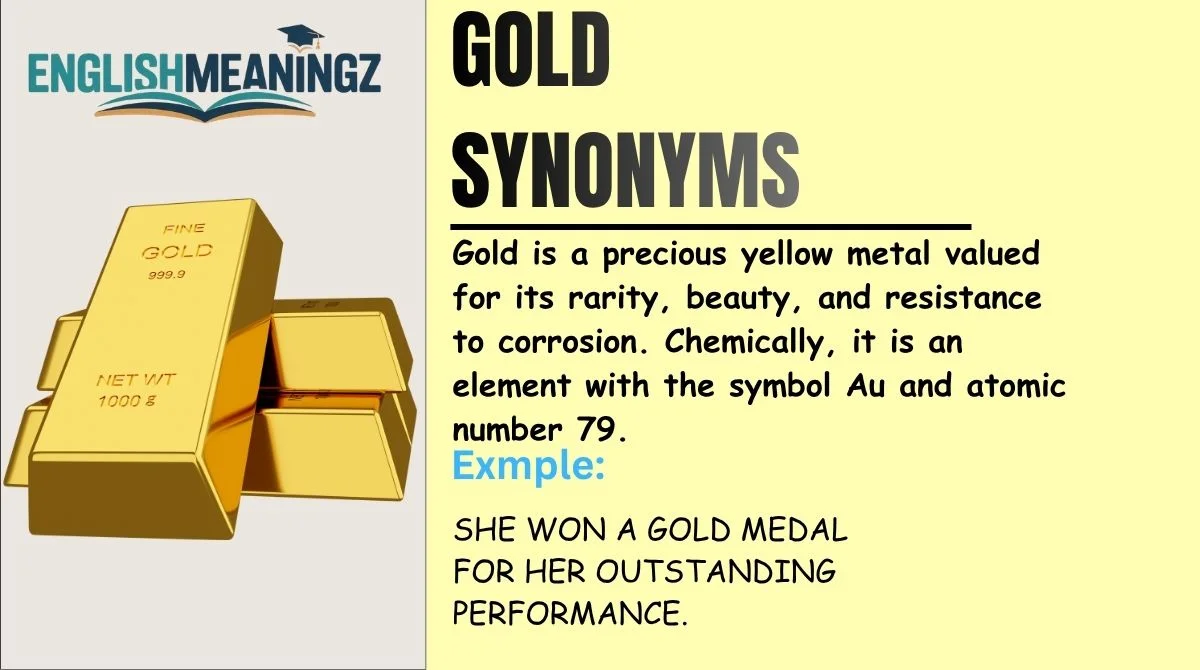
Gold is a precious yellow metal valued for its rarity, beauty, and resistance to corrosion. Chemically, it is an element with the symbol Au and atomic number 79. It has been used for thousands of years in jewelry, currency, and decorative arts.
Beyond its literal meaning, the word also functions metaphorically. In many forms of writing, “gold” represents:
- Exceptional quality
- High value or importance
- Achievement or victory
- Wealth or prosperity
For example:
- She won a gold medal for her outstanding performance.
- The company discovered a gold opportunity in the emerging market.
In both literal and figurative uses, the word communicates value, excellence, or rarity. However, using the same word repeatedly may weaken writing. Synonyms provide flexibility while preserving meaning.
26 Synonyms Grouped by Context
General Use
Precious
Meaning: Extremely valuable or important.
Context: Often used to describe something rare, cherished, or highly valued.
Example:
The museum protects its precious artifacts with advanced security systems.
Valuable
Meaning: Worth a great deal of money or importance.
Context: Used in academic, professional, and everyday writing.
Example:
The research provides valuable insights into climate change patterns.
Rich
Meaning: Abundant in resources or wealth.
Context: Can refer to material wealth, culture, or natural resources.
Example:
The region is rich in mineral deposits.
Radiant
Meaning: Shining brightly or glowing with warmth.
Context: Often used in descriptive writing and literature.
Example:
The radiant sunset reflected beautifully across the lake.
Gleaming
Meaning: Shining brightly with reflected light.
Context: Used in visual descriptions.
Example:
The gleaming trophy stood proudly on the champion’s shelf.
Shimmering
Meaning: Reflecting light with a soft sparkling effect.
Context: Often used in poetic or narrative writing.
Example:
The lake appeared shimmering under the evening sunlight.
Formal & Academic Writing
Noble
Meaning: Associated with high value, dignity, or purity.
Context: Used in science and formal descriptions, such as “noble metals.”
Example:
Gold is classified as a noble metal due to its resistance to corrosion.
Distinguished
Meaning: Recognized for excellence or achievement.
Context: Academic and professional writing.
Example:
The distinguished scientist received international recognition for her research.
Eminent
Meaning: Highly respected within a profession or field.
Context: Formal academic writing.
Example:
The conference invited several eminent scholars to discuss economic policy.
Prestigious
Meaning: Having high status or reputation.
Context: Used for awards, institutions, and achievements.
Example:
She received a prestigious scholarship for her academic excellence.
Esteemed
Meaning: Highly respected or admired.
Context: Formal communication and academic writing.
Example:
The professor is an esteemed authority in linguistics.
Illustrious
Meaning: Widely known and respected for achievements.
Context: Formal and literary contexts.
Example:
The university has produced many illustrious graduates.
Informal Usage
Awesome
Meaning: Extremely impressive.
Context: Casual conversations and informal writing.
Example:
That performance was awesome.
Fantastic
Meaning: Extremely good or impressive.
Context: Informal descriptive language.
Example:
She delivered a fantastic presentation.
Brilliant
Meaning: Exceptionally good or impressive.
Context: Common in conversational English.
Example:
His solution to the problem was brilliant.
Amazing
Meaning: Causing great surprise or admiration.
Context: Informal writing and speech.
Example:
The view from the mountain peak was amazing.
Superb
Meaning: Of excellent quality.
Context: Used in both informal and semi-formal contexts.
Example:
The restaurant provided superb service.
Technical or Subject-Specific Use
Auric
Meaning: Relating to gold chemically.
Context: Scientific or chemical terminology.
Example:
Auric compounds are studied in advanced chemistry laboratories.
Golden
Meaning: Made of gold or extremely valuable.
Context: Both literal and metaphorical uses.
Example:
Education offers golden opportunities for future success.
Metallic
Meaning: Having properties of metal.
Context: Scientific or descriptive contexts.
Example:
The sculpture had a smooth metallic finish.
Opulent
Meaning: Extremely luxurious or wealthy.
Context: Describing wealth, luxury environments, or high status.
Example:
The palace interior reflected an opulent lifestyle.
Lavish
Meaning: Richly luxurious or extravagant.
Context: Used in descriptions of spending or decoration.
Example:
The wedding celebration was lavish and unforgettable.
Majestic
Meaning: Grand and impressive.
Context: Describing appearance, architecture, or landscapes.
Example:
The majestic building dominated the city skyline.
Splendid
Meaning: Magnificent or impressive.
Context: Formal descriptive writing.
Example:
The garden looked splendid during the spring festival.
Regal
Meaning: Suitable for royalty.
Context: Used to describe dignity and grandeur.
Example:
She entered the hall with a regal presence.
Glittering
Meaning: Shining with many bright reflections.
Context: Descriptive writing.
Example:
The glittering lights transformed the city at night.
Word Intensity & Tone Comparison Table
| Word | Formal Level | Emotional Strength | Typical Context |
|---|---|---|---|
| Precious | Medium | High | Emotional or descriptive writing |
| Valuable | High | Medium | Academic and professional |
| Noble | High | Medium | Scientific or formal |
| Prestigious | High | High | Awards and institutions |
| Amazing | Low | High | Informal speech |
| Brilliant | Medium | High | Informal or semi-formal |
| Opulent | High | Strong | Luxury descriptions |
| Majestic | Medium | Strong | Literature and descriptions |
| Regal | High | Medium | Royal or dignified contexts |
| Superb | Medium | Medium | Reviews and evaluations |
Common Mistakes When Using These Synonyms
One common mistake occurs when writers replace words without considering context.
Incorrect:
The scientist conducted a gold experiment.
Correct:
The scientist conducted a valuable experiment.
Another error involves using overly informal synonyms in academic writing.
Incorrect:
The researcher made an awesome discovery.
Correct:
The researcher made a significant or remarkable discovery.
Writers may also confuse descriptive synonyms with literal meanings.
Incorrect:
The jewelry was made of precious.
Correct:
The jewelry was made of gold.
Synonyms in Academic Writing
Example Paragraph 1
Modern economies depend heavily on valuable natural resources. Among these resources, gold has historically played a significant role in global trade and financial stability. However, contemporary economists emphasize that knowledge and innovation are equally precious assets in the modern economy.
Example Paragraph 2
Educational institutions strive to create prestigious academic environments that promote intellectual development. Students who gain access to such opportunities often benefit from distinguished faculty and valuable research facilities that support advanced learning.
IELTS & Exam Writing Tips
Students preparing for language examinations should use synonyms carefully.
Avoid Repetition
Instead of repeating a word several times, alternate with appropriate synonyms.
Example:
Gold is a valuable metal. This precious element has been used for centuries.
Maintain Meaning
Not all synonyms are interchangeable. Some carry stronger emotional or formal tones.
When Not to Replace the Word
In scientific or technical contexts, replacing a precise term may reduce clarity.
Example:
Gold is used in electronics.
Replacing “gold” with “precious metal” may be less precise in certain cases.
Similar Words vs True Synonyms
Many words appear similar to “gold” but are not exact synonyms.
Golden vs Gold
“Golden” often has symbolic meaning, such as success or opportunity.
Example:
This internship is a golden opportunity.
Opulent vs Gold
“Opulent” refers to luxury rather than the metal itself.
Example:
The hotel lobby displayed opulent decorations.
Valuable vs Gold
“Valuable” describes worth but not necessarily material composition.
Example:
The professor offered valuable advice.
Understanding these subtle differences helps writers maintain accuracy.
Practice Sentences
Fill in the blanks using suitable synonyms.
- The professor provided ______ advice that helped the students complete their research.
- The palace interior reflected an ______ lifestyle of historical royalty.
- She received a ______ award for her contributions to environmental science.
- The evening sky appeared ______ as the sun set behind the mountains.
- The team celebrated their ______ achievement after years of hard work.
FAQs
What are the best synonyms for “gold”?
Common synonyms include precious, valuable, noble, prestigious, and golden. Each conveys a slightly different nuance depending on context.
Can “golden” always replace “gold”?
No. “Golden” is often metaphorical, while “gold” refers specifically to the metal.
Which synonyms are suitable for academic writing?
Words such as valuable, prestigious, eminent, distinguished, and noble are more appropriate in formal contexts.
Why are synonyms important in exam writing?
Using varied vocabulary demonstrates lexical range, which can improve writing scores in academic language tests.
How can I learn synonyms effectively?
Reading academic texts, practicing writing exercises, and studying vocabulary lists can gradually expand lexical knowledge.
Conclusion
Expanding vocabulary is one of the most effective ways to improve writing quality. The word “gold” carries powerful meanings related to value, excellence, and rarity. However, relying on a single word repeatedly can weaken communication.
By learning and practicing these 26 synonyms, writers can express ideas with greater precision and stylistic variety.
Students preparing for academic exams, bloggers producing engaging content, and professionals writing reports all benefit from a richer vocabulary.
Consistent practice, careful attention to context, and thoughtful word selection will gradually strengthen language skills and produce clearer, more persuasive writing.