Language becomes sharper, more persuasive, and more precise when you understand not only what a word means—but also what it does not mean.
Mastering opposites, or antonyms, is one of the fastest ways to elevate your writing quality, especially when dealing with abstract words like attitude.
Writers often rely on repetitive vocabulary, which weakens impact. By using accurate opposites, you gain control over tone, clarity, and nuance.
This is especially valuable in academic essays, professional communication, and SEO writing, where precision determines credibility.
In academic contexts, antonyms help demonstrate critical thinking and depth. In professional settings, they allow you to frame behavior, mindset, and communication styles more effectively.
Understanding antonyms for attitude is not just a vocabulary exercise—it’s a strategic tool for better expression.
What Does “Attitude” Mean?
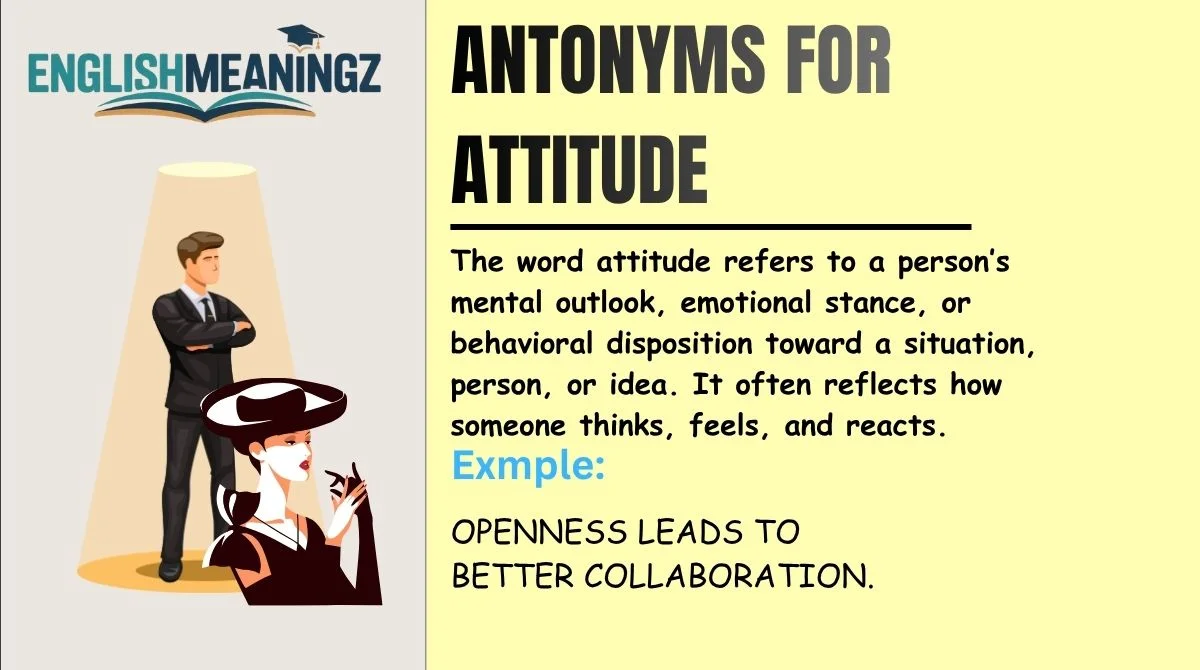
The word attitude refers to a person’s mental outlook, emotional stance, or behavioral disposition toward a situation, person, or idea. It often reflects how someone thinks, feels, and reacts.
Tone Explanation
Attitude can carry both positive and negative tones depending on context:
- Positive: confidence, optimism, determination
- Negative: arrogance, hostility, defiance
Emotional or Action Intensity
The intensity of attitude varies widely:
- Mild: preference, inclination
- Moderate: opinion, mindset
- Strong: defiance, aggression
Because of this flexibility, its antonyms are not always direct opposites—they often depend on context, tone, and emotional strength.
14 Best Antonyms for “Attitude”
Humility
Meaning: A modest view of oneself
Tone: Formal / Academic
Example: She approached the discussion with humility rather than dominance.
Why it’s opposite: While attitude can imply ego or assertiveness, humility removes self-importance.
Compliance
Meaning: Willingness to follow rules or instructions
Tone: Formal
Example: His compliance made teamwork much smoother.
Why it’s opposite: Attitude often suggests resistance; compliance reflects cooperation.
Respectfulness
Meaning: Showing politeness and consideration
Tone: Professional
Example: Her respectful tone improved the conversation.
Why it’s opposite: Negative attitude often includes disrespect; this reverses that behavior.
Neutrality
Meaning: Lack of strong opinion or bias
Tone: Academic
Example: The judge maintained neutrality throughout the case.
Why it’s opposite: Attitude implies a stance, while neutrality removes it.
Openness
Meaning: Willingness to consider new ideas
Tone: Professional / Academic
Example: Openness leads to better collaboration.
Why it’s opposite: A rigid attitude resists change; openness embraces it.
Politeness
Meaning: Good manners and courteous behavior
Tone: Formal
Example: Politeness can defuse tension quickly.
Why it’s opposite: Harsh attitudes contrast directly with polite conduct.
Acceptance
Meaning: Willingness to tolerate or agree
Tone: Emotional / Formal
Example: Acceptance helped him move forward.
Why it’s opposite: Attitude can involve rejection; acceptance reverses that stance.
Flexibility
Meaning: Ability to adapt to change
Tone: Professional
Example: Flexibility is essential in dynamic environments.
Why it’s opposite: Strong attitudes can be rigid; flexibility allows adjustment.
Calmness
Meaning: A peaceful, composed state
Tone: Emotional
Example: Her calmness prevented escalation.
Why it’s opposite: Intense attitude often brings tension; calmness removes it.
Submission
Meaning: Yielding to authority or control
Tone: Formal
Example: Submission ended the conflict quickly.
Why it’s opposite: Attitude may resist authority; submission accepts it.
Cooperation
Meaning: Working together harmoniously
Tone: Professional
Example: Cooperation improved the project outcome.
Why it’s opposite: Attitude can create conflict; cooperation resolves it.
Indifference
Meaning: Lack of interest or concern
Tone: Neutral
Example: His indifference surprised everyone.
Why it’s opposite: Attitude implies strong feeling; indifference removes emotional involvement.
Modesty
Meaning: Not boasting about achievements
Tone: Formal
Example: Modesty earns respect over time.
Why it’s opposite: Attitude can reflect pride or arrogance; modesty counters that.
Agreeableness
Meaning: Pleasant and cooperative nature
Tone: Professional / Psychological
Example: Agreeableness makes teamwork easier.
Why it’s opposite: A negative attitude causes friction; agreeableness reduces it.
Passivity
Meaning: Lack of active response
Tone: Academic
Example: Passivity can limit progress.
Why it’s opposite: Attitude often involves strong reaction; passivity removes it.
Strong vs Mild Opposites
Not all antonyms carry the same intensity. Some directly oppose strong attitudes, while others simply soften them.
Strong Opposites
These completely counter intense attitudes:
- Submission
- Compliance
- Humility
These words neutralize dominance, arrogance, or resistance.
Mild Opposites
These reduce intensity rather than fully reverse it:
- Politeness
- Calmness
- Flexibility
They don’t eliminate attitude entirely but soften its expression.
Neutral Opposites
These remove emotional charge:
- Neutrality
- Indifference
These are useful in academic or analytical writing where emotional tone should be minimized.
Understanding intensity helps you choose the right antonym—not just any opposite.
Context-Based Opposites
The best antonym for attitude depends heavily on context.
Workplace Context
- Attitude → Cooperation / Compliance
Used when discussing teamwork or leadership.
Emotional Context
- Attitude → Calmness / Acceptance
Useful in conflict or personal growth discussions.
Academic Context
- Attitude → Neutrality / Objectivity
Important in research and formal analysis.
Social Behavior Context
- Attitude → Politeness / Respectfulness
Common in etiquette and communication topics.
A single antonym cannot fit all situations. Context determines accuracy.
Common Mistakes When Using Opposites
Using Weak Opposites
Incorrect: His attitude was replaced by kindness.
Problem: Kindness is not a direct antonym.
Correct: His attitude was replaced by humility.
Ignoring Tone
Incorrect: The manager showed submission.
Problem: Sounds negative in a leadership context.
Correct: The manager showed flexibility.
Mixing Contexts
Incorrect: Scientific neutrality replaced his attitude toward friends.
Problem: Academic term used in social context.
Correct: Respectfulness replaced his attitude toward friends.
Overusing One Antonym
Repeating “humility” or “politeness” reduces variety and impact. Use a range of alternatives for stronger writing.
Sentence Transformation Examples
Original
He had a bad attitude during the meeting.
Improved: He showed a lack of cooperation during the meeting.
Original
Her attitude caused conflict.
Improved: Her lack of flexibility caused conflict.
Original
His attitude made people uncomfortable.
Improved: His absence of respectfulness made people uncomfortable.
Original
She always shows attitude in class.
Improved: She rarely shows cooperation in class.
Original
Their attitude blocked progress.
Improved: Their lack of openness blocked progress.
FAQs
What is the simplest antonym for attitude?
The simplest antonym depends on context, but humility and neutrality are commonly used.
Can attitude have positive meaning?
Yes, it can represent confidence, determination, or optimism depending on usage.
Why are there many antonyms for attitude?
Because attitude is a broad concept covering emotions, behavior, and mindset.
Which antonym is best for professional writing?
Cooperation, flexibility, and respectfulness are ideal for workplace communication.
Is neutrality always an opposite of attitude?
Only in analytical or academic contexts where emotional stance is removed.
What is the strongest opposite of attitude?
Submission or compliance can act as strong opposites in power-related contexts.
How do I choose the right antonym?
Consider tone, context, and intensity before selecting the most accurate opposite.
Conclusion
Understanding antonyms for attitude is more than a vocabulary exercise—it’s a writing strategy that enhances clarity, precision, and impact.
By selecting the right opposite based on tone and context, you gain control over how your message is perceived.
Whether you’re writing academically, professionally, or creatively, using the correct antonym allows you to express contrast effectively and avoid vague or repetitive language.
Mastering these opposites ultimately leads to stronger communication and more persuasive writing.