Mastering opposites is one of the fastest ways to sharpen your language skills. When you understand how a word contrasts with others, you gain deeper control over tone, clarity, and expression.
This is especially important for a term like “oration,” which carries a strong sense of formal, public communication.
In both academic and professional environments, choosing the right opposite can transform your message. Whether you are writing essays, delivering presentations, or crafting persuasive content, knowing antonyms allows you to shift meaning with precision.
It helps avoid monotony, improves readability, and strengthens your argument by showing contrast.
This article explores the most accurate and context-rich antonyms of “oration,” giving you practical tools to improve both writing and speaking.
What Does “Oration” Mean?
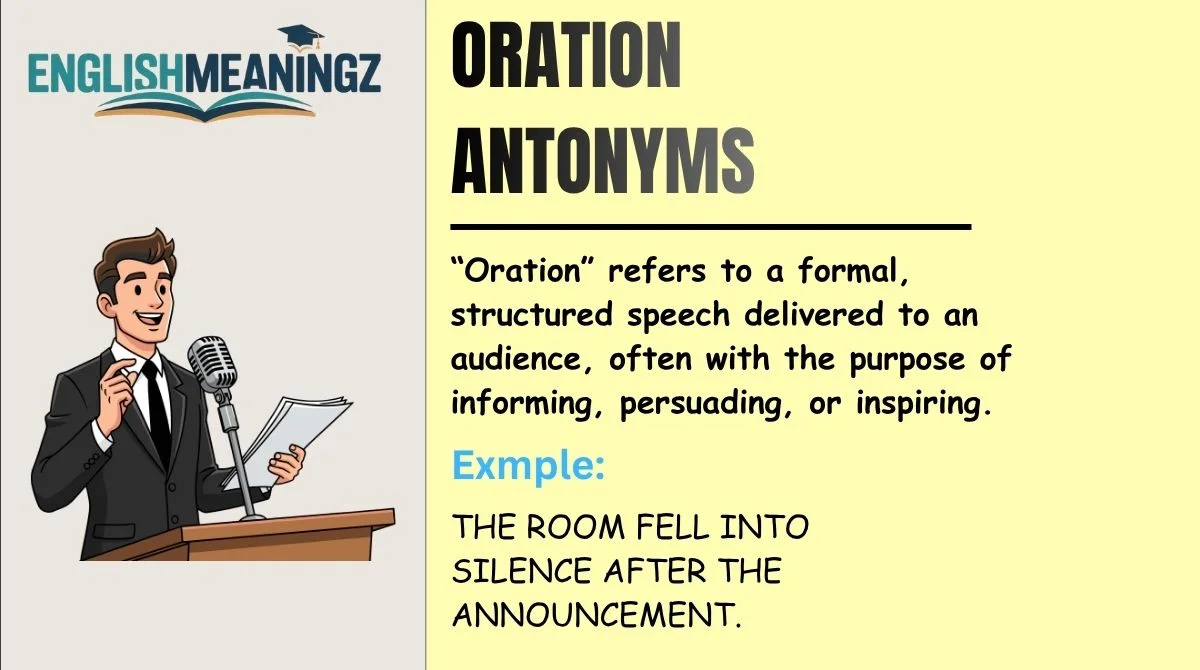
“Oration” refers to a formal, structured speech delivered to an audience, often with the purpose of informing, persuading, or inspiring. It is typically associated with ceremonial events, political addresses, academic lectures, or public speaking platforms.
The tone of “oration” is usually:
- Formal
- Structured
- Purpose-driven
- Emotionally controlled but impactful
In terms of intensity, an oration sits high on the communication scale. It is not casual or spontaneous. Instead, it is deliberate, polished, and often rehearsed. Because of this, its antonyms tend to reflect informality, silence, brevity, or lack of structured communication.
19 Best Antonyms for “Oration”
Silence
Meaning: Complete absence of sound or speech
Tone: Neutral / Formal
Example: The room fell into silence after the announcement.
Why it is opposite: Oration involves speaking; silence represents total absence of verbal expression.
Quiet
Meaning: Minimal noise or subdued sound
Tone: Neutral
Example: The library remained quiet throughout the day.
Why it is opposite: While oration is loud and expressive, quiet suggests restraint and minimal communication.
Muteness
Meaning: Inability or refusal to speak
Tone: Formal / Emotional
Example: His muteness during the meeting surprised everyone.
Why it is opposite: Oration requires vocal expression, whereas muteness eliminates it entirely.
Whisper
Meaning: Speaking very softly
Tone: Informal / Emotional
Example: She spoke in a whisper to avoid attention.
Why it is opposite: Oration is projected and audible; whispering is subdued and private.
Murmur
Meaning: Low, continuous speaking sound
Tone: Informal
Example: A murmur spread through the crowd.
Why it is opposite: Oration is clear and structured; murmuring is indistinct and unorganized.
Brevity
Meaning: Shortness in speech or writing
Tone: Formal / Academic
Example: His response was appreciated for its brevity.
Why it is opposite: Oration is often extended and elaborate, while brevity emphasizes conciseness.
Conversation
Meaning: Informal exchange of ideas
Tone: Informal
Example: They had a casual conversation over coffee.
Why it is opposite: Oration is formal and one-directional; conversation is casual and interactive.
Chat
Meaning: Light, informal talk
Tone: Informal
Example: They sat down for a quick chat.
Why it is opposite: A chat lacks the structure and seriousness of an oration.
Dialogue
Meaning: Exchange between two or more people
Tone: Academic / Neutral
Example: The dialogue between the leaders was productive.
Why it is opposite: Oration is typically one speaker addressing many; dialogue involves mutual participation.
Listening
Meaning: Act of hearing attentively
Tone: Neutral
Example: Good communication requires active listening.
Why it is opposite: Oration focuses on speaking; listening is its receptive counterpart.
Reticence
Meaning: Reserved or restrained communication
Tone: Formal
Example: His reticence made him seem distant.
Why it is opposite: Oration is expressive; reticence reflects hesitation or withholding speech.
Hesitation
Meaning: Pause before speaking
Tone: Neutral
Example: There was hesitation in her reply.
Why it is opposite: Oration is confident and continuous; hesitation interrupts flow.
Informality
Meaning: Lack of structure or formality
Tone: Neutral
Example: The meeting had an air of informality.
Why it is opposite: Oration is highly formal; informality removes that structure.
Casual Talk
Meaning: Relaxed, everyday conversation
Tone: Informal
Example: They engaged in casual talk after dinner.
Why it is opposite: Oration is deliberate and formal, unlike relaxed speech.
Scribble
Meaning: Quick, unstructured writing
Tone: Informal
Example: He left a scribble on the note.
Why it is opposite: Oration is polished and organized; scribbling is careless and unrefined.
Note
Meaning: Short written message
Tone: Neutral
Example: She left a note on the desk.
Why it is opposite: Oration is lengthy and spoken; a note is brief and written.
Silence in Protest
Meaning: Refusal to speak as a statement
Tone: Emotional
Example: The group observed silence in protest.
Why it is opposite: Instead of speaking out, silence becomes the message itself.
Interruption
Meaning: Breaking the flow of speech
Tone: Neutral
Example: The interruption disrupted the meeting.
Why it is opposite: Oration is continuous; interruption halts communication.
Fragment
Meaning: Incomplete or broken expression
Tone: Academic
Example: The statement was just a fragment of thought.
Why it is opposite: Oration is complete and structured; fragments are incomplete.
Strong vs Mild Opposites
Not all antonyms carry the same intensity. Some completely negate the concept of oration, while others only partially contrast it.
Strong opposites include:
- Silence
- Muteness
- Reticence
These represent a complete absence or rejection of speech.
Mild opposites include:
- Conversation
- Chat
- Whisper
These still involve communication but lack the formality, scale, and structure of an oration.
Understanding this scale helps you choose the right word depending on how strong you want the contrast to be.
Context-Based Opposites
Antonyms often depend on context rather than strict dictionary definitions.
In a public speaking context:
- Silence is the strongest opposite
In a formal vs informal context:
- Chat or conversation becomes more relevant
In a structural context:
- Fragment or scribble contrasts with organized speech
In emotional situations:
- Reticence or hesitation works better
This flexibility is why vocabulary mastery requires contextual awareness, not just memorization.
Common Mistakes When Using Opposites
One frequent mistake is assuming all antonyms are interchangeable. For example:
Incorrect:
He replaced the oration with a whisper in a large auditorium.
Why wrong:
A whisper cannot function as a practical opposite in that setting.
Correct:
He replaced the oration with silence.
Another mistake is confusing tone levels:
Incorrect:
The formal oration was replaced with a scribble.
Why wrong:
“Scribble” shifts from spoken to written context inappropriately.
Correct:
The formal oration was replaced with a casual conversation.
A third mistake is ignoring intensity:
Incorrect:
Her oration turned into a chat during the ceremony.
Why wrong:
A ceremony typically demands formal tone.
Correct:
Her oration turned into silence due to technical issues.
Sentence Transformation Examples
Original:
The leader delivered a powerful oration.
Rewritten:
The leader remained in complete silence.
Original:
Her oration inspired the audience.
Rewritten:
Her quiet reflection left the audience thoughtful.
Original:
The professor gave an oration on history.
Rewritten:
The professor engaged in a casual conversation about history.
Original:
His oration lasted an hour.
Rewritten:
His brief note conveyed the message in seconds.
Original:
The event featured a formal oration.
Rewritten:
The event encouraged open dialogue instead.
FAQs
What is the simplest antonym of oration?
The simplest and most direct antonym is “silence,” as it completely removes the act of speaking.
Can “conversation” be an antonym of oration?
Yes, in context. Oration is formal and one-sided, while conversation is informal and interactive.
Is “whisper” a true opposite?
It is a partial or mild opposite because it reduces volume and intensity rather than eliminating speech entirely.
Why is context important for antonyms?
Because words can have multiple meanings, and their opposites change depending on tone, setting, and purpose.
Is “writing” an antonym of oration?
Not always. Writing is a different mode of communication, not necessarily an opposite unless contrast is intentional.
Which antonyms are best for academic writing?
Words like “brevity,” “reticence,” and “silence” work well due to their formal tone.
How can antonyms improve vocabulary?
They expand your expressive range, help avoid repetition, and allow clearer contrasts in communication.
Conclusion
Understanding the antonyms of “oration” is more than a vocabulary exercise—it is a strategic skill for effective communication.
From absolute opposites like silence to softer contrasts like conversation, each word offers a different shade of meaning.
By learning these distinctions, you gain control over tone, clarity, and expression. Whether you are writing academically, speaking professionally, or simply improving your language skills, mastering opposites gives you the power to communicate with precision and impact.