Understanding opposites is one of the fastest ways to sharpen your language skills. When you know not only what a word means but also what it does not mean, your writing becomes clearer, more precise, and more persuasive.
This is especially important for abstract terms like “ethos,” which carry deep philosophical and rhetorical weight.
In both academic and professional communication, using accurate antonyms helps you express contrast, critique arguments, and refine tone.
Whether you’re writing essays, research papers, marketing copy, or speeches, mastering antonyms gives you the ability to communicate nuance instead of vague ideas.
This article provides a complete, SEO-optimized guide to the best antonyms of “ethos,” along with explanations, examples, and practical applications.
What Does “Ethos” Mean?
Definition:
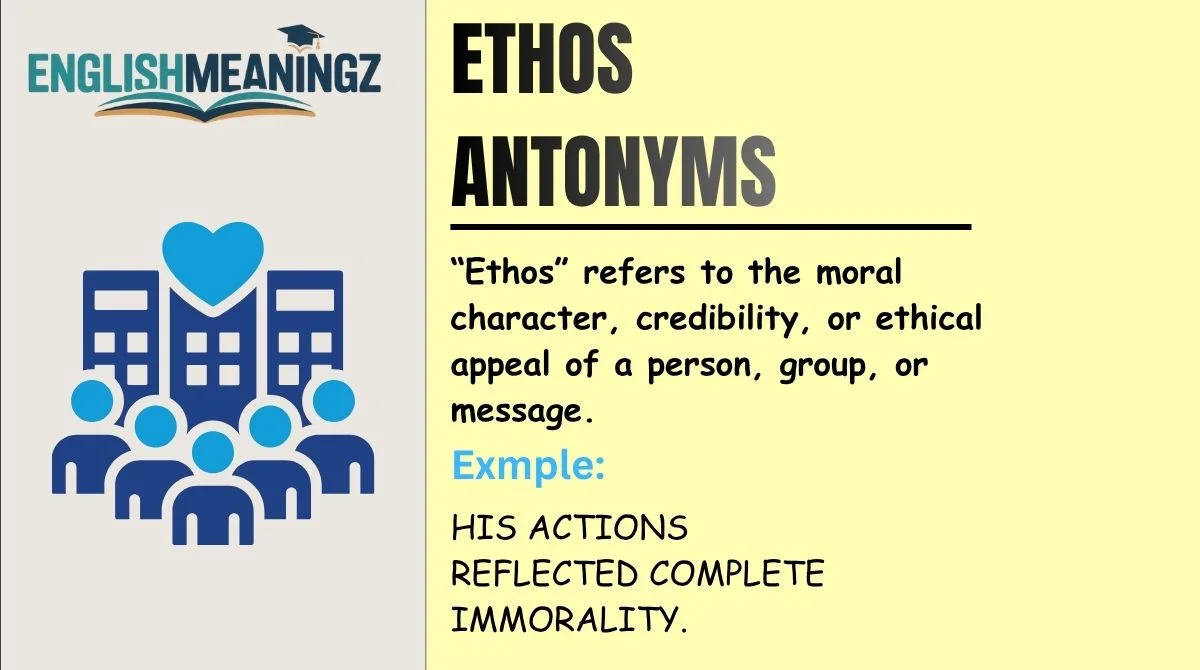
“Ethos” refers to the moral character, credibility, or ethical appeal of a person, group, or message. It is commonly used in rhetoric to describe how a speaker establishes trustworthiness and authority.
Tone Explanation:
The tone of “ethos” is typically formal and academic, often associated with logic, ethics, and credibility.
Emotional or Action Intensity:
Ethos carries a moderate to strong intensity, as it directly impacts how trustworthy or reliable someone appears. It’s not just about behavior—it reflects deeper values and principles.
19 Best Antonyms for “Ethos”
1. Immorality
Meaning: Lack of moral principles
Tone: Formal / Academic
Example: His actions reflected complete immorality.
Why Opposite: Ethos is rooted in ethical credibility, while immorality rejects moral standards entirely.
2. Corruption
Meaning: Dishonest or unethical conduct
Tone: Formal
Example: The scandal exposed widespread corruption in the organization.
Why Opposite: Ethos builds trust; corruption destroys it.
3. Dishonesty
Meaning: Lack of honesty or integrity
Tone: Neutral
Example: Dishonesty in reporting damages credibility.
Why Opposite: Ethos depends on truthfulness, while dishonesty undermines it.
4. Deceit
Meaning: Intentional deception
Tone: Formal
Example: The company relied on deceit to mislead customers.
Why Opposite: Ethos requires transparency; deceit hides the truth.
5. Untrustworthiness
Meaning: Inability to be relied upon
Tone: Neutral
Example: His untrustworthiness made collaboration difficult.
Why Opposite: Ethos is about trust; this represents its absence.
6. Hypocrisy
Meaning: Pretending to have values one does not follow
Tone: Formal
Example: The leader’s hypocrisy was widely criticized.
Why Opposite: Ethos reflects genuine character, while hypocrisy reflects false character.
7. Vice
Meaning: Immoral or wicked behavior
Tone: Formal
Example: The novel explores human vice and downfall.
Why Opposite: Ethos aligns with virtue; vice is its direct contrast.
8. Cynicism
Meaning: Distrust in human sincerity
Tone: Emotional
Example: His cynicism made him question every motive.
Why Opposite: Ethos builds belief in sincerity; cynicism rejects it.
9. Fraudulence
Meaning: Deceptive or fake behavior
Tone: Formal
Example: The investigation uncovered fraudulence in financial records.
Why Opposite: Ethos represents authenticity; fraudulence is artificial.
10. Manipulation
Meaning: Controlling others unfairly
Tone: Neutral
Example: The speech relied on emotional manipulation.
Why Opposite: Ethos persuades ethically, not through control.
11. Mistrust
Meaning: Lack of trust
Tone: Emotional
Example: Years of conflict created deep mistrust.
Why Opposite: Ethos fosters trust; mistrust eliminates it.
12. Disrepute
Meaning: Loss of respect or credibility
Tone: Formal
Example: The incident brought disrepute to the institution.
Why Opposite: Ethos enhances reputation; disrepute damages it.
13. Illegitimacy
Meaning: Lack of validity or authority
Tone: Academic
Example: The decision was criticized for its illegitimacy.
Why Opposite: Ethos establishes authority; illegitimacy questions it.
14. Degradation
Meaning: Decline in moral character
Tone: Formal
Example: The story highlights moral degradation.
Why Opposite: Ethos represents integrity; degradation reflects its loss.
15. Scandal
Meaning: Public disgrace caused by wrongdoing
Tone: Informal / Formal
Example: The scandal ruined his career.
Why Opposite: Ethos builds respect; scandal destroys it publicly.
16. Amorality
Meaning: Absence of moral concern
Tone: Academic
Example: The character’s amorality shocked readers.
Why Opposite: Ethos depends on moral awareness; amorality ignores it.
17. Treachery
Meaning: Betrayal or disloyalty
Tone: Emotional
Example: His treachery ended their friendship.
Why Opposite: Ethos involves trust and loyalty; treachery breaks both.
18. Depravity
Meaning: Extreme moral corruption
Tone: Formal
Example: The film depicts human depravity.
Why Opposite: Ethos represents high moral standing; depravity is its extreme opposite.
19. Discredit
Meaning: Harm to reputation or credibility
Tone: Formal
Example: False accusations aimed to discredit her.
Why Opposite: Ethos builds credibility; discredit removes it.
Strong vs Mild Opposites
Not all antonyms carry the same intensity. Some are extreme, while others are subtle contrasts.
Strong Opposites:
Words like depravity, corruption, and treachery represent complete rejection of ethical principles. These are powerful and often used in serious or dramatic contexts.
Mild Opposites:
Words like mistrust, discredit, and cynicism suggest a weaker contrast. They don’t fully reject ethics but indicate doubt or decline.
Why This Matters:
Choosing the right intensity ensures your writing matches the context. Overusing strong antonyms can sound exaggerated, while mild ones may seem too weak.
Context-Based Opposites
Antonyms are not always fixed—they depend on context.
- In academic writing, “ethos” may be opposed by illegitimacy or disrepute.
- In emotional contexts, words like betrayal or mistrust work better.
- In business communication, corruption or fraudulence are more relevant.
Example:
- Academic: “The argument lacks ethos” → “The argument suffers from illegitimacy.”
- Emotional: “He lost his ethos” → “He became untrustworthy.”
Understanding context ensures you pick the most precise antonym.
Common Mistakes When Using Opposites
1. Confusing Tone
Incorrect: “His ethos turned into cynicism”
Correct: “His credibility turned into cynicism”
Reason: Ethos is not something that “turns”; it describes perception.
2. Using Weak Antonyms
Incorrect: “Ethos vs doubt”
Correct: “Ethos vs mistrust”
Reason: “Doubt” is too vague.
3. Overusing Extreme Words
Incorrect: “Every mistake shows depravity”
Correct: “Every mistake affects credibility”
Reason: Strong antonyms should be used carefully.
4. Ignoring Context
Incorrect: “The company’s ethos became treachery”
Correct: “The company’s actions reflected corruption”
Reason: Treachery fits personal betrayal, not corporate behavior.
Sentence Transformation Examples
Original Sentence 1
The speaker built strong ethos through honesty.
Rewritten: The speaker lost credibility through dishonesty.
Original Sentence 2
Her ethos made her argument convincing.
Rewritten: Her lack of trustworthiness weakened her argument.
Original Sentence 3
The brand relies on ethos to attract customers.
Rewritten: The brand’s reputation suffers due to corruption.
Original Sentence 4
Ethos is essential in leadership.
Rewritten: Leadership fails in the presence of mistrust.
Original Sentence 5
His ethos earned public respect.
Rewritten: His scandal destroyed public respect.
FAQs
What is the simplest antonym of ethos?
The simplest antonym is dishonesty, as it directly opposes credibility.
Is “pathos” an antonym of ethos?
No, pathos is a different rhetorical appeal (emotion), not an opposite.
Can ethos have multiple antonyms?
Yes, depending on context—examples include corruption, mistrust, and hypocrisy.
Which antonym is strongest?
Depravity and corruption are among the strongest opposites.
Are all antonyms negative?
Yes, because ethos represents positive moral character.
How do I choose the right antonym?
Consider tone, context, and intensity before selecting a word.
Is ethos used only in academic writing?
No, it is also common in business, marketing, and public speaking.
Conclusion
Mastering the antonyms of “ethos” gives you a powerful advantage in writing and communication. It allows you to express contrast, critique arguments effectively, and adapt your tone to different contexts.
From mild contrasts like mistrust to strong opposites like depravity, each word offers a unique way to challenge credibility and highlight ethical differences.
By understanding these 19 antonyms, their meanings, and their appropriate usage, you can write with greater clarity, precision, and impact in 2026 and beyond.