A strong vocabulary is one of the most valuable tools for effective communication. Whether someone is writing an academic essay, a professional report, or a blog article, the ability to choose the right word can dramatically improve clarity and impact.
One common challenge many writers face is repetition. Using the same word repeatedly can make writing feel monotonous and less engaging.
This is where synonyms become essential. By learning alternative words that convey similar meanings, writers can express ideas more precisely and professionally.
Vocabulary variety also plays a major role in standardized exams such as IELTS, TOEFL, and other academic assessments where lexical range contributes to higher scores.
The word petty is frequently used in English to describe something trivial, minor, or overly concerned with small matters.
However, depending on context, other words may communicate the idea more accurately. Students, bloggers, professionals, and researchers can all benefit from understanding a broader range of alternatives.
This comprehensive guide explores 15 synonyms for petty, explains their meanings, shows when to use them, and provides practical examples for academic and everyday writing.
Definition and Core Meaning of “Petty”
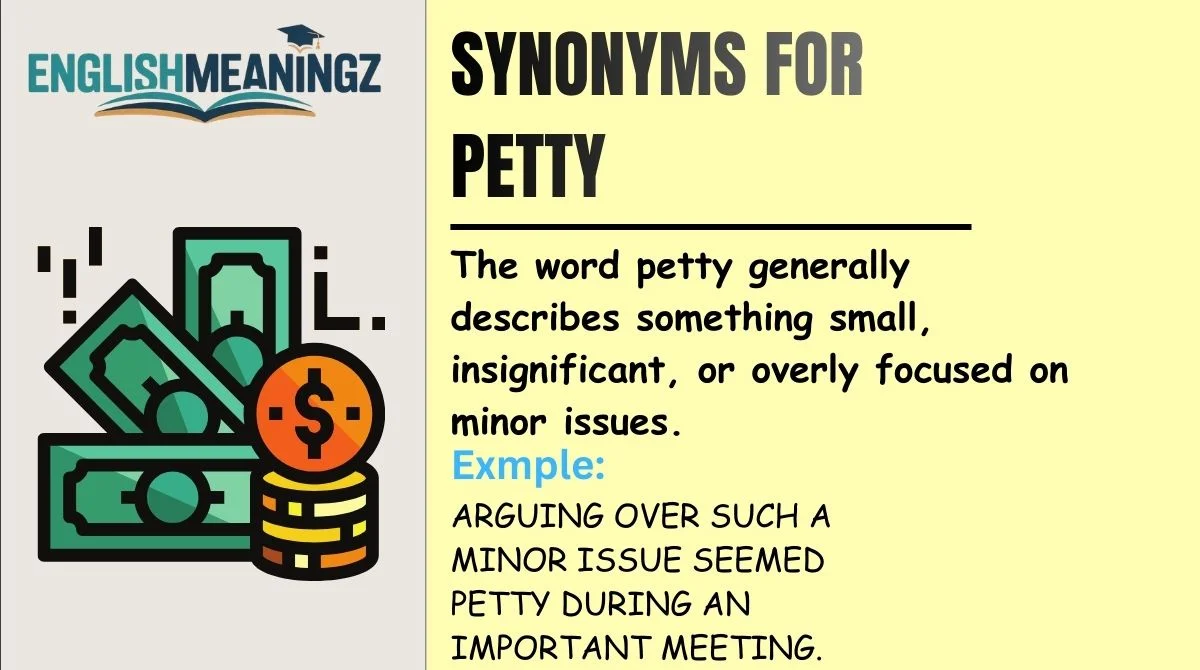
The word petty generally describes something small, insignificant, or overly focused on minor issues. It often carries a slightly negative tone because it implies unnecessary concern with trivial matters.
In everyday conversation, petty behavior may refer to someone holding grudges over small problems. In academic or professional contexts, it can refer to minor details that lack importance.
The term originates from the Old French word petit, meaning small. Over time, it evolved to describe not only physical smallness but also insignificant importance or narrow-minded attitudes.
Key characteristics of the word “petty”
- Concerned with trivial matters
- Small in importance
- Narrow-minded or spiteful in behavior
- Often used to criticize unnecessary arguments or complaints
For example:
Arguing over such a minor issue seemed petty during an important meeting.
Because the word can apply to different contexts—behavior, importance, authority, or finances—many synonyms exist that capture specific shades of meaning.
15 Synonyms Grouped by Context
General Use Synonyms
1. Trivial
Meaning: Something of little value or importance.
Context: Often used when describing issues or details that do not deserve serious attention.
Example Sentence:
The committee refused to delay the project because of trivial concerns.
2. Minor
Meaning: Small or less significant in comparison with something larger.
Context: Common in both formal and informal writing when discussing small issues or limited impact.
Example Sentence:
The report identified only minor errors in the data analysis.
3. Insignificant
Meaning: Lacking importance or influence.
Context: Used in academic and professional settings when describing something that has little measurable effect.
Example Sentence:
The difference between the two results was statistically insignificant.
4. Small-minded
Meaning: Having narrow or limited thinking, often focused on unimportant issues.
Context: Often used to criticize attitudes or behavior rather than events.
Example Sentence:
Rejecting the proposal for personal reasons appeared small-minded.
Formal and Academic Writing Synonyms
5. Trifling
Meaning: Extremely small or unimportant.
Context: Common in formal writing and literature.
Example Sentence:
The researcher dismissed the criticism as trifling and continued the experiment.
6. Inconsequential
Meaning: Not important enough to produce meaningful results.
Context: Frequently used in academic discussions, especially when evaluating outcomes.
Example Sentence:
The slight variation in temperature was inconsequential to the overall findings.
7. Marginal
Meaning: Slight or minimal in importance or effect.
Context: Common in research papers and analytical writing.
Example Sentence:
The new policy produced only marginal improvements in productivity.
8. Paltry
Meaning: So small or inadequate that it appears almost worthless.
Context: Often used to criticize low amounts or weak results.
Example Sentence:
The organization offered a paltry reward for valuable information.
Informal Usage Synonyms
9. Picky
Meaning: Overly concerned with small details.
Context: Often used to describe people who complain about minor imperfections.
Example Sentence:
He can be picky about grammar when reviewing documents.
10. Nitpicky
Meaning: Excessively critical about tiny details.
Context: Informal but common in everyday conversations.
Example Sentence:
The editor was nitpicky about punctuation in the manuscript.
11. Childish
Meaning: Immature behavior focused on small grievances.
Context: Used to describe emotional reactions that lack maturity.
Example Sentence:
Refusing to cooperate because of a disagreement seemed childish.
Technical or Subject-Specific Synonyms
12. Subordinate
Meaning: Lower in rank or importance.
Context: Used in organizational, administrative, or hierarchical discussions.
Example Sentence:
The manager delegated subordinate tasks to junior staff members.
13. Secondary
Meaning: Less important than the primary issue.
Context: Often used in analytical writing and research discussions.
Example Sentence:
Cost became a secondary concern compared with safety.
14. Peripheral
Meaning: Related to the edges rather than the central issue.
Context: Common in academic writing when discussing topics of limited relevance.
Example Sentence:
The study excluded peripheral variables that did not affect the main outcome.
15. Meager
Meaning: Insufficient or extremely small in quantity.
Context: Often used when discussing limited resources or results.
Example Sentence:
The team had only meager funding to complete the project.
Word Intensity and Tone Comparison Table
Different synonyms for petty vary in tone and formality. Understanding these differences helps writers choose the most appropriate word.
| Word | Formal Level | Emotional Strength | Typical Use |
|---|---|---|---|
| Minor | Neutral | Low | General discussion |
| Trivial | Medium | Low | Academic critique |
| Insignificant | High | Low | Research writing |
| Trifling | High | Medium | Formal literature |
| Marginal | High | Low | Data analysis |
| Paltry | Medium | High | Criticism |
| Picky | Informal | Medium | Personal description |
| Nitpicky | Informal | Medium | Behavioral criticism |
| Small-minded | Medium | High | Character judgment |
| Peripheral | High | Low | Academic contexts |
This comparison shows that not every synonym fits every situation, which is why context matters.
Common Mistakes When Using These Synonyms
Writers sometimes misuse synonyms because they assume all alternatives have identical meanings. However, subtle differences can change the tone of a sentence.
Mistake 1: Using informal words in academic writing
Incorrect:
The researcher made a nitpicky observation about the methodology.
Correct:
The researcher made a trivial observation about the methodology.
Mistake 2: Confusing “minor” with “insignificant”
Incorrect:
The disease caused insignificant injuries.
Correct:
The disease caused minor injuries.
Explanation:
“Minor” refers to small severity, while “insignificant” refers to lack of importance.
Mistake 3: Overusing strong negative synonyms
Incorrect:
The teacher rejected the student’s paltry effort.
Correct:
The teacher rejected the student’s incomplete assignment.
Explanation:
“Paltry” may sound unnecessarily harsh in academic contexts.
Synonyms in Academic Writing
Example Paragraph 1
Many conflicts within organizations arise from trivial disagreements rather than serious policy issues. Employees sometimes focus on minor procedural details instead of addressing the broader objectives of the institution. As a result, decision-making becomes inefficient and productivity declines.
Example Paragraph 2
In statistical research, analysts must distinguish between meaningful findings and marginal variations that do not significantly influence results. Small fluctuations in data may appear noteworthy at first glance, but closer analysis often reveals that they are inconsequential to the overall conclusions.
IELTS and Exam Writing Tips
Vocabulary variety is one of the criteria used to evaluate writing skills in many academic exams. However, replacing words with synonyms should be done carefully.
1. Avoid unnecessary repetition
If the word petty appears multiple times in an essay, consider alternatives such as trivial, minor, or insignificant.
Example:
Original:
The conflict started because of a petty disagreement. The petty issue continued for weeks.
Improved:
The conflict started because of a trivial disagreement. The minor issue continued for weeks.
2. Maintain clarity
Replacing a word with an unfamiliar synonym may confuse readers.
Example:
Clear:
The disagreement was minor.
Confusing:
The disagreement was peripheral.
“Peripheral” works only in specific contexts.
3. Do not replace technical terms
In research writing, some words should remain unchanged because they have precise meanings.
Example:
“Minor surgery” should not be replaced with “trivial surgery.”
4. Focus on natural language
Examiners prefer natural vocabulary rather than forced synonym usage. Always prioritize clarity over complexity.
Similar Words vs True Synonyms
Many words appear similar to petty but are not exact replacements. Understanding the differences prevents mistakes.
Petty vs Minor
- Petty: Often refers to small issues combined with negative behavior.
- Minor: Simply means small in scale.
Example:
His petty complaints annoyed everyone.
The project required only minor adjustments.
Petty vs Trivial
- Petty: Focuses on attitude or behavior.
- Trivial: Focuses on importance or significance.
Petty vs Small-minded
- Petty: Concerned with minor matters.
- Small-minded: Describes narrow or intolerant thinking.
Petty vs Marginal
- Petty: Often emotional or behavioral.
- Marginal: Analytical and often used in statistics or research.
Recognizing these differences helps writers select words that match the intended meaning.
Practice Sentences
Choose the correct synonym for petty to complete each sentence.
- The committee ignored the ______ complaints and focused on major issues.
- The editor was extremely ______ about punctuation mistakes.
- The difference between the two measurements was statistically ______.
- Their argument started over a ______ misunderstanding.
- The company received only ______ funding for the project.
Suggested answers:
- trivial
- nitpicky
- insignificant
- minor
- meager
Practicing with sentences like these strengthens vocabulary retention and helps writers apply synonyms correctly.
Frequently Asked Questions
What is the closest synonym for petty?
The closest synonym is trivial, because both words describe something that lacks importance or significance.
Can “minor” replace “petty” in all situations?
No. While “minor” can sometimes replace “petty,” it does not capture the negative emotional tone often associated with petty behavior.
Which synonym is best for academic writing?
Words like trivial, insignificant, marginal, and inconsequential are more suitable for academic contexts.
Is “nitpicky” a formal synonym for petty?
No. “Nitpicky” is informal and best used in casual conversation rather than professional or academic writing.
Why is learning synonyms important for IELTS writing?
A wider vocabulary demonstrates lexical range, which is one of the key criteria used to score writing tasks.
Conclusion
Expanding vocabulary is one of the most effective ways to improve writing quality. Instead of repeating the word petty, writers can choose from a wide range of alternatives such as trivial, minor, insignificant, marginal, trifling, and paltry, depending on the context.
Understanding the subtle differences between synonyms helps students, bloggers, and professionals communicate ideas more accurately and persuasively.
In academic writing, selecting the correct word not only improves clarity but also demonstrates linguistic precision.
By practicing with these synonyms and applying them in essays, reports, and conversations, writers can develop a stronger vocabulary and produce more engaging, sophisticated writing.