Understanding opposites is one of the fastest ways to sharpen your vocabulary and elevate your writing. When you know not just what a word means—but also what it does not mean—you gain precision, flexibility, and clarity in communication.
Opposites, or antonyms, allow writers to create contrast, emphasize ideas, and avoid repetition. This is especially valuable in academic essays, professional reports, and persuasive writing where nuance matters.
A strong command of antonyms also improves comprehension, making it easier to interpret tone and intent in complex texts.
In this guide, we’ll break down the meaning of “converse” and explore 21 powerful antonyms you can use to upgrade your writing in 2026.
What Does “Converse” Mean?
The word converse has multiple meanings depending on context, but the most common uses are:
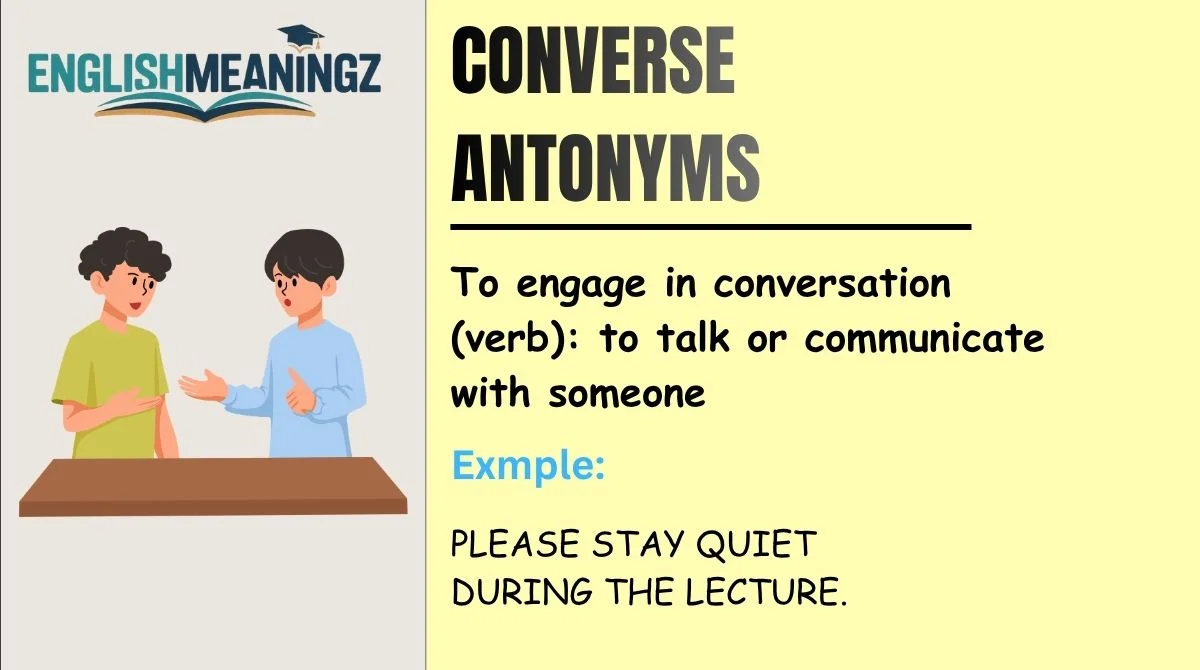
- To engage in conversation (verb): to talk or communicate with someone
- Opposite or reversed relationship (adjective/noun): used in logic or mathematics to describe reversed conditions
Tone Explanation
“Converse” generally carries a neutral to formal tone, often used in academic, intellectual, or polite communication settings.
Emotional or Action Intensity
- As a verb: calm, social, and interactive
- As a concept: analytical and logical
Because of its dual meaning (communication vs. reversal), its antonyms vary depending on context—either focusing on silence or agreement/consistency.
21 Best Antonyms for “Converse”
1. Silence
Meaning: Complete absence of sound or speech
Tone: Neutral
Example: The room fell into silence after the announcement.
Why Opposite: Converse requires speaking; silence eliminates it entirely.
2. Mute
Meaning: Unable or unwilling to speak
Tone: Neutral / Medical
Example: He remained mute during the entire discussion.
Why Opposite: Converse implies verbal exchange; mute removes that ability.
3. Quiet
Meaning: Making little or no noise
Tone: Informal
Example: Please stay quiet during the lecture.
Why Opposite: Quietness limits or prevents conversation.
4. Withhold
Meaning: To hold back information or speech
Tone: Formal
Example: She chose to withhold her opinion.
Why Opposite: Converse involves sharing; withholding avoids it.
5. Ignore
Meaning: To deliberately pay no attention
Tone: Neutral
Example: He ignored her attempts to talk.
Why Opposite: Conversation requires engagement; ignoring breaks it.
6. Shun
Meaning: To avoid deliberately
Tone: Formal
Example: He shunned social interaction.
Why Opposite: Converse involves interaction; shunning avoids it.
7. Withdraw
Meaning: To remove oneself from interaction
Tone: Neutral
Example: She withdrew from the conversation early.
Why Opposite: Converse is active participation; withdrawal is the opposite.
8. Disconnect
Meaning: To break communication
Tone: Technical / Neutral
Example: The call disconnected suddenly.
Why Opposite: Converse depends on connection.
9. Repress
Meaning: To hold back expression
Tone: Formal / Psychological
Example: He repressed his thoughts instead of sharing them.
Why Opposite: Converse expresses ideas; repression hides them.
10. Conceal
Meaning: To hide something intentionally
Tone: Formal
Example: She concealed her true feelings.
Why Opposite: Conversation reveals; concealment hides.
11. Suppress
Meaning: To forcibly prevent expression
Tone: Formal
Example: The government suppressed public discussion.
Why Opposite: Converse promotes dialogue; suppression stops it.
12. Avoid
Meaning: To keep away from
Tone: Neutral
Example: He avoided talking about the issue.
Why Opposite: Converse engages; avoidance disengages.
13. Neglect
Meaning: To ignore or disregard
Tone: Neutral
Example: She neglected to respond.
Why Opposite: Converse requires attention and response.
14. Disagree
Meaning: To have a different opinion
Tone: Neutral
Example: They disagree on the topic.
Why Opposite: In logical sense, converse implies relational pairing; disagreement breaks alignment.
15. Contradict
Meaning: To assert the opposite
Tone: Formal
Example: His statement contradicts earlier claims.
Why Opposite: Converse suggests reciprocal relation; contradiction opposes it.
16. Oppose
Meaning: To resist or go against
Tone: Formal
Example: She opposed the proposal.
Why Opposite: Converse may imply exchange; opposition resists it.
17. Refuse
Meaning: To decline communication or participation
Tone: Neutral
Example: He refused to answer questions.
Why Opposite: Converse requires willingness.
18. Isolate
Meaning: To separate from others
Tone: Formal
Example: The patient was isolated from visitors.
Why Opposite: Converse depends on interaction; isolation prevents it.
19. Detach
Meaning: To separate emotionally or physically
Tone: Neutral
Example: She detached from the group discussion.
Why Opposite: Converse involves connection; detachment removes it.
20. Dismiss
Meaning: To reject or disregard
Tone: Formal
Example: He dismissed her attempt to speak.
Why Opposite: Converse values exchange; dismissal shuts it down.
21. Block
Meaning: To prevent communication
Tone: Informal / Digital
Example: She blocked him on social media.
Why Opposite: Converse enables communication; blocking stops it entirely.
Strong vs Mild Opposites
Not all antonyms carry the same intensity. Some completely eliminate conversation, while others only reduce or weaken it.
Strong Opposites
- Silence
- Mute
- Suppress
- Block
- Isolate
These words represent total absence or prevention of communication.
Mild Opposites
- Quiet
- Avoid
- Withdraw
- Detach
These indicate reduced interaction, not complete absence.
Why This Matters
Choosing the right intensity helps match your message. For example:
- “He stayed quiet” is softer than
- “He suppressed all communication”
Precision improves clarity and tone.
Context-Based Opposites
The antonym of “converse” depends heavily on context.
Social Context
- Converse → Silence, Ignore
Used when discussing human interaction.
Emotional Context
- Converse → Repress, Conceal
Used when dealing with feelings or thoughts.
Logical/Academic Context
- Converse → Contradict, Oppose
Used in arguments, reasoning, or analysis.
Digital Context
- Converse → Block, Disconnect
Used in online communication.
Understanding context ensures accurate word choice and prevents miscommunication.
Common Mistakes When Using Opposites
1. Using Weak Opposites
Incorrect: “Quiet” as a full opposite of “converse”
Correct: Use “silence” for stronger contrast
2. Confusing Logical Meaning
Incorrect: Using “disagree” in casual conversation context
Correct: Use it only in argument-based scenarios
3. Overusing Formal Words
Incorrect: “He suppressed talking at lunch”
Correct: “He stayed silent at lunch”
4. Ignoring Tone
Mismatch between context and word choice can confuse readers.
5. Using Non-Opposites
Words like “listen” are not true antonyms—they are part of communication, not its opposite.
Sentence Transformation Examples
Original Sentence 1
She likes to converse with her colleagues.
Rewritten: She prefers to remain silent around her colleagues.
Original Sentence 2
They conversed for hours about the topic.
Rewritten: They avoided discussing the topic entirely.
Original Sentence 3
He often converses with strangers.
Rewritten: He usually ignores strangers.
Original Sentence 4
We need to converse openly.
Rewritten: We should not suppress our thoughts.
Original Sentence 5
She enjoys conversing online.
Rewritten: She has blocked most online interactions.
FAQs
What is the simplest antonym of “converse”?
The simplest and most direct antonym is silence, as it completely removes communication.
Are all antonyms of “converse” about speaking?
No. Some relate to logic (contradict) or emotion (repress) depending on context.
Can “ignore” be an antonym of “converse”?
Yes, because ignoring prevents interaction, which is essential for conversation.
Is “quiet” a strong opposite?
No, it is a mild antonym. It reduces communication but doesn’t eliminate it entirely.
What is the strongest antonym?
Words like mute, silence, suppress, and block are considered strong opposites.
How do I choose the right antonym?
Focus on context, tone, and intensity of your sentence.
Why is learning antonyms important?
It improves clarity, enhances vocabulary, and strengthens both writing and comprehension.
Conclusion
Mastering antonyms like those for “converse” gives you a powerful advantage in communication. Whether you’re writing academically, professionally, or creatively, understanding the full spectrum—from mild disengagement to complete silence—helps you choose words with precision and intent.
Instead of relying on basic vocabulary, using context-aware opposites allows you to express subtle differences in tone, emotion, and meaning. In 2026, strong communication isn’t just about knowing words—it’s about knowing their contrasts.
Build this habit, and your writing will instantly become sharper, clearer, and more impactful.