Understanding opposites is one of the fastest ways to sharpen your writing. When you know not just what a word means—but what it doesn’t mean—you gain control over tone, precision, and clarity.
Antonyms help you avoid vague language, add contrast, and make your arguments more compelling.
In academic and professional communication, this becomes even more important. Whether you’re writing essays, reports, or business emails, choosing the right opposite word can completely change how your message is perceived.
A well-placed antonym can turn a weak sentence into a persuasive one, or a neutral statement into a powerful contrast.
This article explores 22 compatible antonyms, breaking them down with meanings, tone, examples, and clear reasoning—so you can use them naturally and effectively.
What Does “Compatible” Mean?
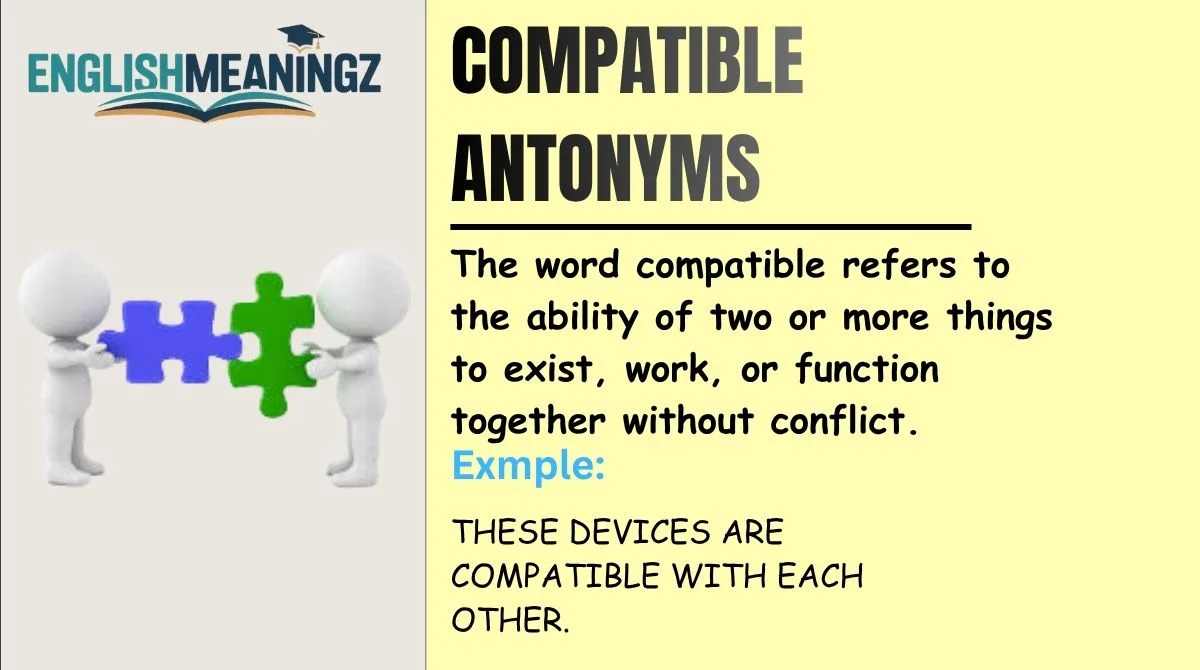
The word compatible refers to the ability of two or more things to exist, work, or function together without conflict.
- Core meaning: Able to coexist harmoniously
- Tone: Neutral to positive
- Intensity: Moderate (suggests ease, agreement, or smooth interaction)
It can apply to relationships, technology, personalities, systems, or ideas.
- Example: These devices are compatible with each other.
Emotionally, “compatible” implies agreement, harmony, and alignment. Its opposites, therefore, revolve around conflict, mismatch, resistance, or inability to function together.
22 Best Antonyms for “Compatible”
Incompatible
- Meaning: Unable to function or exist together
- Tone: Formal / Academic
- Example: The software is incompatible with older systems.
- Why opposite: Direct contradiction of compatibility
Inconsistent
- Meaning: Not in agreement or harmony
- Tone: Formal
- Example: His actions are inconsistent with his words.
- Why opposite: Lacks alignment
Conflicting
- Meaning: In opposition or disagreement
- Tone: Academic
- Example: The reports contain conflicting information.
- Why opposite: Indicates direct clash
Contradictory
- Meaning: Mutually opposed or logically inconsistent
- Tone: Academic
- Example: Her statements were contradictory.
- Why opposite: Cannot coexist logically
Opposing
- Meaning: Acting against something
- Tone: Neutral
- Example: They held opposing views.
- Why opposite: Active resistance
Disagreeable
- Meaning: Not pleasant or acceptable
- Tone: Emotional
- Example: He found the proposal disagreeable.
- Why opposite: Emotional incompatibility
Mismatched
- Meaning: Poorly paired or unsuitable together
- Tone: Informal
- Example: The colors are mismatched.
- Why opposite: Lack of harmony
Clashing
- Meaning: In conflict or sharp contrast
- Tone: Informal / Emotional
- Example: Their personalities are clashing.
- Why opposite: Strong disagreement
Discordant
- Meaning: Lacking harmony
- Tone: Academic
- Example: The music sounded discordant.
- Why opposite: Absence of unity
Divergent
- Meaning: Moving in different directions
- Tone: Academic
- Example: They have divergent opinions.
- Why opposite: No alignment
Irreconcilable
- Meaning: Impossible to bring into agreement
- Tone: Formal
- Example: They had irreconcilable differences.
- Why opposite: Cannot be made compatible
Uncooperative
- Meaning: Not willing to work together
- Tone: Neutral
- Example: The team was uncooperative.
- Why opposite: Blocks compatibility
Resistant
- Meaning: Opposing or refusing change
- Tone: Neutral
- Example: He is resistant to new ideas.
- Why opposite: Rejects alignment
Unaligned
- Meaning: Not in agreement or position
- Tone: Academic
- Example: Their goals are unaligned.
- Why opposite: Lack of coordination
Hostile
- Meaning: Unfriendly or antagonistic
- Tone: Emotional
- Example: The environment was hostile.
- Why opposite: Opposes harmony
Adverse
- Meaning: Harmful or unfavorable
- Tone: Formal
- Example: They faced adverse conditions.
- Why opposite: Works against compatibility
Unfit
- Meaning: Not suitable for a purpose
- Tone: Neutral
- Example: This tool is unfit for the job.
- Why opposite: Lacks suitability
Inharmonious
- Meaning: Not forming a pleasing whole
- Tone: Academic
- Example: The design feels inharmonious.
- Why opposite: No balance or unity
Disconnected
- Meaning: Not linked or related
- Tone: Neutral
- Example: The ideas seem disconnected.
- Why opposite: No relationship
Unmatched
- Meaning: Not equal or corresponding
- Tone: Neutral
- Example: Their skills are unmatched.
- Why opposite: Lack of pairing
Frictional
- Meaning: Causing conflict or tension
- Tone: Formal
- Example: There was a frictional relationship.
- Why opposite: Produces resistance
At odds
- Meaning: In disagreement
- Tone: Informal
- Example: They are at odds over the issue.
- Why opposite: Clear conflict
Strong vs Mild Opposites
Not all antonyms carry the same intensity. Some are subtle, while others indicate complete breakdown.
Mild opposites
- Unaligned
- Inconsistent
- Divergent
These suggest partial disagreement or misalignment.
Moderate opposites
- Conflicting
- Mismatched
- Disconnected
These imply noticeable incompatibility.
Strong opposites
- Incompatible
- Irreconcilable
- Hostile
These indicate total inability to function together.
Understanding this scale helps you choose the right level of contrast depending on your message.
Context-Based Opposites
Antonyms are not always fixed—they depend on context.
- In technology: compatible → incompatible
- In relationships: compatible → clashing / irreconcilable
- In ideas: compatible → contradictory / divergent
- In design: compatible → mismatched / discordant
Example:
Their personalities are incompatible vs Their styles are mismatched
Choosing the right antonym depends on what exactly is failing to align.
Common Mistakes When Using Opposites
Using weak opposites
❌ Not good as an opposite of compatible
✔ Use incompatible or conflicting
Ignoring context
❌ Hostile software systems
✔ Incompatible software systems
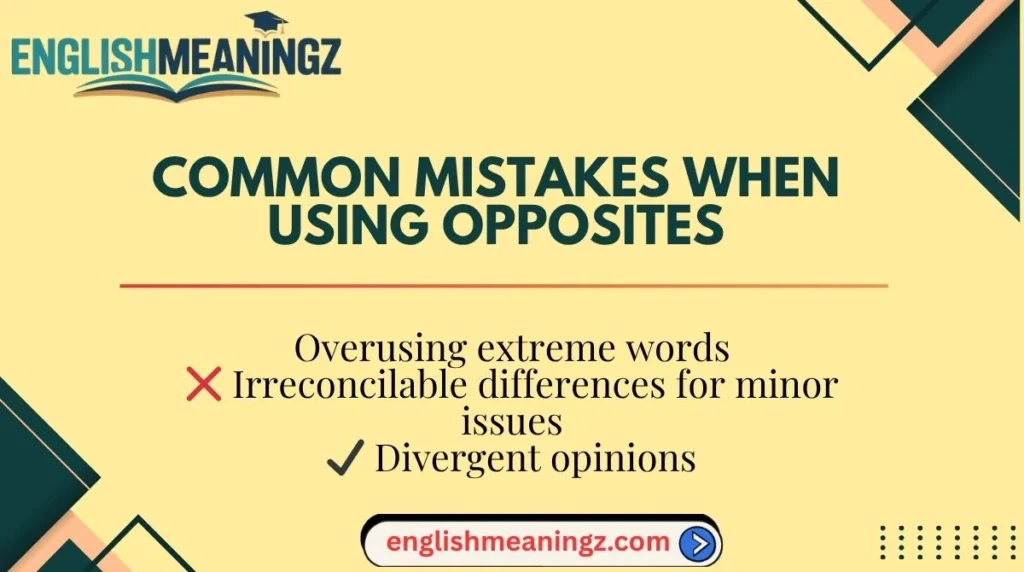
Overusing extreme words
❌ Irreconcilable differences for minor issues
✔ Divergent opinions
Confusing tone
❌ Using informal antonyms in academic writing
✔ Use contradictory instead of at odds
Sentence Transformation Examples
Original: The two systems are compatible.
Rewritten: The two systems are incompatible.
Original: Their ideas are compatible.
Rewritten: Their ideas are contradictory.
Original: We have compatible goals.
Rewritten: We have divergent goals.
Original: The design elements are compatible.
Rewritten: The design elements are mismatched.
Original: They are compatible as partners.
Rewritten: They are irreconcilable as partners.
FAQs
What is the exact opposite of compatible?
The most direct antonym is incompatible, as it completely reverses the meaning.
Are all antonyms interchangeable?
No. Each antonym carries a different tone and intensity depending on context.
Which antonym is best for formal writing?
Words like contradictory, inconsistent, and irreconcilable work best in academic or formal settings.
Can “different” be an antonym of compatible?
Not exactly. “Different” doesn’t always imply conflict or inability to coexist.
What is a mild opposite of compatible?
Words like unaligned or divergent offer softer contrast.
What antonym fits relationships best?
Clashing, irreconcilable, or hostile, depending on intensity.
How do I choose the right antonym?
Focus on context, tone, and how strong you want the contrast to be.
Conclusion
Mastering antonyms like those for “compatible” gives you more than just vocabulary—it gives you control over meaning. Whether you’re writing academically, professionally, or creatively, the right opposite word can sharpen your message, clarify your intent, and add persuasive power.
From mild contrasts like unaligned to strong opposites like irreconcilable, each word serves a purpose. The key is understanding not just the definition, but the tone and context behind it.
Use these 22 compatible antonyms strategically, and your writing will immediately become more precise, dynamic, and impactful.