Understanding opposites is one of the fastest ways to sharpen your writing. When you know not only what a word means but also what it doesn’t mean, you gain precision, clarity, and flexibility.
This is especially useful in both academic essays and professional communication, where word choice directly impacts how your message is perceived.
Writers who actively use antonyms develop stronger contrast, clearer arguments, and more engaging narratives.
Instead of repeating the same expressions, they can shift tone, adjust meaning, and present ideas more effectively.
In this guide, you’ll explore the best antonyms of “recount,” understand their nuances, and learn how to use them correctly in real contexts.
What Does “Recount” Mean?
Definition:
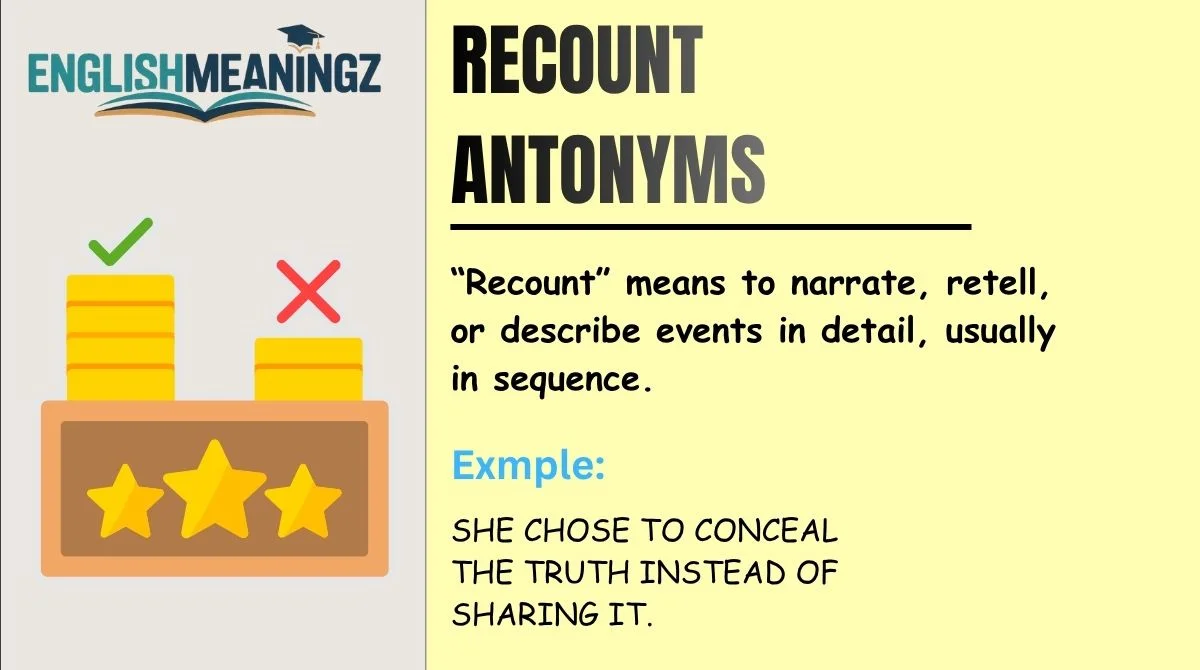
“Recount” means to narrate, retell, or describe events in detail, usually in sequence.
Tone Explanation:
The word is generally neutral to formal. It is commonly used in academic writing, storytelling, journalism, and reports.
Emotional or Action Intensity:
“Recount” suggests deliberate communication. It implies that someone is actively sharing information, often with clarity and structure. The intensity can vary depending on context—ranging from casual storytelling to detailed reporting.
14 Best Antonyms for “Recount”
1. Conceal
Meaning: To hide or keep something secret
Tone: Formal
Example: She chose to conceal the truth instead of sharing it.
Why It’s Opposite: Instead of telling details, it involves deliberately hiding them.
2. Suppress
Meaning: To prevent information from being revealed
Tone: Formal / Academic
Example: The report was suppressed to avoid public reaction.
Why It’s Opposite: “Recount” reveals information, while “suppress” blocks it.
3. Withhold
Meaning: To hold back information
Tone: Formal
Example: He decided to withhold key details from the discussion.
Why It’s Opposite: It avoids sharing information rather than describing it.
4. Omit
Meaning: To leave something out
Tone: Academic
Example: Important facts were omitted from the summary.
Why It’s Opposite: “Recount” includes details; “omit” excludes them.
5. Ignore
Meaning: To deliberately pay no attention
Tone: Neutral
Example: She ignored the incident completely.
Why It’s Opposite: Instead of narrating events, it dismisses them entirely.
6. Deny
Meaning: To refuse to admit or acknowledge
Tone: Formal / Emotional
Example: He denied ever witnessing the event.
Why It’s Opposite: It contradicts recounting by rejecting the truth.
7. Forget
Meaning: To fail to remember
Tone: Informal / Neutral
Example: I forgot the details of what happened.
Why It’s Opposite: Recounting requires memory; forgetting eliminates it.
8. Distort
Meaning: To twist or misrepresent facts
Tone: Formal
Example: The story was distorted beyond recognition.
Why It’s Opposite: Instead of accurately telling events, it alters them.
9. Silence
Meaning: To prevent someone from speaking
Tone: Formal
Example: The witness was silenced before sharing the story.
Why It’s Opposite: It blocks recounting entirely.
10. Mute
Meaning: To reduce or remove expression
Tone: Neutral
Example: His response was muted and unclear.
Why It’s Opposite: It limits communication rather than expressing it.
11. Erase
Meaning: To remove completely
Tone: Neutral
Example: The records were erased from the system.
Why It’s Opposite: Recounting preserves events; erasing eliminates them.
12. Conceive (internally, not express)
Meaning: To form an idea internally
Tone: Academic
Example: She conceived the idea but never shared it.
Why It’s Opposite: It remains internal rather than being narrated.
13. Silence (self-imposed)
Meaning: Choosing not to speak
Tone: Emotional
Example: He remained silent about the incident.
Why It’s Opposite: It avoids retelling any events.
14. Dismiss
Meaning: To treat something as unimportant
Tone: Formal
Example: The issue was dismissed without discussion.
Why It’s Opposite: Instead of describing, it minimizes or rejects the topic.
Strong vs Mild Opposites
Not all antonyms carry the same intensity. Understanding this helps you choose the right word.
Strong Opposites:
Words like suppress, erase, and silence completely block communication. They represent total opposition to recounting.
Moderate Opposites:
Words like withhold and omit partially oppose recounting by limiting information rather than eliminating it.
Mild Opposites:
Words like ignore or forget suggest a passive lack of recounting rather than intentional avoidance.
Choosing the right intensity depends on your context. Academic writing often prefers moderate or strong opposites, while casual communication may use milder ones.
Context-Based Opposites
Antonyms change depending on the situation.
1. Legal Context:
- Recount → testify
- Opposite → deny / suppress
2. Academic Writing:
- Recount → describe
- Opposite → omit / ignore
3. Storytelling:
- Recount → narrate
- Opposite → conceal / distort
4. Everyday Conversation:
- Recount → tell
- Opposite → forget / ignore
This shows that antonyms are not fixed—they depend heavily on how the word is used.
Common Mistakes When Using Opposites
1. Confusing omission with denial
Incorrect: He omitted the truth.
Correct: He denied the truth.
(Omission is leaving out; denial is rejecting.)
2. Using “ignore” instead of “conceal”
Incorrect: She ignored the secret.
Correct: She concealed the secret.
3. Misusing “distort” as a simple opposite
Distort doesn’t remove information—it changes it.
4. Overusing “forget” in formal writing
“Forget” is too informal for academic or professional contexts.
5. Treating all antonyms as equal
Each word carries a different tone and intensity. Choosing the wrong one can weaken your message.
Sentence Transformation Examples
Original: He recounted the entire incident in detail.
Rewritten: He concealed the entire incident.
Original: She recounted her experience clearly.
Rewritten: She withheld key parts of her experience.
Original: They recounted the story to the audience.
Rewritten: They omitted the story from the discussion.
Original: The witness recounted what happened.
Rewritten: The witness denied what happened.
Original: He recounted every detail of the event.
Rewritten: He ignored the details of the event.
FAQs
What is the simplest antonym of “recount”?
The simplest antonym is “ignore,” as it represents not addressing or mentioning something at all.
Is “forget” a true opposite of “recount”?
Yes, but it is a mild and unintentional opposite, unlike stronger words like “suppress.”
Which antonym is best for academic writing?
“Omit” and “withhold” are most suitable due to their formal tone.
Can “deny” replace “recount”?
Yes, when the context involves rejecting or contradicting an event.
Is “distort” a direct opposite?
Not exactly. It changes the story rather than eliminating it, making it a partial opposite.
Why are there multiple antonyms for one word?
Because opposites vary by context, tone, and intensity.
How can I improve my vocabulary using antonyms?
Practice rewriting sentences and using different opposites based on context.
Conclusion
Mastering antonyms of “recount” gives you more than just vocabulary—it gives you control over meaning. Whether you want to hide information, limit details, or reject a narrative entirely, choosing the right opposite word allows you to communicate with precision.
By understanding tone, intensity, and context, you can elevate both your academic and professional writing.
Instead of relying on basic expressions, you’ll be able to craft clearer, sharper, and more impactful sentences.