Understanding opposites is one of the fastest ways to deepen your command of language. When you learn antonyms, you don’t just expand your vocabulary—you sharpen your ability to express contrast, nuance, and precision in both writing and speech.
This is especially useful in academic essays, professional communication, and content creation where clarity and tone matter.
Writers who actively use antonyms can frame arguments more effectively, highlight differences, and avoid repetition.
In professional environments, using the right opposite word can shift meaning dramatically—turning a vague sentence into a precise and impactful one.
This guide explores 23 carefully selected antonyms for creative, along with meanings, tone labels, examples, and explanations—so you can use them confidently in real contexts.
What Does “Creative” Mean?
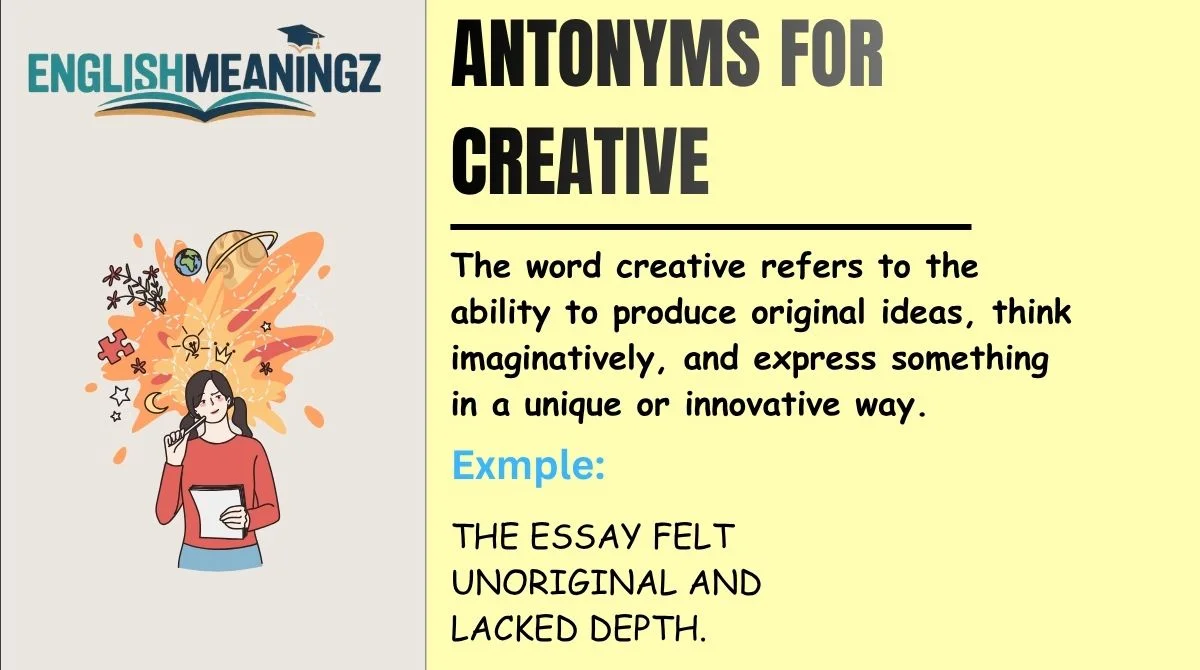
The word creative refers to the ability to produce original ideas, think imaginatively, and express something in a unique or innovative way.
Tone Explanation:
Creative carries a positive tone. It suggests originality, flexibility, and intelligence. It is often associated with artists, writers, designers, and problem-solvers.
Emotional or Action Intensity:
The word implies active mental engagement—generating ideas, exploring possibilities, and breaking conventional patterns. It sits high on the scale of innovation and originality.
23 Best Antonyms for “Creative”
1. Unimaginative
- Meaning: Lacking originality or new ideas
- Tone: Formal
- Example: His presentation was dull and completely unimaginative.
- Why Opposite: It directly contrasts with the imaginative aspect of creativity.
2. Conventional
- Meaning: Following traditional or standard methods
- Tone: Academic
- Example: She preferred a conventional approach to problem-solving.
- Why Opposite: Creativity breaks norms, while conventional thinking follows them.
3. Unoriginal
- Meaning: Not fresh or new; copied or repetitive
- Tone: Formal
- Example: The essay felt unoriginal and lacked depth.
- Why Opposite: Creativity thrives on originality; this removes it.
4. Derivative
- Meaning: Imitative; based on someone else’s work
- Tone: Academic
- Example: The film was criticized for being derivative.
- Why Opposite: Creativity is independent, while derivative work depends on others.
5. Predictable
- Meaning: Easy to anticipate; lacking surprise
- Tone: Neutral
- Example: The plot was predictable from the beginning.
- Why Opposite: Creativity often involves unexpected ideas.
6. Routine
- Meaning: Done regularly without variation
- Tone: Neutral
- Example: His job became routine and uninspiring.
- Why Opposite: Creativity requires variation and novelty.
7. Mechanical
- Meaning: Done without thought or feeling
- Tone: Formal
- Example: She gave a mechanical response without thinking.
- Why Opposite: Creativity involves thoughtful engagement.
8. Boring
- Meaning: Not interesting or engaging
- Tone: Informal
- Example: The lecture was boring and repetitive.
- Why Opposite: Creative work usually captures attention.
9. Dull
- Meaning: Lacking excitement or interest
- Tone: Neutral
- Example: The design looked dull and lifeless.
- Why Opposite: Creativity adds vibrancy and energy.
10. Rigid
- Meaning: Not flexible in thinking
- Tone: Formal
- Example: His rigid mindset limited innovation.
- Why Opposite: Creativity requires flexibility.
11. Stale
- Meaning: Old and no longer fresh
- Tone: Informal
- Example: The ideas felt stale and outdated.
- Why Opposite: Creativity depends on freshness.
12. Uninspired
- Meaning: Lacking imagination or enthusiasm
- Tone: Formal
- Example: The project felt uninspired and weak.
- Why Opposite: Creativity is driven by inspiration.
13. Formulaic
- Meaning: Following a fixed formula
- Tone: Academic
- Example: The movie was too formulaic.
- Why Opposite: Creativity breaks formulas.
14. Static
- Meaning: Not changing or evolving
- Tone: Formal
- Example: The design remained static over the years.
- Why Opposite: Creativity involves growth and change.
15. Uninventive
- Meaning: Not resourceful or imaginative
- Tone: Formal
- Example: The solution was uninventive and basic.
- Why Opposite: Creativity requires inventiveness.
16. Imitative
- Meaning: Copying others
- Tone: Academic
- Example: The artwork seemed imitative.
- Why Opposite: Creativity emphasizes originality.
17. Lifeless
- Meaning: Lacking energy or vitality
- Tone: Emotional
- Example: The performance was lifeless.
- Why Opposite: Creativity brings life and energy.
18. Tedious
- Meaning: Long and tiresome
- Tone: Formal
- Example: The process was tedious and repetitive.
- Why Opposite: Creativity makes things engaging.
19. Conservative
- Meaning: Resistant to change
- Tone: Academic
- Example: His conservative thinking blocked innovation.
- Why Opposite: Creativity embraces change.
20. Plain
- Meaning: Simple and lacking decoration
- Tone: Neutral
- Example: The design was plain and unremarkable.
- Why Opposite: Creativity adds uniqueness.
21. Mundane
- Meaning: Ordinary and unexciting
- Tone: Formal
- Example: Daily tasks felt mundane.
- Why Opposite: Creativity makes things extraordinary.
22. Unremarkable
- Meaning: Not worthy of attention
- Tone: Formal
- Example: The idea was unremarkable.
- Why Opposite: Creative ideas stand out.
23. Repetitive
- Meaning: Repeating the same thing
- Tone: Neutral
- Example: The pattern was repetitive.
- Why Opposite: Creativity values variety.
Strong vs Mild Opposites
Not all antonyms carry the same intensity. Some strongly oppose creativity, while others only partially contrast it.
Strong Opposites:
Words like unimaginative, derivative, uninspired, and uninventive directly attack the core of creativity—original thinking.
Mild Opposites:
Words like plain, routine, and conventional suggest limited creativity but not a complete absence of it.
Understanding this scale helps you choose words more precisely. For example, calling a design “plain” is softer than calling it “uninspired.”
Context-Based Opposites
Antonyms change depending on context.
- In art, derivative or uninspired works best
- In business, conventional or rigid is more appropriate
- In education, formulaic or uninventive fits better
- In daily conversation, boring or dull is common
Choosing the right antonym depends on tone, audience, and purpose.
Common Mistakes When Using Opposites
1. Using weak opposites in strong contexts
Incorrect: The innovation was plain.
Correct: The innovation was uninspired.
2. Confusing tone levels
Incorrect: His academic paper was boring.
Better: His academic paper was derivative.
3. Overusing simple words
Instead of repeating “boring,” use mundane, tedious, or uninspired.
4. Ignoring context
“Rigid” works for thinking, but not for describing art.
Sentence Transformation Examples
1. Original: She has a very creative mind.
Rewritten: She has a rigid and conventional mindset.
2. Original: The design is creative and unique.
Rewritten: The design is plain and unremarkable.
3. Original: His ideas are always creative.
Rewritten: His ideas are often predictable and repetitive.
4. Original: The story was creative and engaging.
Rewritten: The story was dull and uninspired.
5. Original: They used a creative solution.
Rewritten: They relied on a conventional and formulaic solution.
FAQs
What is the best antonym for creative?
The best antonym depends on context, but unimaginative and uninspired are the most direct.
Is “boring” a true opposite of creative?
Yes, but it is informal and less precise compared to academic alternatives.
Can “conventional” be negative?
Not always. It becomes negative when innovation is expected.
What is a formal antonym of creative?
Derivative, formulaic, and uninventive are strong formal choices.
Are all antonyms exact opposites?
No. Some are partial opposites depending on intensity and context.
Which antonym is best for academic writing?
Derivative, formulaic, and uninspired work well in academic contexts.
How can antonyms improve writing?
They add contrast, clarity, and variety, making your writing more impactful.
Conclusion
Mastering antonyms for creative gives you a powerful edge in communication. Whether you’re writing academically, professionally, or casually, the ability to express contrast with precision enhances clarity and depth.
By understanding tone, intensity, and context, you can choose the perfect opposite word every time—making your language sharper, more engaging, and more effective.