Understanding opposites is one of the fastest ways to sharpen your writing. When you know not just a word but its full semantic range—including its antonyms—you gain control over tone, precision, and clarity.
This is especially important with nuanced words like inchoate, which carries a subtle meaning that many writers misuse or only partially understand.
Mastering antonyms helps you avoid vague expression and replace it with intentional language. In academic writing, this means clearer arguments and stronger claims.
In professional communication, it ensures your message is direct, confident, and easy to interpret.
Whether you’re crafting essays, reports, or creative content, knowing the right opposite can transform your sentence from uncertain to authoritative.
What Does “Inchoate” Mean?
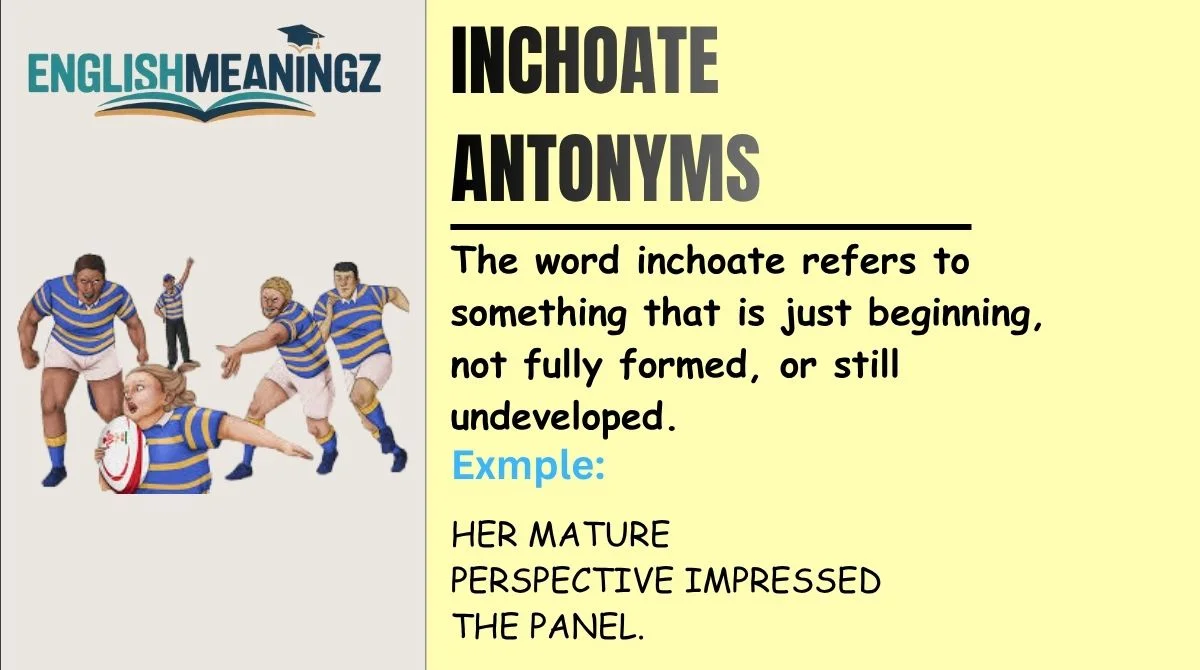
The word inchoate refers to something that is just beginning, not fully formed, or still undeveloped. It often describes ideas, plans, emotions, or systems that exist in an early or incomplete stage.
Tone Explanation:
Inchoate carries a slightly formal and academic tone. It suggests vagueness, lack of structure, or an unfinished state.
Emotional / Action Intensity:
The intensity is low to moderate. It implies potential but also incompleteness. Something inchoate may grow into something significant, but right now it lacks clarity, organization, or maturity.
21 Best Antonyms for “Inchoate”
Developed
Meaning: Fully formed and advanced
Tone: Academic
Example: The developed theory gained wide acceptance.
Why it’s an opposite: It represents the complete stage, unlike something still forming.
Mature
Meaning: Fully grown or refined
Tone: Formal
Example: Her mature perspective impressed the panel.
Why it’s an opposite: Maturity contrasts with early-stage development.
Complete
Meaning: Having all parts; finished
Tone: Neutral
Example: The project is now complete and ready for submission.
Why it’s an opposite: Completeness eliminates the incompleteness implied by inchoate.
Finished
Meaning: Brought to an end; finalized
Tone: Informal
Example: The artist declared the painting finished.
Why it’s an opposite: No longer in progress or beginning.
Perfected
Meaning: Made flawless or highly refined
Tone: Formal
Example: The method was perfected over years.
Why it’s an opposite: Suggests ultimate refinement rather than early formation.
Refined
Meaning: Improved and polished
Tone: Academic
Example: The refined argument was convincing.
Why it’s an opposite: Refinement implies development beyond initial stages.
Established
Meaning: Firmly set or recognized
Tone: Formal
Example: The established system runs efficiently.
Why it’s an opposite: Opposes the uncertainty of something just beginning.
Advanced
Meaning: Highly developed or progressed
Tone: Academic
Example: The advanced technology improved outcomes.
Why it’s an opposite: Indicates progression beyond early stages.
Organized
Meaning: Structured and arranged
Tone: Neutral
Example: The organized plan ensured success.
Why it’s an opposite: Organization contrasts with the disorder of inchoate ideas.
Defined
Meaning: Clearly outlined or specified
Tone: Academic
Example: The defined goals guided the team.
Why it’s an opposite: Clarity replaces vagueness.
Structured
Meaning: Arranged systematically
Tone: Formal
Example: The structured essay was easy to follow.
Why it’s an opposite: Structure eliminates lack of form.
Formulated
Meaning: Carefully developed or created
Tone: Academic
Example: The policy was formulated after research.
Why it’s an opposite: Indicates deliberate development.
Polished
Meaning: Refined and improved
Tone: Informal
Example: His polished speech captivated the audience.
Why it’s an opposite: Opposes rough or incomplete form.
Accomplished
Meaning: Successfully completed
Tone: Formal
Example: The accomplished task met all expectations.
Why it’s an opposite: Signals completion rather than beginning.
Realized
Meaning: Fully achieved or understood
Tone: Academic
Example: The vision was finally realized.
Why it’s an opposite: Represents fulfillment.
Perfect
Meaning: Without flaws
Tone: Neutral
Example: She delivered a perfect performance.
Why it’s an opposite: Removes any sense of incompleteness.
Concluded
Meaning: Brought to an end
Tone: Formal
Example: The study concluded with clear findings.
Why it’s an opposite: Final stage vs. initial stage.
Executed
Meaning: Carried out successfully
Tone: Formal
Example: The plan was executed flawlessly.
Why it’s an opposite: Action completed vs. barely begun.
Settled
Meaning: Resolved or finalized
Tone: Neutral
Example: The issue has been settled permanently.
Why it’s an opposite: Stability replaces uncertainty.
Fully Formed
Meaning: Completely developed
Tone: Neutral
Example: The idea was fully formed before presentation.
Why it’s an opposite: Direct contrast to partial formation.
Crystallized
Meaning: Made clear and definite
Tone: Academic
Example: Her thoughts crystallized into a clear argument.
Why it’s an opposite: Clarity replaces vagueness and ambiguity.
Strong vs Mild Opposites
Not all antonyms carry the same intensity. Some words represent a complete contrast, while others only suggest partial opposition.
Strong Opposites:
Words like perfected, complete, and fully formed directly negate the idea of incompleteness. These are ideal when you want to emphasize a total transformation or final stage.
Mild Opposites:
Words like organized, defined, and refined suggest improvement but not necessarily perfection. They imply progress rather than total completion.
Practical Tip:
Choose strong antonyms when making decisive claims. Use mild ones when describing gradual development.
Context-Based Opposites
The best antonym often depends on context. Inchoate can describe ideas, emotions, systems, or plans—each requiring a slightly different opposite.
- For ideas: Use defined, formulated, or crystallized
- For projects: Use completed, executed, or finished
- For emotions: Use clear, settled, or resolved
- For systems: Use established, structured, or organized
Key Insight:
There is no single “perfect” antonym. The right choice depends on what aspect of incompleteness you want to oppose—lack of clarity, lack of structure, or lack of progress.
Common Mistakes When Using Opposites
Mistake 1: Choosing a weak contrast
Incorrect: The inchoate plan became better.
Better: The inchoate plan became fully developed.
Mistake 2: Ignoring tone mismatch
Using informal antonyms in academic writing reduces credibility.
Example: Avoid “done” when “completed” fits better.
Mistake 3: Confusing clarity with completion
Defined does not always mean finished.
Example: A defined plan can still be incomplete.
Mistake 4: Overusing “complete”
Repeating the same antonym weakens writing variety.
Mistake 5: Misinterpreting “inchoate”
It does not mean “bad”—it simply means undeveloped.
Sentence Transformation Examples
Original: His ideas were inchoate and unclear.
Rewritten: His ideas were clearly defined and structured.
Original: The project remained inchoate for months.
Rewritten: The project was finally completed and executed.
Original: Her thoughts felt inchoate.
Rewritten: Her thoughts crystallized into a clear vision.
Original: The system is still inchoate.
Rewritten: The system is now fully established and operational.
Original: Their plan was inchoate at best.
Rewritten: Their plan was well-formulated and refined.
FAQs
What is the simplest antonym of inchoate?
The simplest antonym is complete, as it directly opposes incompleteness.
Is “developed” a strong opposite?
Yes, but it can be moderate depending on context. It suggests growth rather than perfection.
Can “organized” be an antonym of inchoate?
Yes, especially when inchoate refers to lack of structure.
Is “perfect” always the best opposite?
No. It may be too strong for contexts where something is just improved, not flawless.
What tone does “inchoate” carry?
It is formal and often used in academic or analytical writing.
Are all antonyms interchangeable?
No. Each antonym fits specific contexts and nuances.
How can I remember antonyms effectively?
Group them by meaning: completion, clarity, structure, and refinement.
Conclusion
Mastering antonyms of inchoate equips you with the ability to express progress, clarity, and completion with precision.
Instead of relying on generic opposites, you can now choose words that match the exact context—whether you’re describing a refined argument, a completed project, or a fully developed idea.
This level of vocabulary control not only enhances your writing but also strengthens your communication across academic and professional settings. The key is not just knowing opposites—but knowing which opposite fits best.