Strong vocabulary plays a crucial role in effective communication, especially in academic writing, professional reports, and digital content creation.
One of the most common issues writers face is word repetition, which can weaken the clarity and impact of their writing.
Using a variety of synonyms allows writers to express the same idea in multiple ways while maintaining reader engagement.
The phrase “detail-oriented” is frequently used to describe someone who pays close attention to small elements, ensures accuracy, and avoids errors.
While this expression is useful, relying on it repeatedly can make writing appear limited or repetitive.
Expanding your vocabulary with well-chosen synonyms improves writing quality and often contributes to higher scores in exams and assessments.
This is particularly important for students writing essays, bloggers creating engaging content, and professionals preparing reports or resumes.
This article provides 15 carefully explained synonyms for “detail-oriented”, organized by context and usage.
Each word includes its meaning, explanation, and example sentence so you can confidently use it in both academic and professional writing.
Definition and Core Meaning of “Detail-Oriented”
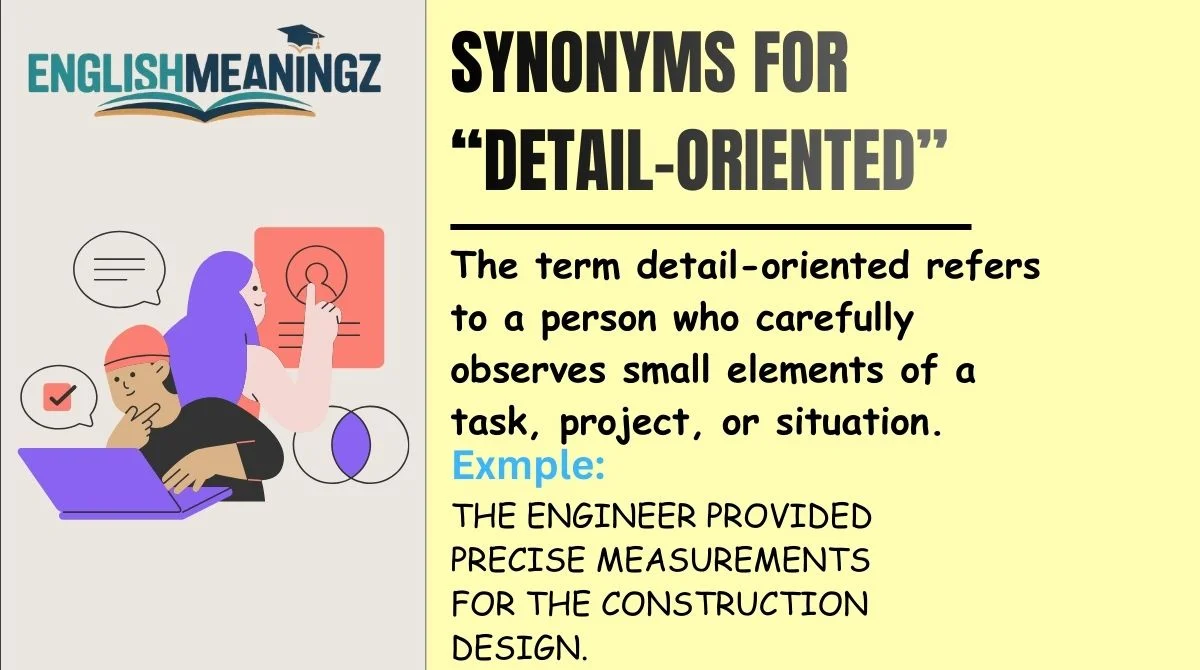
The term detail-oriented refers to a person who carefully observes small elements of a task, project, or situation. Someone with this trait ensures accuracy, consistency, and completeness by focusing on even the smallest components.
In professional environments, detail-oriented individuals are often valued because they help prevent mistakes, maintain quality standards, and ensure that tasks are completed correctly.
From an academic perspective, being detail-oriented means carefully reviewing information, organizing ideas clearly, and verifying facts before presenting them in written or spoken form.
For example, a detail-oriented researcher carefully reviews data to ensure accuracy before publishing results. Similarly, a detail-oriented editor thoroughly checks grammar, structure, and clarity to improve the quality of a document.
In essence, the core meaning of detail-oriented includes:
- Careful attention to small elements
- High accuracy and precision
- Strong focus on organization and correctness
- Ability to notice subtle differences or errors
Because this trait is highly valued in many fields—including research, engineering, writing, and business—having multiple ways to express it can significantly strengthen your vocabulary.
15 Synonyms Grouped by Context
General Use
Observant
Meaning: Someone who quickly notices small details or changes.
Context Explanation: This synonym is commonly used when describing individuals who are attentive to their surroundings or situations.
Example Sentence:
The observant researcher noticed a minor inconsistency in the experiment’s results.
Thorough
Meaning: Completing tasks carefully and completely without overlooking details.
Context Explanation: Often used in professional or academic settings where accuracy and completeness are important.
Example Sentence:
The auditor conducted a thorough examination of the company’s financial records.
Meticulous
Meaning: Showing extreme care and precision in work.
Context Explanation: This word emphasizes careful attention to even the smallest elements.
Example Sentence:
The scientist maintained meticulous records during the research project.
Precise
Meaning: Accurate and exact in every aspect.
Context Explanation: Frequently used when discussing technical work, measurements, or instructions.
Example Sentence:
The engineer provided precise measurements for the construction design.
Formal & Academic Writing
Diligent
Meaning: Consistently hardworking and attentive to responsibilities.
Context Explanation: Commonly used in academic or professional descriptions of work ethic.
Example Sentence:
The diligent student carefully reviewed every section of the research paper before submission.
Attentive
Meaning: Paying close attention to details or instructions.
Context Explanation: Often used when describing someone who listens carefully or follows instructions accurately.
Example Sentence:
The attentive assistant ensured that every document was correctly organized.
Methodical
Meaning: Performing tasks according to a structured and systematic process.
Context Explanation: Frequently used in academic and research environments.
Example Sentence:
The scientist followed a methodical approach to analyze the experimental data.
Analytical
Meaning: Skilled at examining information carefully and logically.
Context Explanation: Often used in academic disciplines such as research, data analysis, and critical thinking.
Example Sentence:
Her analytical approach allowed her to identify errors in the dataset.
Informal Usage
Careful
Meaning: Taking time to avoid mistakes or problems.
Context Explanation: A simple and widely used synonym suitable for everyday conversation.
Example Sentence:
He is a careful editor who checks every article before publication.
Sharp-Eyed
Meaning: Quick to notice small or hidden details.
Context Explanation: Often used informally to describe someone who easily detects subtle differences.
Example Sentence:
The sharp-eyed photographer noticed the lighting change immediately.
Focused
Meaning: Concentrating strongly on a task or objective.
Context Explanation: Commonly used in both casual and professional communication.
Example Sentence:
The focused designer paid close attention to every visual element of the project.
Technical or Subject-Specific Use
Systematic
Meaning: Organized according to a clear process or method.
Context Explanation: Frequently used in scientific research and technical fields.
Example Sentence:
The systematic analysis helped identify patterns in the data.
Exacting
Meaning: Demanding high accuracy and strict standards.
Context Explanation: Often used to describe tasks requiring extreme precision.
Example Sentence:
The exacting nature of medical research requires exceptional attention to detail.
Scrupulous
Meaning: Extremely careful and precise, especially regarding rules or accuracy.
Context Explanation: Typically used in formal or ethical contexts.
Example Sentence:
The editor was scrupulous in ensuring the accuracy of historical facts.
Conscientious
Meaning: Responsible and careful in fulfilling duties.
Context Explanation: Often used in professional evaluations and academic descriptions.
Example Sentence:
A conscientious researcher verifies every source before citing it.
Word Intensity & Tone Comparison Table
| Synonym | Formal Level | Emotional Strength | Typical Context |
|---|---|---|---|
| Careful | Low | Mild | Everyday conversation |
| Observant | Medium | Moderate | General writing |
| Thorough | Medium | Strong | Professional tasks |
| Meticulous | High | Strong | Academic or technical |
| Diligent | High | Moderate | Academic evaluations |
| Analytical | High | Strong | Research and analysis |
| Methodical | High | Moderate | Scientific processes |
| Precise | Medium | Strong | Technical accuracy |
| Scrupulous | Very High | Strong | Ethical or formal writing |
| Conscientious | High | Moderate | Professional responsibility |
This comparison helps writers choose synonyms that match the tone and context of their writing.
Common Mistakes When Using These Synonyms
Even though these words are similar, they are not always interchangeable. Misusing them can create confusion.
Mistake 1: Using Informal Words in Academic Writing
Incorrect:
The researcher was sharp-eyed when examining the data.
Correct:
The researcher was meticulous when examining the data.
Mistake 2: Using Technical Words in Casual Conversation
Incorrect:
My friend is very methodical about choosing a restaurant.
Correct:
My friend is very careful about choosing a restaurant.
Mistake 3: Confusing “Analytical” with “Observant”
Incorrect:
The analytical guard noticed someone entering the building.
Correct:
The observant guard noticed someone entering the building.
“Analytical” refers to logical examination, while “observant” refers to noticing details quickly.
Synonyms in Academic Writing
Example Paragraph 1
Successful research requires a meticulous and methodical approach. Scholars must carefully collect, analyze, and interpret data to ensure that their conclusions are reliable. A conscientious researcher verifies sources, checks calculations, and evaluates evidence critically before presenting findings.
Example Paragraph 2
In professional environments, analytical and diligent employees play an essential role in maintaining quality standards. Their ability to examine processes carefully and detect potential errors contributes to more efficient decision-making and improved organizational outcomes.
IELTS & Exam Writing Tips
Vocabulary diversity is essential for high scores in exams such as IELTS, TOEFL, and academic assessments. However, simply replacing words without understanding their context can reduce clarity.
How to Avoid Repetition
- Replace repeated words with appropriate synonyms.
- Use context-specific vocabulary.
- Combine synonyms with descriptive phrases.
Example:
Repeated sentence:
She is detail-oriented. Her detail-oriented skills helped the project.
Improved version:
She is meticulous, and her analytical skills helped the project succeed.
When NOT to Replace the Word
Sometimes the original word is the most accurate choice. Avoid unnecessary substitutions when:
- The synonym changes the meaning
- The tone becomes too formal or too casual
- The word is part of a technical term
Clarity should always be prioritized over complexity.
Similar Words vs True Synonyms
Many words related to “detail-oriented” share similar meanings but differ slightly in emphasis.
For example:
- Meticulous emphasizes extreme care and precision.
- Analytical focuses on logical examination and reasoning.
- Methodical highlights a systematic process.
- Observant refers to noticing details quickly.
Understanding these subtle differences allows writers to select the most appropriate word for each situation.
Practice Sentences
Fill in the blank with an appropriate synonym for detail-oriented.
- The researcher was extremely ______ and verified every statistic before publishing the study.
- A ______ editor carefully checks grammar, punctuation, and formatting.
- The detective’s ______ nature allowed him to notice the smallest clues.
- A ______ scientist follows a structured process when conducting experiments.
- The ______ accountant reviewed the financial records for possible errors.
These exercises help reinforce vocabulary learning and encourage practical application.
FAQs
What is another word for detail-oriented?
Common alternatives include meticulous, thorough, diligent, observant, and precise. Each word emphasizes careful attention to accuracy and small elements.
Which synonym is best for resumes?
Words like meticulous, analytical, conscientious, and diligent are highly effective for professional resumes because they convey responsibility and precision.
Are “meticulous” and “detail-oriented” the same?
They are very similar, but meticulous usually implies extreme precision and carefulness, making it slightly stronger than “detail-oriented.”
What synonym works best in academic writing?
In academic contexts, analytical, methodical, meticulous, and thorough are often the most appropriate choices.
How can I improve my vocabulary for essays?
Regular reading, vocabulary exercises, and learning synonyms in context can significantly expand your vocabulary and improve writing quality.
Conclusion
Developing a strong vocabulary is one of the most effective ways to improve writing quality and clarity. The phrase “detail-oriented” is valuable, but relying on a single expression repeatedly can limit your writing style.
By learning and applying synonyms such as meticulous, analytical, diligent, observant, and methodical, writers can communicate ideas more effectively and demonstrate greater linguistic flexibility.
Students preparing for exams, bloggers creating engaging content, and professionals writing reports can all benefit from expanding their vocabulary in this way.
With consistent practice and careful usage, these synonyms will help you produce clearer, more professional, and more engaging writing.