Strong writing depends not only on ideas but also on vocabulary choice. Repeating the same word too often can weaken the clarity, tone, and impact of a sentence.
For students, bloggers, and professionals, learning synonyms helps improve writing quality, readability, and overall language sophistication.
Using varied vocabulary also plays a key role in academic success. In essays, research papers, and standardized exams such as IELTS, lexical diversity often contributes directly to higher writing scores.
When writers replace repeated words with accurate alternatives, they demonstrate both linguistic competence and stylistic control.
One word that frequently appears in descriptive writing is “ethereal.” It is commonly used to describe beauty, atmosphere, or qualities that feel delicate, otherworldly, or heavenly.
However, relying on this single word repeatedly can make writing feel monotonous. Expanding your vocabulary with precise alternatives allows you to express subtle differences in meaning and tone.
This comprehensive guide presents 16 synonyms for “ethereal,” explains their meanings, and shows how they can be used effectively in different contexts—from casual communication to academic writing.
Definition and Core Meaning of “Ethereal”
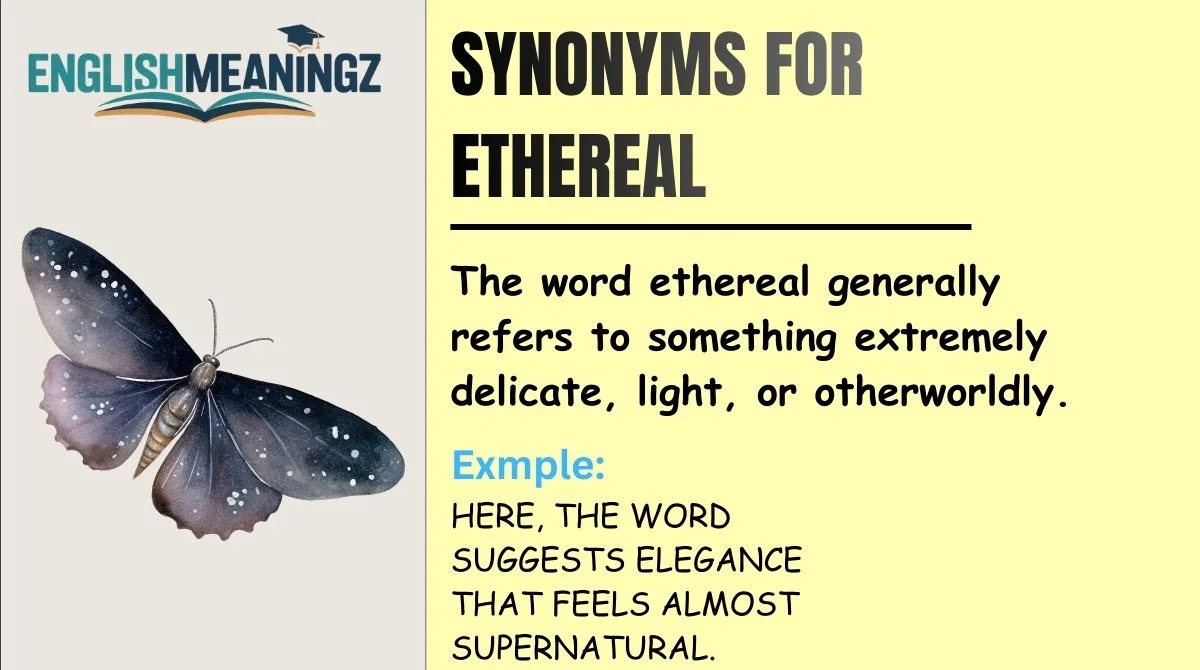
The word ethereal generally refers to something extremely delicate, light, or otherworldly. It often describes beauty or qualities that seem almost too perfect or pure for the physical world.
In literature and descriptive writing, “ethereal” frequently refers to:
- Light, airy beauty
- Heavenly or divine qualities
- Something intangible or dreamlike
- A presence that feels beyond ordinary human experience
For example:
The dancer moved with an ethereal grace that captivated the entire audience.
Here, the word suggests elegance that feels almost supernatural.
In artistic, poetic, and academic contexts, “ethereal” may also describe aesthetic qualities that appear spiritual, transcendent, or intangible. Because of this layered meaning, choosing the correct synonym requires attention to context and tone.
16 Synonyms Grouped by Context
General Use
Delicate
Meaning: Fragile, fine, or easily damaged.
Context Explanation:
“Delicate” is often used to describe objects, movements, or features that appear gentle and refined. While not always mystical like “ethereal,” it can capture a similar sense of softness.
Example Sentence:
The artist painted delicate flowers that seemed almost alive.
Airy
Meaning: Light, open, and spacious.
Context Explanation:
“Airy” is commonly used for environments or visual qualities that feel light and unconstrained.
Example Sentence:
The room had an airy atmosphere filled with soft natural light.
Dreamlike
Meaning: Resembling a dream or unreal experience.
Context Explanation:
This synonym closely aligns with the mystical sense of “ethereal.”
Example Sentence:
The landscape looked dreamlike under the pale moonlight.
Otherworldly
Meaning: Appearing supernatural or beyond normal human experience.
Context Explanation:
“Otherworldly” is often used in artistic descriptions, photography, and literature.
Example Sentence:
The mountain scenery possessed an otherworldly beauty.
Formal & Academic Writing
Transcendent
Meaning: Exceeding ordinary limits or surpassing normal experience.
Context Explanation:
Used in philosophy, literature, and academic discussion to describe something beyond physical or material boundaries.
Example Sentence:
The philosopher described beauty as a transcendent quality beyond sensory perception.
Celestial
Meaning: Related to the heavens or the sky.
Context Explanation:
Often used in scientific, religious, and poetic contexts to describe heavenly elements.
Example Sentence:
Ancient cultures believed celestial bodies influenced human destiny.
Sublime
Meaning: Inspiring awe or admiration due to beauty or greatness.
Context Explanation:
“Sublime” appears frequently in literature, art criticism, and philosophy.
Example Sentence:
The poet attempted to capture the sublime power of nature.
Exquisite
Meaning: Extremely beautiful and delicate.
Context Explanation:
This word emphasizes refined beauty and exceptional detail.
Example Sentence:
The museum displayed an exquisite sculpture carved from marble.
Informal Usage
Magical
Meaning: Enchanting or wonderfully surprising.
Context Explanation:
In everyday language, “magical” often replaces “ethereal” when describing moments or experiences.
Example Sentence:
The evening felt magical as the city lights reflected on the river.
Enchanting
Meaning: Delightfully charming or captivating.
Context Explanation:
Frequently used to describe scenery, music, or personalities.
Example Sentence:
The singer’s voice created an enchanting atmosphere.
Angelic
Meaning: Pure, innocent, or heavenly.
Context Explanation:
This word often describes appearance or behavior that seems perfect.
Example Sentence:
The child’s angelic smile melted everyone’s heart.
Mystical
Meaning: Related to spiritual mystery or supernatural forces.
Context Explanation:
Commonly used in storytelling, spirituality, and fantasy descriptions.
Example Sentence:
The ancient forest had a mystical presence.
Technical or Subject-Specific Use
Immaterial
Meaning: Not physical or tangible.
Context Explanation:
Used in philosophical and theoretical discussions.
Example Sentence:
The concept of consciousness is often considered immaterial.
Intangible
Meaning: Unable to be touched or physically measured.
Context Explanation:
Common in business, philosophy, and social sciences.
Example Sentence:
Trust is an intangible asset in successful leadership.
Spiritual
Meaning: Related to the soul or inner life.
Context Explanation:
Used in religious and psychological discussions.
Example Sentence:
Meditation often provides spiritual clarity.
Radiant
Meaning: Glowing with light or happiness.
Context Explanation:
While more visual than “ethereal,” it can describe luminous beauty.
Example Sentence:
She appeared radiant under the golden sunlight.
Word Intensity & Tone Comparison Table
| Word | Formal Level | Emotional Strength | Typical Context |
|---|---|---|---|
| Delicate | Neutral | Low | Everyday description |
| Airy | Neutral | Low | Spaces and environments |
| Dreamlike | Semi-formal | Medium | Literature |
| Otherworldly | Semi-formal | High | Creative writing |
| Transcendent | Highly formal | High | Philosophy |
| Celestial | Formal | Medium | Science, religion |
| Sublime | Highly formal | Very high | Literary criticism |
| Magical | Informal | Medium | Storytelling |
| Enchanting | Neutral | Medium | Descriptive writing |
| Mystical | Semi-formal | High | Spiritual contexts |
This table helps writers quickly determine which synonym best suits the tone of their work.
Common Mistakes When Using These Synonyms
Even advanced writers sometimes misuse synonyms. Understanding context prevents errors.
Mistake 1: Using Formal Words in Casual Context
Incorrect:
The party had a transcendent vibe.
Correct:
The party had a magical vibe.
Explanation:
“Transcendent” sounds overly academic for casual descriptions.
Mistake 2: Confusing Physical and Abstract Meanings
Incorrect:
The sculpture felt intangible.
Correct:
The sculpture had delicate details.
Explanation:
“Intangible” refers to something that cannot be physically touched.
Mistake 3: Overusing Dramatic Words
Incorrect:
The cafeteria served a sublime lunch.
Correct:
The cafeteria served a delicious lunch.
Explanation:
“Sublime” is usually reserved for extraordinary beauty or greatness.
Synonyms in Academic Writing
Example Paragraph 1
Nature often evokes a sense of sublime beauty that transcends ordinary perception. Scholars of environmental philosophy argue that landscapes possess an almost transcendent quality, inspiring emotional responses that connect humans to broader ecological systems.
Example Paragraph 2
In literary analysis, authors frequently employ imagery that suggests celestial or dreamlike environments. Such descriptions create an otherworldly atmosphere, allowing readers to interpret themes of spirituality and imagination.
IELTS & Exam Writing Tips
Avoid Repetition
Examiners often assess lexical variety. Instead of repeating “ethereal,” writers can alternate between related terms.
Example:
Original:
The landscape looked ethereal. The lake created an ethereal reflection.
Improved:
The landscape looked ethereal, and the lake produced a dreamlike reflection.
Maintain Accuracy
Not every synonym fits every sentence. Replacing words without considering meaning may reduce clarity.
Example:
Incorrect Replacement:
The teacher gave a mystical explanation of mathematics.
Correct Usage:
The teacher gave a clear explanation of mathematics.
Use Synonyms Strategically
In exam writing:
- Replace repeated descriptive words
- Maintain formal tone
- Avoid overly dramatic language
Balanced vocabulary shows linguistic maturity.
Similar Words vs True Synonyms
Many words resemble “ethereal,” but they are not perfect substitutes.
Radiant vs Ethereal
- Radiant: Focuses on brightness or glowing appearance.
- Ethereal: Emphasizes delicate, otherworldly beauty.
Example:
The bride looked radiant (glowing and joyful).
The bride looked ethereal (delicate and almost heavenly).
Mystical vs Ethereal
- Mystical: Connected to spirituality or mystery.
- Ethereal: Focuses more on lightness and elegance.
Example:
A mystical temple suggests spiritual mystery.
An ethereal temple emphasizes delicate beauty.
Understanding these nuances improves word precision.
Practice Sentences
Choose the most appropriate synonym.
- The mountain scenery looked ______ under the glowing sunrise.
- The scientist studied the ______ properties of consciousness.
- The singer’s voice created an ______ atmosphere in the concert hall.
- The palace interior felt bright and ______.
- The painting captured a ______ beauty rarely seen in modern art.
Possible Answers: dreamlike, immaterial, enchanting, airy, sublime.
FAQs
What does ethereal mean in writing?
In writing, “ethereal” describes something extremely delicate, light, or heavenly. It often conveys beauty that appears almost supernatural.
What is the closest synonym for ethereal?
Words like otherworldly, dreamlike, and celestial are among the closest synonyms because they preserve the idea of supernatural beauty.
Can ethereal describe a person?
Yes. Writers frequently use it to describe someone with delicate, graceful beauty or an elegant presence.
Example:
She had an ethereal appearance.
Is ethereal a positive word?
Generally, yes. It typically carries positive connotations such as beauty, purity, and elegance.
When should writers avoid using ethereal?
Writers should avoid it in highly technical or factual contexts where emotional description may reduce clarity.
Conclusion
Expanding vocabulary is one of the most effective ways to improve writing quality.
Learning multiple synonyms for descriptive words like “ethereal” allows writers to express subtle shades of meaning, avoid repetition, and maintain reader engagement.
For students preparing essays, bloggers crafting creative content, or professionals writing reports, mastering these alternatives strengthens communication skills and enhances stylistic sophistication.
With practice, selecting the right synonym becomes intuitive, allowing ideas to appear more precise, elegant, and impactful.
Developing vocabulary is an ongoing process, but each new word adds another tool to a writer’s expressive power.