Understanding opposites is one of the fastest ways to sharpen your writing and communication skills.
When you know both a word and its antonyms, you gain the ability to control tone, precision, and emotional impact with far greater accuracy.
This is especially important in academic writing, professional communication, and even everyday conversations where clarity matters.
In modern writing, especially in 2026’s fast-paced digital landscape, vocabulary depth is a competitive advantage.
Whether you’re crafting essays, blog posts, emails, or reports, knowing the right opposite word helps you express contrast, avoid repetition, and sound more articulate.
This article explores the word “scuffle” and provides 13 powerful antonyms you can use to elevate your language instantly.
What Does “Scuffle” Mean?
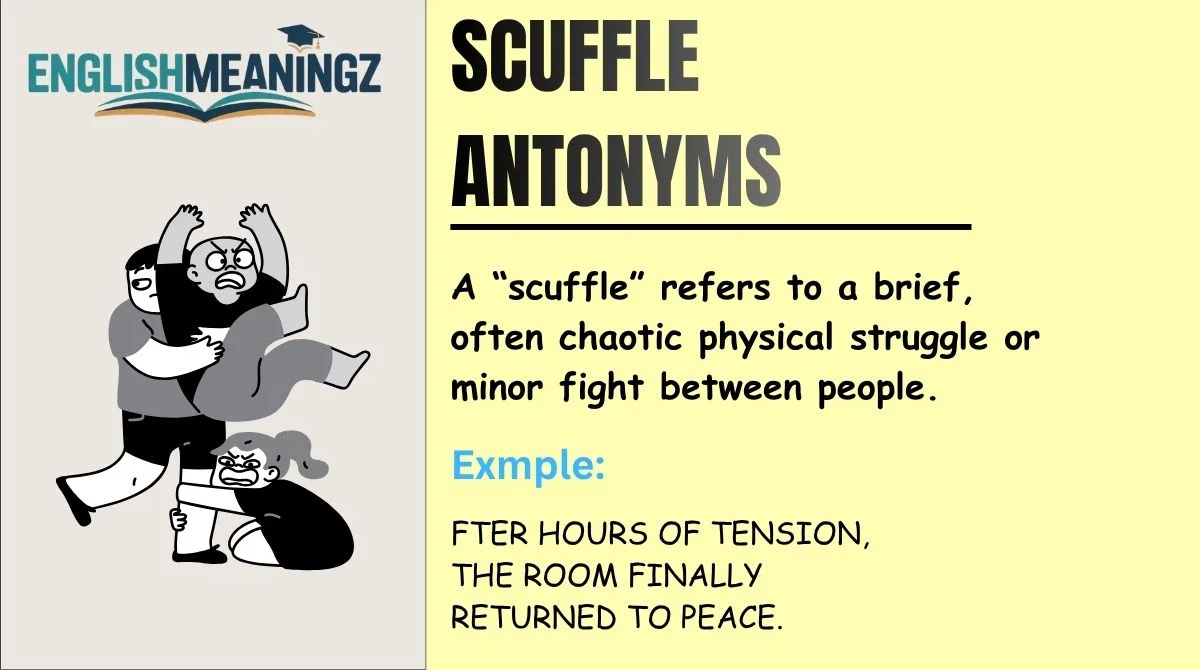
A “scuffle” refers to a brief, often chaotic physical struggle or minor fight between people. It usually implies low intensity compared to a full fight but still involves disorder, aggression, and conflict.
In terms of tone, “scuffle” carries a slightly informal and action-oriented feeling. It suggests something sudden, unplanned, and somewhat messy rather than organized or controlled.
Emotionally, the word leans toward tension, conflict, and mild aggression. It is not as intense as “battle” or “fight,” but it still indicates physical or verbal confrontation.
13 Best Antonyms for “Scuffle”
Peace
- Meaning: A state of calm without conflict
- Tone: Formal / Emotional
- Example: After hours of tension, the room finally returned to peace.
- Why it’s an opposite: A scuffle involves conflict, while peace represents complete absence of it.
Harmony
- Meaning: Agreement and balance among people
- Tone: Academic / Emotional
- Example: The team worked in harmony to complete the project successfully.
- Why it’s an opposite: Harmony eliminates the disorder and tension present in a scuffle.
Agreement
- Meaning: Mutual understanding or shared decision
- Tone: Formal / Academic
- Example: Both parties reached an agreement without any conflict.
- Why it’s an opposite: A scuffle reflects disagreement, whereas agreement reflects unity.
Calm
- Meaning: A peaceful and quiet state
- Tone: Neutral / Emotional
- Example: She remained calm despite the chaos around her.
- Why it’s an opposite: Calmness directly contrasts the agitation of a scuffle.
Cooperation
- Meaning: Working together toward a common goal
- Tone: Formal / Professional
- Example: Cooperation between departments improved efficiency.
- Why it’s an opposite: Cooperation replaces conflict with teamwork.
Friendship
- Meaning: A close, supportive relationship
- Tone: Emotional / Informal
- Example: Their friendship prevented any arguments from escalating.
- Why it’s an opposite: A scuffle indicates conflict, while friendship promotes understanding.
Unity
- Meaning: Being joined together in agreement
- Tone: Formal / Academic
- Example: Unity among citizens led to positive change.
- Why it’s an opposite: Unity removes division, which is central to a scuffle.
Reconciliation
- Meaning: Restoring friendly relations after conflict
- Tone: Formal / Academic
- Example: The reconciliation ended years of hostility.
- Why it’s an opposite: Instead of conflict, it focuses on resolving and ending it.
Order
- Meaning: Organized and controlled arrangement
- Tone: Formal
- Example: The teacher restored order in the classroom.
- Why it’s an opposite: A scuffle is chaotic, while order is structured.
Tranquility
- Meaning: Deep calm and peacefulness
- Tone: Formal / Literary
- Example: The lake reflected complete tranquility at sunrise.
- Why it’s an opposite: Tranquility removes all forms of disturbance.
Civility
- Meaning: Polite and respectful behavior
- Tone: Formal / Academic
- Example: Even during debates, they maintained civility.
- Why it’s an opposite: Civility avoids the aggression seen in a scuffle.
Understanding
- Meaning: Awareness and empathy between people
- Tone: Emotional / Academic
- Example: Mutual understanding prevented conflict.
- Why it’s an opposite: Understanding eliminates the cause of a scuffle.
Negotiation
- Meaning: Discussion to reach an agreement
- Tone: Professional / Formal
- Example: Negotiation resolved the dispute peacefully.
- Why it’s an opposite: Negotiation replaces physical or verbal conflict with dialogue.
Strong vs Mild Opposites
Not all antonyms carry the same intensity. Some completely eliminate the idea of conflict, while others simply reduce it.
Strong opposites like “tranquility,” “peace,” and “unity” represent a total absence of conflict. They create a sense of complete emotional and physical calm.
Mild opposites like “agreement,” “negotiation,” and “understanding” still involve interaction but remove hostility. They are practical opposites used in real-world communication.
Choosing the right intensity depends on context. For formal writing, stronger antonyms often create more impact. In conversational contexts, mild opposites feel more natural.
Context-Based Opposites
Antonyms are not always fixed; they can change depending on context.
For example, in a physical setting, “order” or “calm” may be the best opposite of “scuffle.” In a professional setting, “cooperation” or “negotiation” works better. In emotional contexts, “harmony” or “understanding” is more appropriate.
This flexibility allows you to tailor your vocabulary based on your audience and purpose. Strong writers select antonyms based on situation rather than memorization.
Common Mistakes When Using Opposites
One common mistake is choosing an antonym that does not match the tone. For instance, using “friendship” in a formal legal document may sound unprofessional. A better choice would be “agreement” or “negotiation.”
Another error is misunderstanding intensity. Replacing “scuffle” with “silence” may not always work because silence does not necessarily imply resolution or harmony.
Writers also often confuse related words with opposites. For example, “discussion” is not always the opposite of “scuffle” because discussions can still involve disagreement.
To avoid these mistakes, always consider tone, context, and intensity.
Sentence Transformation Examples
Original: The argument turned into a scuffle.
Rewritten: The argument was resolved through calm discussion.
Original: A scuffle broke out between the players.
Rewritten: The players maintained cooperation throughout the game.
Original: The meeting ended in a scuffle of opinions.
Rewritten: The meeting concluded with mutual agreement.
Original: Their disagreement led to a scuffle.
Rewritten: Their disagreement led to understanding.
Original: The crowd was close to a scuffle.
Rewritten: The crowd remained in complete harmony.
FAQs
What is the simplest antonym for “scuffle”?
The simplest antonym is “peace” because it directly contrasts conflict.
Can “calm” always replace “scuffle”?
Not always. “Calm” works best when describing atmosphere, not actions.
Is “discussion” an antonym of “scuffle”?
Not necessarily. Discussions can still involve conflict.
Which antonym is best for formal writing?
“Agreement,” “negotiation,” and “reconciliation” are ideal for formal contexts.
What is the strongest opposite of “scuffle”?
“Tranquility” or “peace” represent the strongest contrast.
Are emotional antonyms useful in academic writing?
Yes, but they should be used carefully to maintain professionalism.
How do I choose the right antonym?
Consider tone, context, and intensity before selecting the word.
Conclusion
Mastering antonyms like those for “scuffle” can dramatically improve your writing clarity and impact. Instead of repeatedly describing conflict, you gain the ability to express resolution, harmony, and professionalism with precision.
In 2026, effective communication is not just about what you say but how you say it. Expanding your vocabulary with accurate opposites allows you to control tone, avoid redundancy, and connect better with your audience.
By using these 13 antonyms strategically, you can transform simple sentences into polished, powerful expressions that stand out in both academic and professional environments.