Understanding opposites is one of the fastest ways to sharpen your vocabulary and improve clarity in writing. When you know not just what a word means but also what it doesn’t mean, you gain control over tone, precision, and expression.
This is especially important in both academic and professional communication, where the wrong word can shift meaning entirely.
Antonyms help writers avoid repetition, express contrast, and communicate nuanced ideas effectively. Whether you’re crafting essays, business emails, or creative content, knowing the right opposite word allows you to convey intent with accuracy and impact.
This guide explores 16 powerful antonyms of “gallantly”, breaking down their meanings, tones, and contextual uses to help you master them effortlessly.
What Does “Gallantly” Mean?
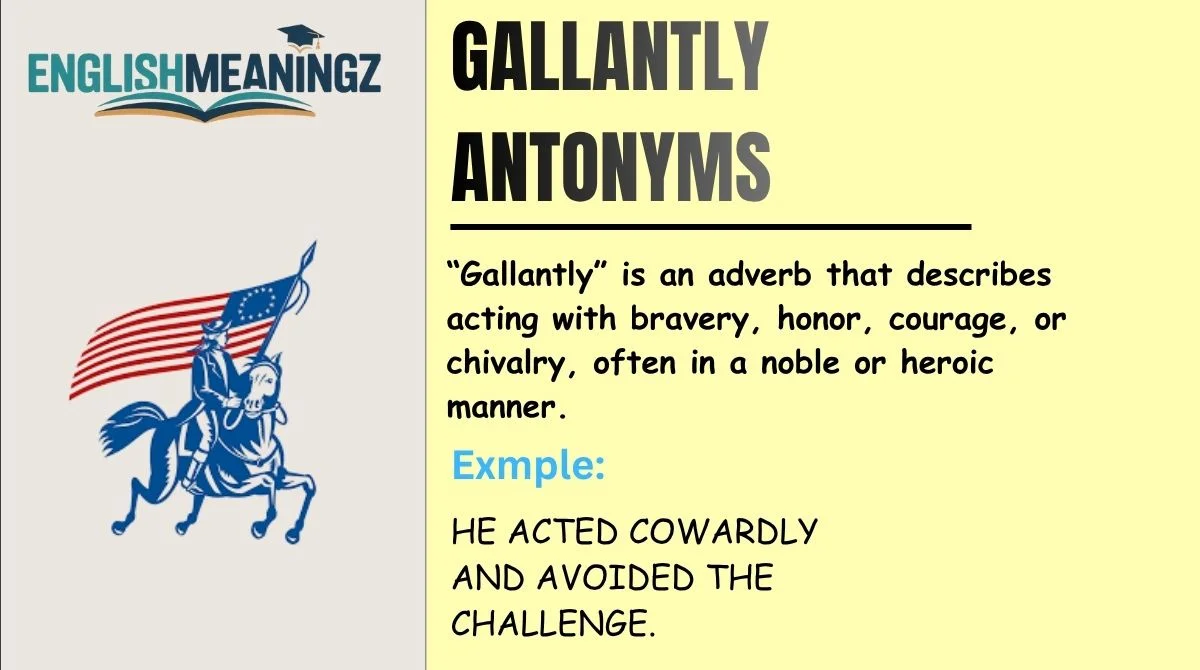
“Gallantly” is an adverb that describes acting with bravery, honor, courage, or chivalry, often in a noble or heroic manner. It is commonly used in both literal and figurative contexts.
Tone Explanation:
The word carries a positive, elevated tone, often associated with admiration. It may appear in formal, literary, or respectful contexts.
Emotional/Action Intensity:
“Gallantly” reflects high-intensity action—it implies not just action, but action taken with courage, dignity, or selflessness. It often suggests facing danger or difficulty with confidence and grace.
16 Best Antonyms for “Gallantly”
1. Cowardly
Meaning: Lacking courage or bravery
Tone: Emotional
Example: He acted cowardly and avoided the challenge.
Why it’s opposite: Gallantly implies bravery, while cowardly reflects fear and avoidance.
2. Fearfully
Meaning: In a way that shows fear
Tone: Emotional
Example: She stepped forward fearfully instead of confidently.
Why it’s opposite: Fear replaces the courage that defines gallant behavior.
3. Timidly
Meaning: Shy or lacking confidence
Tone: Neutral
Example: He spoke timidly during the presentation.
Why it’s opposite: Gallantry involves boldness; timidity reflects hesitation.
4. Weakly
Meaning: Without strength or determination
Tone: Neutral
Example: The argument was delivered weakly.
Why it’s opposite: Gallant actions are strong and decisive; weakness lacks impact.
5. Shamefully
Meaning: In a disgraceful or dishonorable manner
Tone: Formal
Example: He behaved shamefully during the crisis.
Why it’s opposite: Gallantly implies honor, while shamefully implies dishonor.
6. Dishonorably
Meaning: Without integrity or moral principles
Tone: Formal
Example: The deal was handled dishonorably.
Why it’s opposite: Gallantry is tied to honor; dishonorable behavior contradicts it.
7. Selfishly
Meaning: Acting for personal gain only
Tone: Neutral
Example: She acted selfishly and ignored others’ needs.
Why it’s opposite: Gallantly often involves selflessness.
8. Reluctantly
Meaning: Unwillingly or with hesitation
Tone: Neutral
Example: He agreed reluctantly to help.
Why it’s opposite: Gallant actions are willing and enthusiastic.
9. Passively
Meaning: Without active participation
Tone: Academic
Example: He remained passively silent during the debate.
Why it’s opposite: Gallantry involves active courage, not passivity.
10. Lazily
Meaning: Without effort or energy
Tone: Informal
Example: She completed the task lazily.
Why it’s opposite: Gallant behavior requires effort and determination.
11. Indifferently
Meaning: Without interest or concern
Tone: Formal
Example: He responded indifferently to the situation.
Why it’s opposite: Gallantly implies care and commitment.
12. Hesitantly
Meaning: With uncertainty or delay
Tone: Neutral
Example: She answered hesitantly.
Why it’s opposite: Gallantry requires confidence, not hesitation.
13. Meekly
Meaning: Quiet, submissive, and lacking assertiveness
Tone: Neutral
Example: He accepted the decision meekly.
Why it’s opposite: Gallant actions are bold, not submissive.
14. Ignobly
Meaning: In a dishonorable or base manner
Tone: Academic
Example: The leader acted ignobly under pressure.
Why it’s opposite: Gallantly is noble; ignobly is the direct contrast.
15. Spinelessly
Meaning: Without courage or determination
Tone: Informal
Example: He backed down spinelessly.
Why it’s opposite: Gallant behavior requires backbone and resolve.
16. Cravenly
Meaning: Extremely cowardly
Tone: Formal
Example: The soldier fled cravenly.
Why it’s opposite: This is one of the strongest opposites of gallantly.
Strong vs Mild Opposites
Not all antonyms carry the same intensity. Understanding this difference helps you choose the most accurate word.
Strong Opposites:
Words like cravenly, cowardly, and ignobly directly oppose gallantry with strong emotional or moral judgment. These are ideal for dramatic or serious contexts.
Mild Opposites:
Words such as hesitantly, reluctantly, and timidly represent softer contrasts. They suggest a lack of boldness but not necessarily moral failure.
Practical Tip:
Use strong antonyms in persuasive or literary writing. Use mild ones in academic or neutral contexts.
Context-Based Opposites
Antonyms can vary depending on the situation. “Gallantly” may describe physical bravery, moral courage, or polite chivalry.
Physical Context:
Gallantly → Cowardly, Fearfully
Example: Facing danger vs avoiding it.
Moral Context:
Gallantly → Dishonorably, Ignobly
Example: Acting with integrity vs betrayal.
Social Context:
Gallantly → Indifferently, Selfishly
Example: Helping others vs ignoring them.
Choosing the right antonym depends on the type of courage being contrasted.
Common Mistakes When Using Opposites
1. Using weak opposites in strong contexts
Incorrect: He acted gallantly vs hesitantly in battle.
Better: He acted gallantly vs cowardly.
2. Confusing tone
Incorrect: Gallantly vs lazily (in a moral situation)
Better: Gallantly vs dishonorably
3. Ignoring context
Incorrect: Gallantly (social kindness) vs cravenly
Better: Gallantly vs indifferently
4. Overusing one antonym
Writers often repeat “cowardly” instead of exploring nuanced alternatives.
Sentence Transformation Examples
1. Original: He fought gallantly in the war.
Rewritten: He acted cowardly and avoided the fight.
2. Original: She responded gallantly to criticism.
Rewritten: She reacted defensively and timidly.
3. Original: The knight behaved gallantly.
Rewritten: The knight acted dishonorably.
4. Original: He stepped forward gallantly.
Rewritten: He hesitated and stepped back reluctantly.
5. Original: They handled the crisis gallantly.
Rewritten: They managed the situation weakly and fearfully.
FAQs
What is the exact opposite of gallantly?
There is no single exact opposite, but “cowardly” and “cravenly” are the closest in most contexts.
Is “timidly” a strong antonym?
No, it is a mild opposite that reflects lack of confidence rather than complete fear.
Can antonyms change based on context?
Yes, the best opposite depends on whether gallantry refers to bravery, morality, or politeness.
Is “dishonorably” always an opposite?
Only when gallantly refers to moral integrity, not physical bravery.
Which antonym is best for academic writing?
“Passively,” “indifferently,” and “hesitantly” are suitable for formal contexts.
Are emotional antonyms effective in essays?
Yes, but they should be used carefully to match tone and purpose.
How can I remember these antonyms?
Group them by intensity and context—this makes them easier to recall and apply.
Conclusion
Mastering antonyms like those of “gallantly” allows you to write with precision, contrast, and depth.
Instead of relying on a single opposite, understanding a range—from mild hesitation to extreme cowardice—gives you flexibility across different contexts.
Whether you’re writing academically, professionally, or creatively, these opposites empower you to communicate more effectively and persuasively.