Clear communication is one of the most valuable skills in modern writing. Whether someone is crafting academic essays, professional emails, persuasive content, or public speeches, the ability to express ideas directly and confidently determines how well the message is received.
One major obstacle to clarity is the tendency to equivocate—to speak in a vague, ambiguous, or deliberately indirect way.
Understanding the opposites of equivocation helps writers avoid uncertainty and deliver precise messages. When writers know strong antonyms of equivocate, they gain tools that communicate certainty, decisiveness, honesty, and clarity.
These qualities are essential in academic research, journalism, legal communication, business negotiations, and persuasive writing.
Learning antonyms is not just about vocabulary expansion. It improves cognitive understanding of language contrast, which strengthens sentence construction and rhetorical effectiveness.
By mastering opposite words, writers can choose the exact tone they want—whether it is assertive, factual, confident, or transparent.
In professional communication, clarity is often more valued than complexity. Leaders, educators, analysts, and writers must express ideas without confusion. When someone avoids equivocation, their message becomes easier to trust and easier to understand.
This article explores twelve strong antonyms of “equivocate.” Each word will include a clear explanation, tone classification, example sentence, and reasoning that explains why it represents the opposite meaning.
By the end of this guide, you will have a deeper understanding of how to replace vague language with clear, decisive vocabulary.
What Does “Equivocate” Mean?
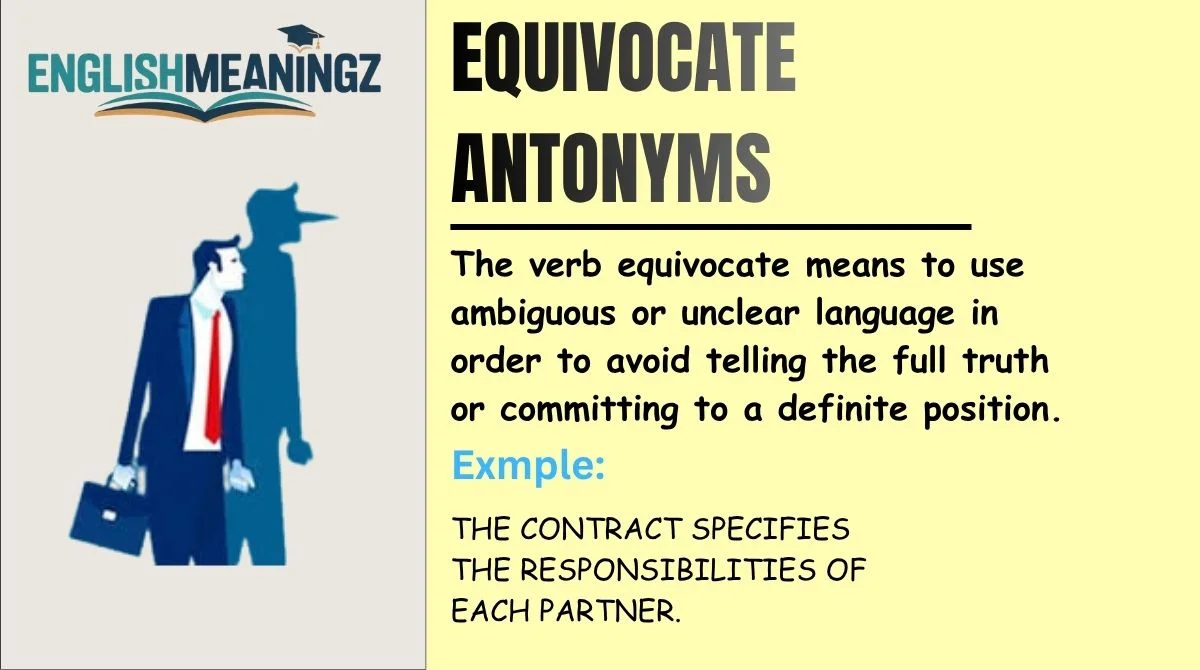
The verb equivocate means to use ambiguous or unclear language in order to avoid telling the full truth or committing to a definite position. People often equivocate when they want to dodge responsibility, soften a statement, or avoid direct answers.
In communication, equivocation usually appears in situations where someone prefers uncertainty instead of clarity.
For example:
“The politician equivocated when asked about the policy change.”
In this sentence, the speaker avoided giving a clear answer.
Tone and Usage
The word generally carries a negative tone, suggesting evasiveness or lack of honesty. When someone equivocates, listeners may feel that the person is hiding something or avoiding commitment.
Emotional and Action Intensity
Equivocation sits on a scale between:
- Neutral uncertainty
- Intentional ambiguity
Sometimes people equivocate unintentionally because they are unsure. However, in many cases the behavior is deliberate.
Because of this ambiguity, antonyms of equivocate typically express the opposite qualities:
- clarity
- decisiveness
- transparency
- honesty
- firmness
These opposites emphasize direct communication rather than avoidance.
12 Best Antonyms for “Equivocate”
Declare
Meaning:
To state something clearly and openly.
Tone: Formal / Academic
Example Sentence:
The scientist declared the results with complete confidence during the conference.
Why It Is an Opposite:
While equivocation hides meaning behind ambiguity, declaring something presents the message directly and without hesitation.
Assert
Meaning:
To state a belief or fact firmly and confidently.
Tone: Formal
Example Sentence:
She asserted that the data clearly supported the research hypothesis.
Why It Is an Opposite:
Equivocation avoids commitment, but asserting a statement demonstrates certainty and conviction.
Clarify
Meaning:
To make an idea easier to understand.
Tone: Neutral / Professional
Example Sentence:
The professor clarified the complex concept with a simple example.
Why It Is an Opposite:
Equivocation creates confusion, whereas clarification removes confusion and improves understanding.
Confirm
Meaning:
To verify that something is true or accurate.
Tone: Professional
Example Sentence:
The company confirmed the announcement in an official press release.
Why It Is an Opposite:
Equivocation introduces doubt. Confirmation removes doubt by providing verification.
Specify
Meaning:
To state something in precise detail.
Tone: Academic / Professional
Example Sentence:
The contract specifies the responsibilities of each partner.
Why It Is an Opposite:
Equivocation uses vague language, but specifying details eliminates vagueness entirely.
Affirm
Meaning:
To publicly support or confirm a statement.
Tone: Formal
Example Sentence:
The witness affirmed the accuracy of the testimony.
Why It Is an Opposite:
Affirmation shows commitment to a statement, whereas equivocation avoids commitment.
Declare Openly
Meaning:
To reveal a position or belief without hesitation.
Tone: Formal / Persuasive
Example Sentence:
The leader openly declared support for the environmental policy.
Why It Is an Opposite:
Open declarations eliminate ambiguity and communicate strong positions.
State Clearly
Meaning:
To communicate something in straightforward language.
Tone: Neutral
Example Sentence:
The instructions clearly state the steps required to complete the process.
Why It Is an Opposite:
Equivocation hides meaning, while clear statements ensure full understanding.
Admit
Meaning:
To acknowledge something honestly.
Tone: Neutral / Emotional
Example Sentence:
He admitted the mistake instead of trying to avoid responsibility.
Why It Is an Opposite:
Equivocation avoids direct truth, whereas admitting something involves honesty and transparency.
Acknowledge
Meaning:
To recognize or accept the existence of something.
Tone: Professional
Example Sentence:
The company acknowledged the issue and promised immediate improvements.
Why It Is an Opposite:
Acknowledging something openly contrasts with evasive language.
Proclaim
Meaning:
To announce something publicly and confidently.
Tone: Formal / Dramatic
Example Sentence:
The mayor proclaimed the new initiative during the public ceremony.
Why It Is an Opposite:
Proclaiming emphasizes bold communication rather than ambiguity.
Testify
Meaning:
To give clear evidence or statement, often under oath.
Tone: Legal / Formal
Example Sentence:
The expert testified that the technology met all safety standards.
Why It Is an Opposite:
Testifying requires direct statements and factual clarity, the opposite of evasive speech.
Strong vs Mild Opposites
Not every antonym opposes equivocation with the same level of intensity. Some words express gentle clarification, while others represent powerful declarations.
Mild Opposites
These words simply remove confusion:
- clarify
- acknowledge
- specify
They emphasize understanding rather than confrontation.
Moderate Opposites
These express confident communication:
- assert
- affirm
- confirm
They indicate certainty but remain professional and balanced.
Strong Opposites
These create powerful statements:
- proclaim
- declare
- testify
These words show strong commitment and often appear in formal or public contexts.
Understanding this intensity scale helps writers choose vocabulary that matches the situation. Academic writing often prefers moderate clarity, while speeches and persuasive communication may benefit from stronger language.
Context-Based Opposites
Antonyms can also change depending on context. The opposite of equivocation in one situation may differ in another.
Academic Context
In research writing, the opposite of equivocation is precision. Scholars must provide clear evidence and specific terminology. Words like specify and clarify work best.
Business Communication
In corporate environments, leaders must communicate decisions directly. Words such as confirm, assert, and declare are more appropriate.
Legal Settings
In law, ambiguity can lead to serious consequences. Therefore, strong opposites such as testify or affirm are used to express formal statements.
Personal Conversations
In everyday communication, people simply prefer honesty. Words like admit and acknowledge represent direct speech without evasion.
Recognizing the situational context helps writers select the most effective antonym.
Common Mistakes When Using Opposites
Even experienced writers sometimes misuse antonyms of equivocate. These mistakes usually occur when people confuse certainty with aggression or clarity with oversimplification.
Mistake 1: Using overly strong words in casual contexts
Incorrect example:
“The student proclaimed the homework answer.”
Correct approach:
“The student clarified the answer.”
Mistake 2: Confusing honesty with confirmation
Incorrect example:
“He confirmed his mistake.”
Better usage:
“He admitted his mistake.”
Mistake 3: Using formal words in informal speech
Incorrect example:
“She testified about the restaurant review.”
Correct usage:
“She clearly stated her opinion about the restaurant.”
Mistake 4: Replacing nuance with rigid statements
Writers should avoid eliminating necessary complexity. Sometimes a situation truly requires careful language rather than extreme certainty.
Learning antonyms should improve clarity, not eliminate thoughtful explanation.
Sentence Transformation Examples
The following examples demonstrate how sentences change when equivocation is replaced with clear language.
Example 1
Original:
The manager equivocated when asked about the deadline.
Rewritten:
The manager confirmed the deadline immediately.
Example 2
Original:
The politician equivocated during the interview.
Rewritten:
The politician declared a clear position during the interview.
Example 3
Original:
She equivocated about her opinion.
Rewritten:
She asserted her opinion confidently.
Example 4
Original:
The witness equivocated about the details.
Rewritten:
The witness testified about the details clearly.
Example 5
Original:
He equivocated about the mistake.
Rewritten:
He admitted the mistake honestly.
These transformations show how replacing vague language with direct words strengthens communication.
FAQs
What is the simplest antonym for equivocate?
One of the simplest antonyms is clarify because it directly removes confusion and explains meaning.
Why do people equivocate in conversation?
People often equivocate to avoid conflict, hide uncertainty, or escape responsibility for a statement.
Are equivocate antonyms always strong statements?
Not always. Some opposites, like clarify, are gentle and neutral, while others, like proclaim, are very strong.
Is equivocation always negative?
In many professional contexts it is considered negative because it creates confusion or distrust. However, careful language can sometimes be necessary when discussing complex topics.
Which antonym works best in academic writing?
Words like specify, clarify, and assert are commonly used in academic communication.
What is the difference between assert and declare?
Assert means stating something confidently, while declare usually involves a public or official statement.
Can antonyms improve writing skills?
Yes. Understanding opposites helps writers control tone, precision, and clarity, which significantly improves communication quality.
Conclusion
Equivocation weakens communication because it introduces ambiguity and uncertainty. When writers rely on vague language, readers may struggle to understand the message or question the speaker’s honesty.
Learning strong antonyms of equivocate provides the opposite effect. Words like clarify, assert, confirm, and declare bring clarity, precision, and confidence to communication.
These terms empower writers to express ideas directly while maintaining professionalism and credibility.
Effective communication depends not only on what we say but also on how clearly we say it. By choosing vocabulary that eliminates ambiguity, writers strengthen both their message and their authority.
Mastering these antonyms will help anyone—from students to professionals—write with greater confidence, clarity, and persuasive impact.