Understanding opposites is one of the fastest ways to improve vocabulary, writing clarity, and communication precision. When writers learn not only what a word means but also what its opposite expresses, they gain better control over tone, emphasis, and meaning.
This ability is especially valuable in academic writing, journalism, business communication, and creative storytelling.
Antonyms help writers compare ideas, highlight contrasts, and express subtle differences in meaning. Instead of repeating the same terms, skilled writers switch between a word and its opposite to create balance and depth in their sentences.
This technique makes writing clearer, more persuasive, and easier for readers to understand.
In academic and professional communication, precision matters. Using the right opposite word can change the entire meaning of a statement.
For example, the difference between documenting evidence and concealing evidence represents a completely opposite action.
Knowing antonyms allows writers to present arguments accurately and avoid misunderstandings.
This guide explores the most effective antonyms for the word document, explains when to use them, and demonstrates how they work in real sentences.
What Does “Document” Mean?
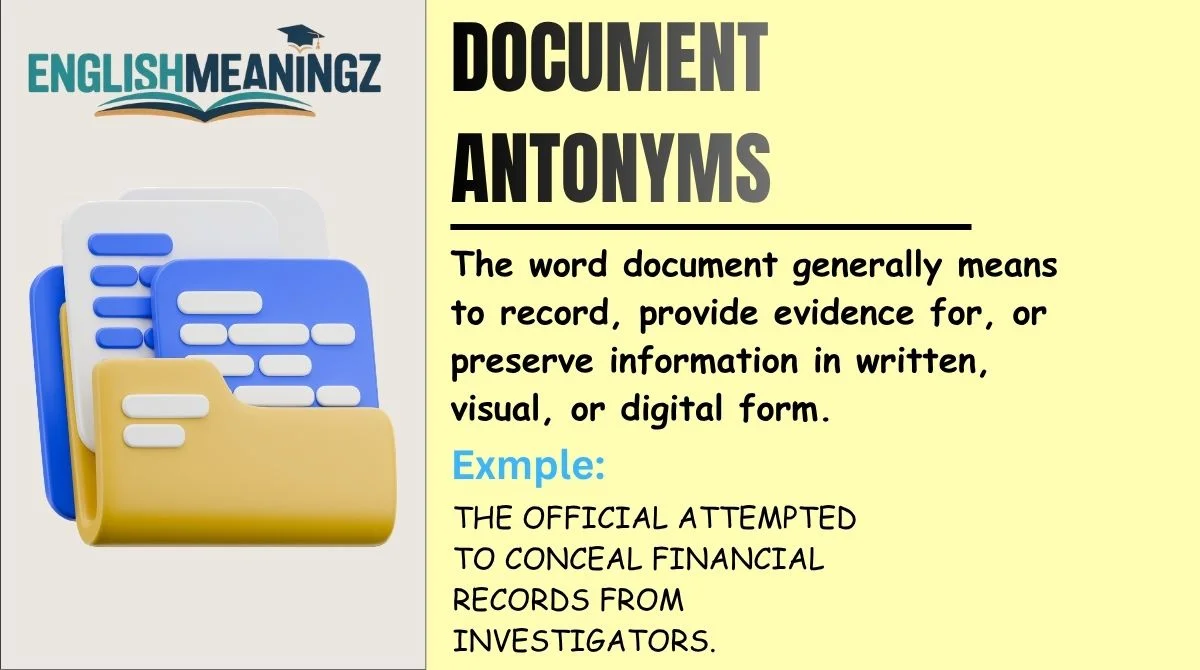
The word document generally means to record, provide evidence for, or preserve information in written, visual, or digital form. It is commonly used in academic research, journalism, legal writing, and professional reports.
A document may include:
- Written records
- Photographic evidence
- Official files
- Historical records
- Digital data
When someone documents something, they are preserving facts so that the information can be verified later.
Tone Explanation
The tone of the word document is typically formal and factual. It suggests accuracy, evidence, and reliability. That is why it frequently appears in research papers, official reports, and investigative writing.
For example:
Researchers documented the environmental changes over a ten-year period.
Here the word suggests careful recording and evidence collection.
Emotional or Action Intensity
The intensity of document is neutral but purposeful. It implies a deliberate action of recording information so that it cannot be lost or disputed.
Because of this meaning, its antonyms usually involve the opposite actions, such as:
- hiding information
- removing evidence
- ignoring facts
- destroying records
12 Best Antonyms for “Document”
Conceal
Meaning: To deliberately hide information or evidence.
Tone: Formal
Example Sentence:
The official attempted to conceal financial records from investigators.
Why It Is an Opposite:
While documenting reveals and preserves information, concealing hides it from others.
Hide
Meaning: To keep something out of sight or secret.
Tone: Informal / Neutral
Example Sentence:
The company tried to hide the internal report from the public.
Why It Is an Opposite:
Documenting makes information visible and traceable, whereas hiding removes it from view.
Suppress
Meaning: To prevent information from being revealed or published.
Tone: Formal / Academic
Example Sentence:
Authorities were accused of suppressing important research findings.
Why It Is an Opposite:
Documentation spreads knowledge, but suppression stops it from reaching others.
Delete
Meaning: To remove digital information completely.
Tone: Neutral / Technical
Example Sentence:
The administrator accidentally deleted the entire project archive.
Why It Is an Opposite:
Documentation stores information; deleting removes it permanently.
Erase
Meaning: To wipe out written or recorded information.
Tone: Neutral
Example Sentence:
The technician erased the data before handing over the device.
Why It Is an Opposite:
Documenting creates records, while erasing eliminates them.
Ignore
Meaning: To deliberately pay no attention to something.
Tone: Neutral
Example Sentence:
The report ignored several important historical events.
Why It Is an Opposite:
When you document something, you record it carefully. Ignoring it means you choose not to record it at all.
Overlook
Meaning: To fail to notice or record something important.
Tone: Formal
Example Sentence:
The study overlooked key evidence that could change the results.
Why It Is an Opposite:
Documentation requires attention to detail, while overlooking means missing those details.
Discard
Meaning: To throw away or reject information.
Tone: Neutral
Example Sentence:
The editor discarded the outdated files.
Why It Is an Opposite:
Documenting preserves information, whereas discarding removes it from use.
Obscure
Meaning: To make information unclear or difficult to understand.
Tone: Formal / Academic
Example Sentence:
Poor formatting can obscure important data in a report.
Why It Is an Opposite:
Documentation clarifies information; obscuring makes it harder to interpret.
Deny
Meaning: To refuse to acknowledge the existence or truth of something.
Tone: Formal
Example Sentence:
The organization denied the allegations despite strong evidence.
Why It Is an Opposite:
Documentation confirms facts, while denial rejects them.
Falsify
Meaning: To alter information dishonestly.
Tone: Academic / Legal
Example Sentence:
The researcher was punished for falsifying experimental data.
Why It Is an Opposite:
Documenting requires accurate recording, but falsifying changes facts.
Misrepresent
Meaning: To present information inaccurately or misleadingly.
Tone: Formal
Example Sentence:
The article misrepresented the original research findings.
Why It Is an Opposite:
Documenting preserves truth, while misrepresentation distorts it.
Additional Useful Antonyms
To expand vocabulary further, here are a few additional opposites:
- Destroy
- Bury
- Withhold
- Silence
Each of these words involves removing, hiding, or preventing the recording of information.
Strong vs Mild Opposites
Not all antonyms carry the same level of intensity. Some represent complete opposites, while others only express partial contrast.
Strong Opposites
These words directly contradict the act of documenting.
Examples:
- erase
- delete
- destroy
- conceal
These terms involve actively removing or hiding records.
Mild Opposites
These words express weaker contrast.
Examples:
- ignore
- overlook
- obscure
They do not always involve intentional actions but still prevent proper documentation.
Intensity Scale
Document → Ignore → Suppress → Conceal → Destroy
This scale shows how the strength of opposition increases depending on the action taken.
Context-Based Opposites
Antonyms often change depending on context. The opposite of a word is not always fixed.
Academic Context
In research writing:
Document → Ignore
Example:
The paper ignored several conflicting studies.
Legal Context
In law or investigations:
Document → Conceal
Example:
The witness concealed crucial evidence.
Digital Context
In technology and data management:
Document → Delete
Example:
Someone deleted the project history.
Journalism Context
In media:
Document → Suppress
Example:
The government suppressed investigative reports.
Understanding context helps writers choose the most accurate opposite word.
Common Mistakes When Using Opposites
Many writers misuse antonyms because they focus only on dictionary definitions rather than context.
Mistake 1: Using Weak Opposites
Incorrect:
The report documented the data, while the other report ignored it.
Better:
The report documented the data, while the other suppressed the findings.
The stronger antonym creates clearer contrast.
Mistake 2: Confusing Distortion With Removal
Incorrect:
The company documented the results but misrepresented them.
This sentence is contradictory because documenting implies accuracy.
Better:
The company recorded the results but misrepresented them.
Mistake 3: Mixing Formal and Informal Tone
Incorrect:
The historian documented events while others hid the facts.
Better:
The historian documented events while others concealed the facts.
Tone consistency improves professional writing.
Sentence Transformation Examples
Here are examples showing how antonyms change meaning.
Original Sentence:
The scientist documented every stage of the experiment.
Opposite Version:
The scientist ignored several stages of the experiment.
Original Sentence:
The journalist documented the corruption scandal.
Opposite Version:
Officials attempted to suppress the corruption scandal.
Original Sentence:
The archivist documented historical records.
Opposite Version:
The careless manager discarded historical records.
Original Sentence:
Researchers documented the climate data.
Opposite Version:
The report overlooked critical climate data.
Original Sentence:
The investigator documented witness statements.
Opposite Version:
The suspect attempted to conceal witness statements.
FAQs
What is the most accurate antonym of document?
The most precise antonym is conceal, because it directly expresses hiding information that could otherwise be recorded.
Is “ignore” a true opposite of document?
Yes, but it is considered a mild antonym because ignoring something means choosing not to record it rather than actively destroying evidence.
What is the opposite of document in research writing?
Common opposites include:
- suppress
- falsify
- overlook
- ignore
These words describe actions that prevent accurate academic recording.
Can delete be considered an antonym of document?
Yes. In digital environments, delete is a direct opposite because documentation stores data while deletion removes it.
What antonym works best in legal writing?
Legal contexts often use conceal, withhold, or suppress because they describe intentionally hiding evidence.
What is the difference between conceal and obscure?
- Conceal hides information completely.
- Obscure makes information difficult to understand.
Both oppose documentation but in different ways.
Why should writers learn antonyms?
Learning antonyms helps writers:
- improve vocabulary
- create contrast in writing
- express ideas more precisely
- strengthen arguments
Conclusion
Mastering antonyms is one of the most effective ways to strengthen vocabulary and improve communication. The word document represents the act of recording information clearly and accurately, which is essential in academic research, journalism, law, and professional reporting.
Its opposites—such as conceal, suppress, delete, erase, ignore, overlook, and falsify—represent actions that hide, distort, or remove information.
Understanding the differences between these words allows writers to choose the most precise term for each context.
Whether you are writing research papers, professional reports, or analytical articles, knowing these antonyms helps you present ideas with clarity and authority.
By expanding your vocabulary and learning how opposites function in language, you can produce stronger, more persuasive writing.