Understanding opposites is one of the most effective ways to expand vocabulary and sharpen writing skills. While many learners focus on synonyms to enrich their language, antonyms play an equally important role.
Opposites clarify meaning, create contrast, and help readers immediately grasp the intended tone of a sentence.
When writers know the opposite of a word, they gain greater control over expression. For example, describing someone as having stamina conveys strength, endurance, and persistence.
Using the correct opposite communicates the exact reverse—fatigue, weakness, or inability to sustain effort.
This knowledge becomes particularly valuable in academic essays, professional communication, and persuasive writing. Professors, editors, and employers often expect precise language. Choosing the right antonym prevents ambiguity and makes arguments clearer.
Opposites also improve rhetorical balance. Writers frequently contrast two ideas to emphasize a point. A well-chosen antonym allows readers to visualize the difference between persistence and collapse, endurance and fragility, or strength and exhaustion.
In professional settings, such vocabulary precision enhances credibility. Researchers, journalists, and analysts rely on carefully selected words to describe performance, productivity, and resilience. Using the wrong opposite can unintentionally weaken a message.
In this guide, you will learn the most accurate antonyms of stamina, understand their tone and context, and see how they function in real sentences.
By mastering these opposites, you will strengthen both your vocabulary and your ability to communicate ideas with clarity.
What Does “Stamina” Mean?
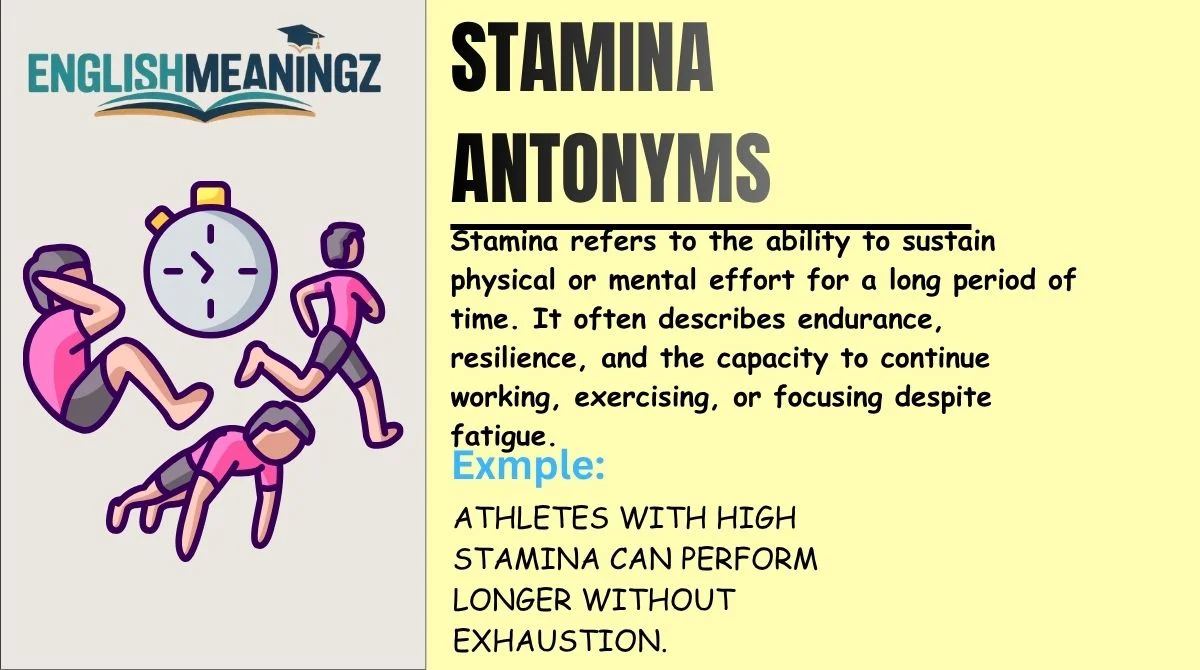
Stamina refers to the ability to sustain physical or mental effort for a long period of time. It often describes endurance, resilience, and the capacity to continue working, exercising, or focusing despite fatigue.
The word commonly appears in discussions about athletic performance, mental concentration, productivity, and emotional resilience.
In simple terms, stamina represents lasting strength.
Definition
Stamina is the physical or mental endurance that allows someone to maintain effort, energy, or performance over time.
Tone Explanation
The tone of the word is generally positive and empowering. It implies persistence, durability, and reliability.
For example:
- Athletes with high stamina can perform longer without exhaustion.
- Professionals with mental stamina maintain focus during complex tasks.
Emotional or Action Intensity
Stamina suggests a high level of sustained effort. It does not simply mean strength; it specifically refers to long-lasting strength.
Because of this meaning, most antonyms relate to:
- fatigue
- weakness
- exhaustion
- inability to persist
Understanding these opposites helps writers describe situations where energy fades, performance declines, or endurance disappears.
12 Best Antonyms for “Stamina”
Below are the most accurate opposites of stamina. Each word reflects a different level or type of reduced endurance.
Exhaustion
Meaning: Extreme physical or mental fatigue.
Tone: Emotional / Formal
Example Sentence:
After working nonstop for twenty hours, the researcher collapsed from exhaustion.
Why It Is an Opposite:
Stamina represents sustained energy, while exhaustion represents the complete loss of energy.
Fatigue
Meaning: A state of tiredness caused by prolonged activity or stress.
Tone: Academic / Professional
Example Sentence:
The long expedition caused severe fatigue among the team members.
Why It Is an Opposite:
Fatigue indicates decreasing endurance, which directly contradicts stamina.
Weakness
Meaning: Lack of physical strength or resilience.
Tone: Neutral / Academic
Example Sentence:
The illness left him with noticeable weakness in his legs.
Why It Is an Opposite:
Stamina implies strength over time, whereas weakness signals an inability to sustain effort.
Fragility
Meaning: The quality of being easily broken or unable to withstand pressure.
Tone: Formal / Academic
Example Sentence:
The economic system revealed its fragility during the crisis.
Why It Is an Opposite:
Stamina suggests durability, but fragility suggests vulnerability and instability.
Frailty
Meaning: Physical weakness often associated with age or illness.
Tone: Formal / Emotional
Example Sentence:
Her frailty made it difficult to walk long distances.
Why It Is an Opposite:
Frailty directly contrasts with the strength and endurance implied by stamina.
Burnout
Meaning: A state of emotional and mental exhaustion caused by prolonged stress.
Tone: Professional / Psychological
Example Sentence:
Continuous deadlines pushed the employee toward burnout.
Why It Is an Opposite:
Burnout occurs when stamina has been depleted over time.
Weariness
Meaning: Deep tiredness affecting both body and mind.
Tone: Literary / Emotional
Example Sentence:
A sense of weariness filled the travelers after the long journey.
Why It Is an Opposite:
Weariness reflects depleted energy rather than sustained endurance.
Lethargy
Meaning: Lack of energy, enthusiasm, or alertness.
Tone: Academic / Medical
Example Sentence:
The medication caused mild lethargy during the afternoon.
Why It Is an Opposite:
Stamina involves high energy levels, while lethargy indicates low energy.
Debility
Meaning: Physical weakness due to illness or aging.
Tone: Medical / Formal
Example Sentence:
Chronic debility prevented him from continuing his athletic career.
Why It Is an Opposite:
Debility removes the strength needed to maintain stamina.
Collapse
Meaning: Sudden failure due to loss of strength.
Tone: Dramatic / Descriptive
Example Sentence:
The runner collapsed just before the finish line.
Why It Is an Opposite:
Collapse represents the breakdown of endurance.
Depletion
Meaning: The reduction or exhaustion of energy or resources.
Tone: Academic / Professional
Example Sentence:
Continuous work without rest leads to energy depletion.
Why It Is an Opposite:
Stamina requires energy reserves, while depletion removes them.
Inability
Meaning: Lack of capability to perform a task.
Tone: Neutral / Academic
Example Sentence:
His inability to concentrate affected the project.
Why It Is an Opposite:
Without stamina, individuals may lack the ability to sustain performance.
Additional Useful Antonyms
To broaden your vocabulary further, consider these additional opposites:
- tiredness
- sluggishness
- fatigue syndrome
- powerlessness
These words also express reduced endurance or lack of sustained energy.
Strong vs Mild Opposites
Not all antonyms carry the same intensity. Some represent mild reductions in endurance, while others indicate complete loss of energy.
Mild Opposites
These describe temporary or moderate tiredness:
- fatigue
- weariness
- tiredness
- sluggishness
They suggest that stamina has decreased but not disappeared entirely.
Example:
A student might feel fatigue after studying for hours but can still continue working.
Moderate Opposites
These indicate significant energy decline:
- lethargy
- weakness
- frailty
- burnout
At this level, endurance is seriously affected.
Example:
Burnout often occurs after prolonged stress without recovery.
Strong Opposites
These represent complete loss of stamina:
- exhaustion
- collapse
- debility
These words imply that endurance has reached its limit.
Understanding intensity helps writers choose the most precise antonym for a situation.
Context-Based Opposites
Some antonyms depend on context rather than strict dictionary definitions. The opposite of stamina can vary depending on whether the discussion involves physical activity, mental focus, or emotional resilience.
Physical Context
When discussing sports or physical activity, common opposites include:
- exhaustion
- weakness
- collapse
Example:
The athlete lacked stamina and experienced rapid exhaustion during the race.
Mental Context
In intellectual work, the opposite may relate to concentration or cognitive endurance.
Examples:
- burnout
- fatigue
- inability to focus
Example sentence:
Mental fatigue reduced the scientist’s ability to analyze complex data.
Emotional Context
In emotional resilience, opposites often reflect psychological depletion.
Examples:
- burnout
- emotional exhaustion
- weariness
Example:
After years of stress, the leader felt emotional burnout.
Recognizing context ensures that the chosen antonym accurately reflects the situation.
Common Mistakes When Using Opposites
Many writers misuse antonyms because they focus only on dictionary definitions without considering nuance.
Below are common mistakes and corrections.
Mistake 1: Using “lazy” as the opposite of stamina
Incorrect:
His stamina disappeared and he became lazy.
Why incorrect:
Laziness refers to unwillingness, not lack of endurance.
Correct alternative:
His stamina disappeared and he experienced severe fatigue.
Mistake 2: Confusing weakness with fear
Incorrect:
Fear is the opposite of stamina.
Why incorrect:
Fear is an emotion, while stamina relates to endurance.
Correct alternative:
Weakness is a more accurate antonym.
Mistake 3: Using unrelated adjectives
Incorrect:
Cold is the opposite of stamina.
Correct explanation:
Temperature has no relation to endurance.
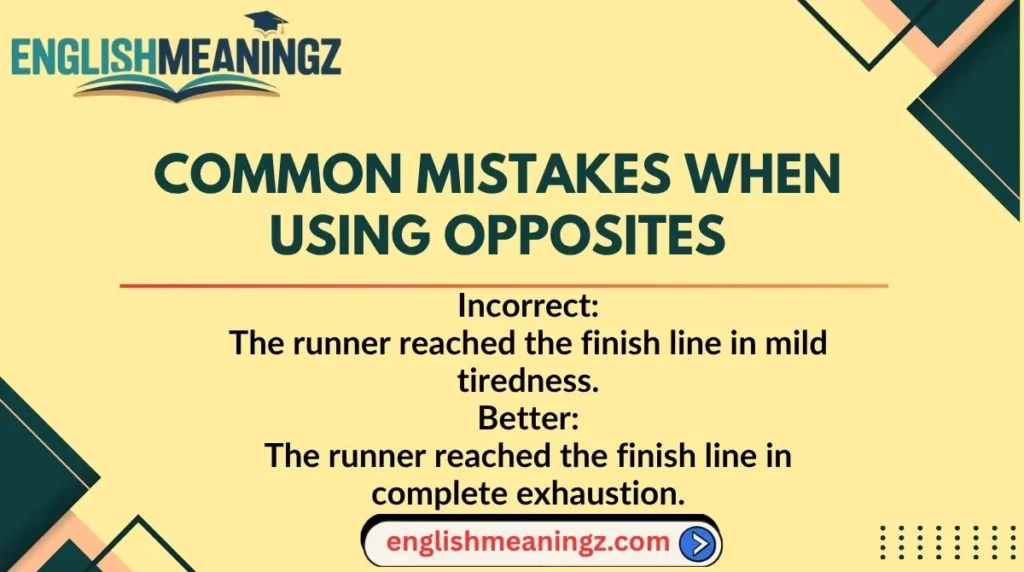
Mistake 4: Ignoring intensity
Some writers use mild antonyms where stronger ones are required.
Example:
Incorrect:
The runner reached the finish line in mild tiredness.
Better:
The runner reached the finish line in complete exhaustion.
Choosing the correct intensity improves clarity.
Sentence Transformation Examples
Below are examples showing how sentences change when antonyms replace the concept of stamina.
Original Sentence:
The marathon runner demonstrated incredible stamina.
Rewritten:
The marathon runner struggled with exhaustion.
Original Sentence:
Her mental stamina allowed her to finish the research.
Rewritten:
Mental fatigue prevented her from finishing the research.
Original Sentence:
The team showed remarkable stamina during the competition.
Rewritten:
The team collapsed from exhaustion during the competition.
Original Sentence:
His stamina helped him work long hours.
Rewritten:
Burnout eventually forced him to stop working.
Original Sentence:
Years of training built great stamina.
Rewritten:
Years of illness created severe debility.
These transformations demonstrate how antonyms completely reverse meaning.
FAQs
What is the exact opposite of stamina?
The most direct opposite is exhaustion, because stamina represents sustained energy while exhaustion represents complete loss of energy.
Is fatigue an antonym of stamina?
Yes. Fatigue is a common antonym because it describes the tiredness that occurs when stamina declines.
Are weakness and stamina opposites?
Yes, particularly in physical contexts. Weakness indicates lack of strength, which prevents sustained endurance.
Can burnout be considered the opposite of stamina?
In professional or mental contexts, burnout is a strong opposite because it represents long-term energy depletion.
Is laziness the opposite of stamina?
Not exactly. Laziness refers to unwillingness to work, while stamina refers to the ability to keep working.
Which antonym is strongest?
Words like exhaustion, collapse, and debility represent the strongest opposites because they indicate complete energy loss.
Why is learning antonyms important for writing?
Antonyms help writers create contrast, clarify meaning, and improve vocabulary precision in both academic and professional communication.
Conclusion
Stamina represents the ability to maintain energy, strength, and persistence over time. It is associated with endurance, resilience, and sustained performance in physical, mental, and emotional contexts.
Understanding its antonyms allows writers to express the opposite conditions—fatigue, weakness, exhaustion, and collapse. These words help describe situations where endurance fades or energy disappears.
By learning multiple antonyms such as exhaustion, fatigue, lethargy, frailty, burnout, and debility, writers gain greater control over tone and intensity. Each word communicates a different degree of reduced endurance.
In academic writing, professional communication, and storytelling, precise opposites strengthen clarity and persuasive impact. When used correctly, antonyms transform simple vocabulary into powerful descriptive language.
Mastering these opposites not only improves vocabulary but also enhances your ability to communicate complex ideas with accuracy and confidence.