Strong vocabulary is one of the most important elements of effective communication. Whether someone is writing an academic essay, a professional report, or a blog post, the ability to vary word choice improves clarity, sophistication, and reader engagement.
One of the most common vocabulary strategies recommended by educators and writing coaches is the use of synonyms. When writers rely too heavily on a single word, the text may appear repetitive or simplistic.
Carefully chosen synonyms help maintain flow while demonstrating linguistic competence.
This is particularly important for students preparing for standardized exams such as IELTS or university assessments, where vocabulary diversity is often a scoring criterion.
Bloggers also benefit from synonym variation because search engines value natural language patterns that avoid unnecessary repetition. Professionals in fields such as journalism, marketing, and research likewise depend on precise vocabulary to communicate nuanced ideas.
The word “connoisseur” is frequently used to describe someone who possesses refined knowledge or deep appreciation in a particular field, especially art, food, or culture.
However, depending on the context, other words may convey similar meanings with slightly different tones or levels of formality.
Understanding these alternatives enables writers to select the most appropriate expression for each situation.
This article presents 15 carefully explained connoisseur synonyms, grouped by context and accompanied by definitions, usage explanations, and example sentences.
The goal is to help students, bloggers, and professionals strengthen vocabulary while maintaining accuracy and clarity in writing.
Definition and Core Meaning of “Connoisseur”
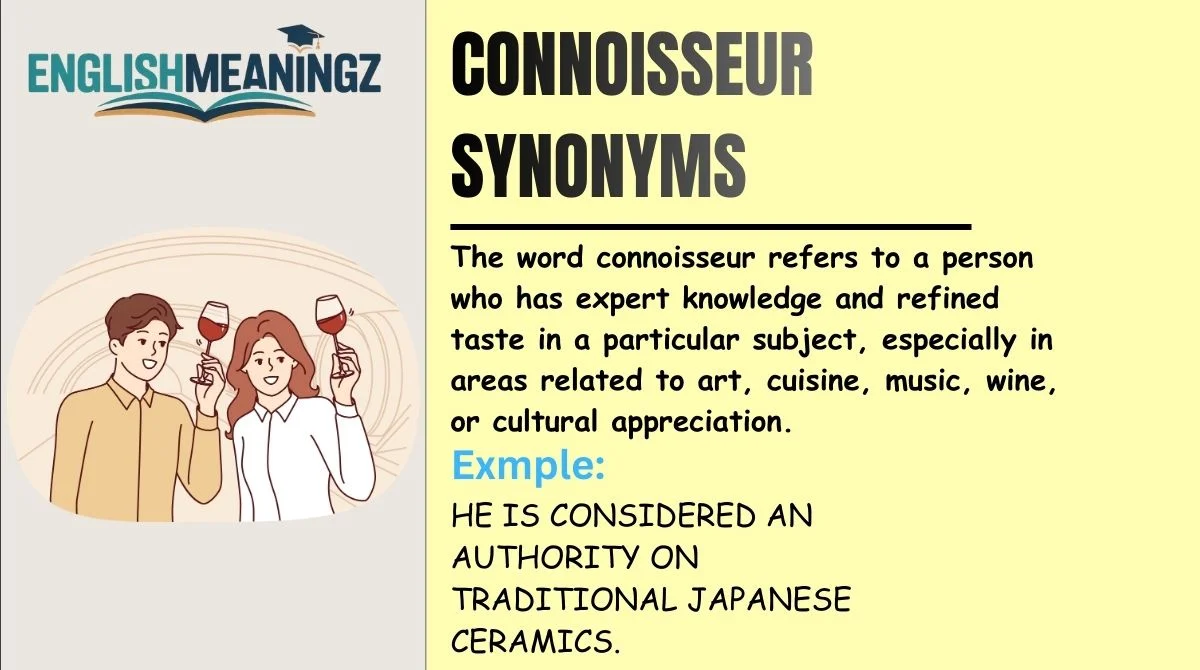
The word connoisseur refers to a person who has expert knowledge and refined taste in a particular subject, especially in areas related to art, cuisine, music, wine, or cultural appreciation.
At its core, the term implies three key qualities:
- Deep knowledge of a subject
- Refined taste or judgment
- Experience developed over time
For example, a wine connoisseur does not merely enjoy wine casually. Instead, they possess advanced knowledge about grape varieties, regions, aromas, and tasting techniques.
Similarly, an art connoisseur can distinguish subtle stylistic differences between artists, historical periods, or artistic movements.
In academic and professional contexts, the word may also be used metaphorically. For instance, someone with deep knowledge of literature might be described as a connoisseur of classic novels.
Because the term carries a sense of expertise combined with appreciation, it is often associated with sophistication and cultivated taste.
15 Synonyms Grouped by Context
Different contexts require different vocabulary choices. Some alternatives to connoisseur emphasize expertise, while others highlight enthusiasm or appreciation.
General Use Synonyms
These words work well in everyday communication and descriptive writing.
Expert
Meaning: A person with advanced knowledge or skill in a specific field.
Context Explanation:
“Expert” is one of the most widely accepted alternatives to connoisseur. It emphasizes professional-level knowledge rather than refined taste.
Example Sentence:
She is an expert in Renaissance art and frequently lectures at international museums.
Specialist
Meaning: Someone who focuses on a particular area of study or profession.
Context Explanation:
This term highlights concentration on a specific discipline rather than general knowledge.
Example Sentence:
The gallery hired a specialist in ancient sculpture to authenticate the artifact.
Authority
Meaning: A person widely recognized for reliable knowledge in a subject.
Context Explanation:
“Authority” suggests both expertise and public recognition.
Example Sentence:
He is considered an authority on traditional Japanese ceramics.
Aficionado
Meaning: A passionate admirer of a particular activity or subject.
Context Explanation:
“Aficionado” emphasizes enthusiasm and devotion more than academic expertise.
Example Sentence:
As a coffee aficionado, she enjoys exploring beans from different regions.
Enthusiast
Meaning: Someone who shows intense interest or passion for a topic.
Context Explanation:
This word focuses on passion rather than formal knowledge.
Example Sentence:
The vintage car enthusiast spent years restoring classic automobiles.
Formal and Academic Writing Synonyms
These words are particularly useful in essays, research writing, and scholarly contexts.
Scholar
Meaning: A person who studies a subject in great depth.
Context Explanation:
“Scholar” suggests academic dedication and intellectual authority.
Example Sentence:
The historian is a respected scholar of medieval European culture.
Savant
Meaning: A person with exceptional knowledge in a specific discipline.
Context Explanation:
“Savant” is often used in academic or intellectual contexts to describe someone with remarkable expertise.
Example Sentence:
The mathematics savant solved complex theoretical problems with ease.
Cognoscenti
Meaning: People who possess expert knowledge about a specialized field.
Context Explanation:
This term is frequently used to refer to a group of experts rather than a single individual.
Example Sentence:
Only the cognoscenti truly appreciated the subtle details of the exhibition.
Critic
Meaning: A professional evaluator of art, literature, or performance.
Context Explanation:
A critic may not only appreciate art but also analyze and judge it publicly.
Example Sentence:
The theater critic praised the production’s innovative staging.
Analyst
Meaning: Someone who examines complex subjects systematically.
Context Explanation:
“Analyst” highlights evaluation and interpretation rather than aesthetic appreciation.
Example Sentence:
The music analyst discussed the composition’s harmonic structure.
Informal Usage Synonyms
These words appear more often in casual speech and conversational writing.
Buff
Meaning: A person who is highly interested in a specific hobby or topic.
Context Explanation:
“Buff” is commonly used in everyday language, such as “film buff” or “history buff.”
Example Sentence:
As a film buff, he watches classic cinema every weekend.
Fan
Meaning: Someone who greatly admires or enjoys something.
Context Explanation:
This is a very common informal term expressing enthusiasm.
Example Sentence:
She is a huge fan of contemporary photography.
Lover
Meaning: A person who deeply enjoys something.
Context Explanation:
“Lover” emphasizes emotional appreciation.
Example Sentence:
As a nature lover, he spends most of his free time hiking.
Technical or Subject-Specific Synonyms
These alternatives are often used in professional or specialized contexts.
Epicure
Meaning: Someone with refined taste in food and drink.
Context Explanation:
An epicure values quality cuisine and culinary experiences.
Example Sentence:
The restaurant attracts epicures who appreciate fine dining.
Gourmet
Meaning: A person knowledgeable about fine food and cooking.
Context Explanation:
This term is widely used in culinary writing.
Example Sentence:
The gourmet carefully selected ingredients for the elaborate meal.
Word Intensity and Tone Comparison Table
| Synonym | Formality Level | Focus | Emotional Strength |
|---|---|---|---|
| Expert | Neutral | Skill and knowledge | Moderate |
| Authority | Formal | Recognized expertise | Strong |
| Aficionado | Semi-formal | Passion and admiration | High |
| Enthusiast | Neutral | Interest and excitement | Moderate |
| Scholar | Formal | Academic knowledge | Strong |
| Savant | Formal | Exceptional intellect | Very strong |
| Buff | Informal | Hobby interest | Light |
| Fan | Informal | Admiration | Light |
| Gourmet | Semi-formal | Culinary expertise | Moderate |
| Epicure | Formal | Refined taste | Moderate |
This comparison helps writers choose the most appropriate synonym based on tone and audience.
Common Mistakes When Using These Synonyms
Even though these words share similar meanings, they cannot always replace each other directly.
Mistake 1: Using an informal word in academic writing
Incorrect:
The professor is a history buff.
Correct:
The professor is a respected scholar of history.
Explanation: “Buff” sounds casual and unsuitable for academic contexts.
Mistake 2: Confusing enthusiasm with expertise
Incorrect:
He is an expert in photography because he enjoys taking pictures.
Correct:
He is a photography enthusiast who enjoys experimenting with new techniques.
Explanation: Enjoyment does not necessarily imply professional expertise.
Mistake 3: Misusing technical synonyms
Incorrect:
She is an epicure of modern architecture.
Correct:
She is an authority on modern architecture.
Explanation: “Epicure” specifically refers to refined taste in food and drink.
Synonyms in Academic Writing
Example Paragraph 1
In the field of art history, scholars play an essential role in preserving cultural knowledge. A respected authority on Renaissance painting can identify stylistic influences that might escape the attention of casual observers. These experts carefully analyze historical context, artistic techniques, and archival records to construct a deeper understanding of artistic development.
Example Paragraph 2
Literary critics often function as intellectual guides for readers. While an enthusiast may simply enjoy a novel, a trained analyst examines narrative structure, symbolism, and thematic complexity. Through systematic interpretation, scholars contribute valuable insights that expand public appreciation of literature.
IELTS and Exam Writing Tips
1. Avoid excessive repetition
In academic writing exams such as IELTS, repeating the same word multiple times can reduce the perceived quality of vocabulary.
Example:
Instead of writing:
“The art connoisseur visited many galleries. The connoisseur admired several paintings.”
You could write:
“The art connoisseur visited many galleries. The expert admired several remarkable paintings.”
2. Choose synonyms carefully
Not all alternatives carry identical meanings. Replacing a word without considering context may distort the intended message.
3. Maintain clarity
Sometimes the original word remains the most accurate choice. If the nuance of connoisseur—refined taste combined with expertise—is essential, replacing it may weaken the meaning.
4. Use synonyms sparingly
Effective writing balances variety with precision. Excessive synonym replacement can sound unnatural.
Similar Words vs True Synonyms
Many vocabulary lists include words that are related to connoisseur but not exact synonyms.
For example:
Enthusiast – indicates passion but not necessarily expertise.
Critic – implies evaluation rather than appreciation.
Scholar – focuses on academic study rather than refined taste.
A true synonym would preserve both the sense of knowledge and appreciation. Words like epicure or gourmet come closer in specialized contexts.
Recognizing these subtle distinctions helps writers avoid inaccurate substitutions.
Practice Sentences
Choose the most appropriate synonym for each sentence.
- The wine ______ carefully evaluated the aroma and flavor profile.
- As a classical music ______, she attends concerts every month.
- The historian is widely regarded as an ______ on ancient civilizations.
- The restaurant attracts ______ who appreciate refined cuisine.
- The film ______ maintains an extensive collection of rare movies.
Suggested answers may include expert, enthusiast, authority, gourmet, buff, depending on context.
Practicing with these exercises strengthens vocabulary recall and improves writing fluency.
Frequently Asked Questions
What is the closest synonym for connoisseur?
The closest general synonym is expert, because both terms indicate deep knowledge in a particular field.
Is “aficionado” the same as “connoisseur”?
Not exactly. An aficionado shows strong enthusiasm, while a connoisseur typically possesses refined knowledge and judgment.
Can “gourmet” replace “connoisseur”?
Yes, but mainly in culinary contexts such as food and wine appreciation.
Is “buff” appropriate in academic writing?
No. “Buff” is informal and should generally be avoided in academic essays.
Why do writers use synonyms?
Synonyms help avoid repetition, improve stylistic variation, and demonstrate a broader vocabulary.
Conclusion
Expanding vocabulary is one of the most effective ways to improve writing quality.
The word connoisseur represents a person with refined knowledge and appreciation in a particular field, but many alternative expressions can convey similar ideas with slightly different tones.
Understanding the distinctions between words such as expert, aficionado, scholar, enthusiast, gourmet, and authority enables writers to communicate more precisely.
Students preparing for exams, bloggers creating engaging content, and professionals writing reports all benefit from mastering synonym variation.
Rather than replacing words randomly, thoughtful vocabulary selection ensures that meaning, tone, and context remain accurate.
With practice and careful observation, writers can develop a rich vocabulary that enhances clarity, sophistication, and reader engagement.