Vocabulary variety is one of the most effective ways to improve the clarity, sophistication, and impact of writing. Whether someone is preparing academic essays, publishing blog content, or communicating professionally, using a wide range of words helps prevent repetition and strengthens expression.
One of the most common mistakes writers make is repeating the same word throughout a paragraph. For example, repeatedly using the word scolding can make writing sound limited and monotonous. Replacing it with appropriate synonyms allows writers to maintain meaning while enhancing style and precision.
Students preparing for academic exams such as IELTS or university assessments often gain higher writing scores when they demonstrate lexical variety.
Bloggers and content creators benefit as well, since varied vocabulary improves readability and search engine optimization. Professionals in workplace communication also rely on nuanced language to maintain tone and professionalism.
This article explores 23 scolding synonyms, explains their meanings, and demonstrates how to use them effectively in different contexts including academic writing, professional communication, and everyday conversation.
Definition and Core Meaning of “Scolding”
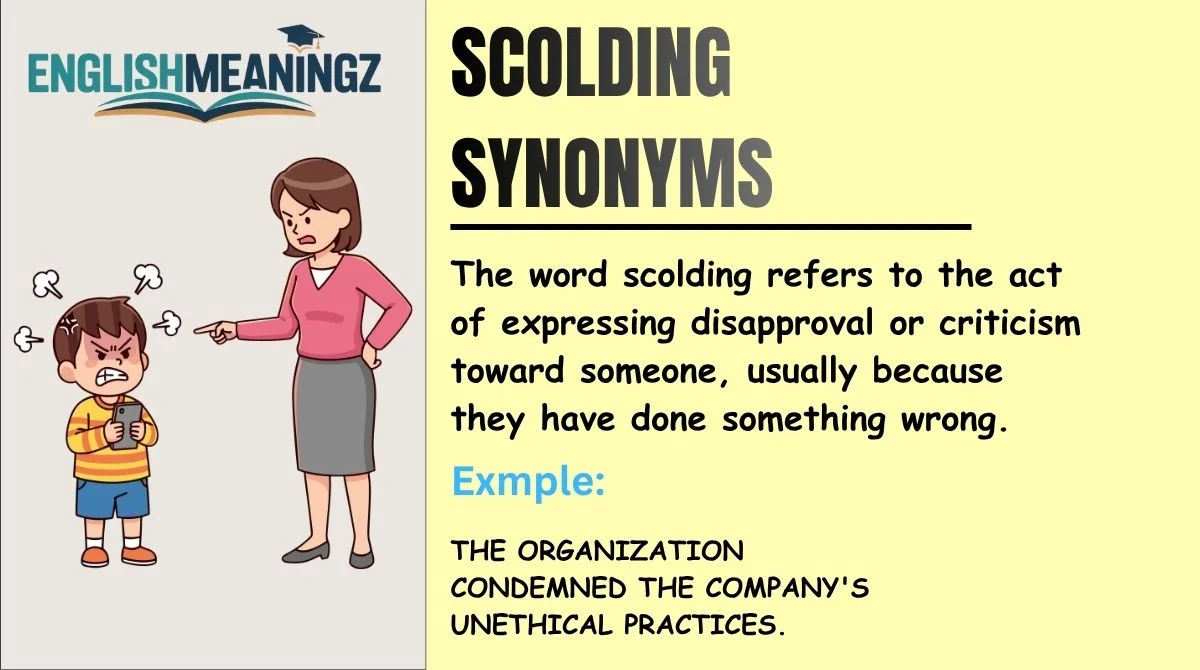
The word scolding refers to the act of expressing disapproval or criticism toward someone, usually because they have done something wrong. It typically involves speaking in a corrective or reprimanding manner.
In everyday communication, scolding often occurs in situations such as:
- A teacher correcting a student’s behavior
- A parent reprimanding a child
- A manager addressing an employee’s mistake
Unlike simple criticism, scolding usually contains a strong emotional tone, often intended to correct behavior or enforce discipline.
From a linguistic perspective, scolding belongs to a broader category of corrective communication, which includes warning, reprimanding, lecturing, or rebuking.
Understanding the various synonyms for scolding helps writers choose words that match the exact tone, context, and level of formality required.
23 Synonyms Grouped by Context
General Use Synonyms
These words can be used in everyday writing and communication when describing someone who is correcting or criticizing another person.
Rebuke
Meaning: A sharp expression of disapproval.
Context: Often used when someone criticizes behavior strongly but formally.
Example Sentence:
The manager rebuked the employee for ignoring safety procedures.
Reprimand
Meaning: An official or formal expression of disapproval.
Context: Common in workplace or institutional environments.
Example Sentence:
The student received a reprimand from the principal for breaking school rules.
Chide
Meaning: To scold someone mildly or gently.
Context: Often used when the correction is not harsh.
Example Sentence:
She gently chided her brother for forgetting their meeting.
Admonish
Meaning: To warn or criticize someone with authority.
Context: Frequently used in professional or educational contexts.
Example Sentence:
The professor admonished the class for submitting incomplete assignments.
Lecture
Meaning: To criticize someone at length, often in a moralizing way.
Context: Used when someone speaks extensively about another person’s mistake.
Example Sentence:
His parents lectured him about the importance of responsibility.
Formal and Academic Writing Synonyms
These synonyms are suitable for research papers, reports, essays, and professional writing.
Censure
Meaning: Formal condemnation or severe criticism.
Context: Common in political, academic, or legal discussions.
Example Sentence:
The committee issued a formal censure against the official for misconduct.
Reproach
Meaning: To express disappointment or disapproval.
Context: Used when criticism carries emotional weight.
Example Sentence:
Her tone conveyed reproach after he ignored her advice.
Condemn
Meaning: To strongly express disapproval of an action.
Context: Often used in formal discussions about ethics or public behavior.
Example Sentence:
The organization condemned the company’s unethical practices.
Berate
Meaning: To scold angrily or repeatedly.
Context: Suggests intense criticism.
Example Sentence:
The coach berated the players for their lack of effort during practice.
Castigate
Meaning: To criticize or punish severely.
Context: Common in academic and political commentary.
Example Sentence:
The article castigated the government for its poor policy decisions.
Informal Usage Synonyms
These synonyms appear more frequently in casual speech or informal writing.
Tell Off
Meaning: To speak angrily to someone because of their behavior.
Context: Very common in everyday conversation.
Example Sentence:
She told him off for arriving late to the meeting.
Lay Into
Meaning: To criticize someone harshly.
Context: Informal and emotionally strong.
Example Sentence:
The supervisor laid into the staff after the project failed.
Chew Out
Meaning: To angrily scold someone.
Context: Common in American informal speech.
Example Sentence:
The coach chewed out the team for poor discipline.
Dress Down
Meaning: To criticize someone strongly, especially in authority.
Context: Often used when a superior scolds a subordinate.
Example Sentence:
The officer dressed down the soldiers for ignoring orders.
Give Someone a Talking-To
Meaning: To speak seriously to someone about their behavior.
Context: Mildly informal but less aggressive.
Example Sentence:
The teacher gave the students a talking-to after the incident.
Technical or Subject-Specific Synonyms
These words appear frequently in academic, legal, or professional discussions.
Reprove
Meaning: To criticize someone gently but formally.
Context: Used in formal or literary contexts.
Example Sentence:
The supervisor reproved the intern for neglecting instructions.
Upbraid
Meaning: To criticize severely.
Context: Often used in literary or formal writing.
Example Sentence:
He was upbraided for failing to meet the deadline.
Scathe
Meaning: To criticize severely and harshly.
Context: Used in journalism and commentary.
Example Sentence:
The critic scathed the film for its weak storyline.
Take to Task
Meaning: To criticize someone for failing to meet expectations.
Context: Common in professional settings.
Example Sentence:
The manager took the employee to task for missing the deadline.
Reprove Publicly
Meaning: To criticize someone in front of others.
Context: Often used in disciplinary environments.
Example Sentence:
The coach publicly reproved the player for unsportsmanlike behavior.
Harangue
Meaning: A long, aggressive speech criticizing someone.
Context: Common in political or rhetorical settings.
Example Sentence:
The leader harangued the audience about civic responsibility.
Lambaste
Meaning: To criticize harshly.
Context: Frequently used in journalism.
Example Sentence:
The newspaper lambasted the company for its poor service.
Tongue-Lash
Meaning: To scold someone severely.
Context: Informal but vivid.
Example Sentence:
The teacher tongue-lashed the students for cheating.
Word Intensity and Tone Comparison Table
| Word | Formal Level | Emotional Strength |
|---|---|---|
| Chide | Medium | Mild |
| Admonish | High | Moderate |
| Rebuke | High | Strong |
| Reprimand | High | Moderate |
| Lecture | Medium | Moderate |
| Berate | Medium | Strong |
| Castigate | High | Very Strong |
| Lambaste | Medium | Very Strong |
| Reprove | High | Mild |
| Tell Off | Low | Moderate |
This comparison helps writers select the correct synonym based on tone and context.
Common Mistakes When Using These Synonyms
Writers often misuse synonyms because they overlook differences in tone and formality.
Mistake 1: Using Informal Words in Academic Writing
Incorrect:
The professor told off the students for plagiarism.
Correct:
The professor reprimanded the students for plagiarism.
Mistake 2: Overusing Strong Words
Incorrect:
The teacher castigated the student for whispering.
Correct:
The teacher chided the student for whispering.
Mistake 3: Confusing Criticism with Guidance
Incorrect:
The mentor berated the student for asking questions.
Correct:
The mentor advised the student about improving performance.
Synonyms in Academic Writing
Example Paragraph 1
Educational institutions frequently address misconduct through formal disciplinary communication. In many cases, instructors may admonish students who violate academic integrity policies. Such actions are intended not merely to criticize but to reinforce ethical standards within the academic community.
Example Paragraph 2
Organizations often implement structured procedures to address professional misconduct. Managers may reprimand employees who fail to follow safety protocols, while regulatory bodies might censure institutions that violate established regulations. These corrective measures promote accountability and encourage improved behavior.
IELTS and Exam Writing Tips
Vocabulary range is a critical scoring factor in exams such as IELTS and TOEFL.
Tip 1: Avoid Repetition
Instead of repeating the same word multiple times, alternate between appropriate synonyms.
Example:
Poor:
The teacher scolded the student. Later, she scolded him again.
Improved:
The teacher reprimanded the student. Later, she admonished him again.
Tip 2: Match the Context
Use formal synonyms in academic essays.
Good academic choices:
- Reprimand
- Admonish
- Censure
- Reprove
Avoid overly informal phrases in formal exams.
Tip 3: Do Not Replace Words Unnecessarily
If a synonym changes the meaning, it should not be used.
For instance, chide suggests mild criticism, while castigate implies severe condemnation.
Similar Words vs True Synonyms
Not all words related to scolding mean the same thing.
Criticize vs Scold
Criticize refers to expressing disapproval but does not necessarily include emotional intensity.
Scolding usually involves stronger emotional correction.
Warn vs Admonish
Warning informs someone about danger, while admonishing combines warning with criticism.
Advise vs Reprimand
Advising offers guidance, whereas reprimanding expresses disapproval for a mistake.
Understanding these distinctions ensures precise vocabulary usage.
Practice Sentences
Choose the most appropriate synonym to complete each sentence.
- The teacher ______ the student for submitting copied work.
- The manager ______ the staff for ignoring company guidelines.
- The parent gently ______ the child for speaking rudely.
- The committee ______ the official for violating regulations.
- The coach ______ the players after their poor performance.
Possible answers include: reprimanded, admonished, chided, censured, berated.
Practicing these examples strengthens vocabulary recall and contextual understanding.
FAQs
What is the strongest synonym for scolding?
Words such as castigate, lambaste, and berate represent some of the strongest forms of scolding because they imply severe criticism.
Which synonym is best for academic writing?
Formal terms such as reprimand, admonish, censure, and reprove are appropriate for academic writing.
Is “lecture” a synonym for scolding?
Yes, in informal contexts, lecture can mean criticizing someone at length about their behavior.
What is a mild synonym for scolding?
Words such as chide or reprove indicate gentle or mild criticism.
Why should writers use synonyms?
Using synonyms improves vocabulary range, avoids repetition, and enhances writing quality in essays, articles, and professional communication.
Conclusion
Expanding vocabulary is essential for effective communication. The word scolding can be expressed in many different ways depending on tone, context, and level of formality.
By learning and practicing the 23 scolding synonyms discussed in this article, writers can communicate criticism more precisely and professionally.
Students preparing for exams can improve their lexical range, bloggers can produce more engaging content, and professionals can maintain clarity and authority in workplace communication.
The key is understanding not only the meanings of these words but also their appropriate contexts.
Consistent practice with synonyms strengthens writing skills and builds confidence in expressing ideas with precision and variety.