In modern academic and professional writing, vocabulary diversity plays a crucial role in improving clarity, readability, and credibility.
Repeating the same word multiple times can weaken an argument and reduce the quality of writing. This is especially true for frequently used verbs such as illustrate.
By learning alternative expressions, writers can communicate ideas more effectively and demonstrate stronger language proficiency.
Using synonyms strategically also improves writing scores in standardized tests and academic evaluations. In examinations such as IELTS, TOEFL, and university assessments, examiners often reward lexical variety.
Writers who use a wide range of accurate vocabulary appear more sophisticated and capable of expressing nuanced ideas.
Students, bloggers, and professionals benefit greatly from mastering synonyms.
Students improve their essays and research papers, bloggers produce engaging content, and professionals write clearer reports and presentations.
Understanding when and how to use alternatives to illustrate allows writers to adapt their tone to different contexts.
This article explores 13 powerful synonyms of “illustrate”, explains their meanings, and demonstrates how to use them effectively in academic and everyday writing.
Definition and Core Meaning of “Illustrate”
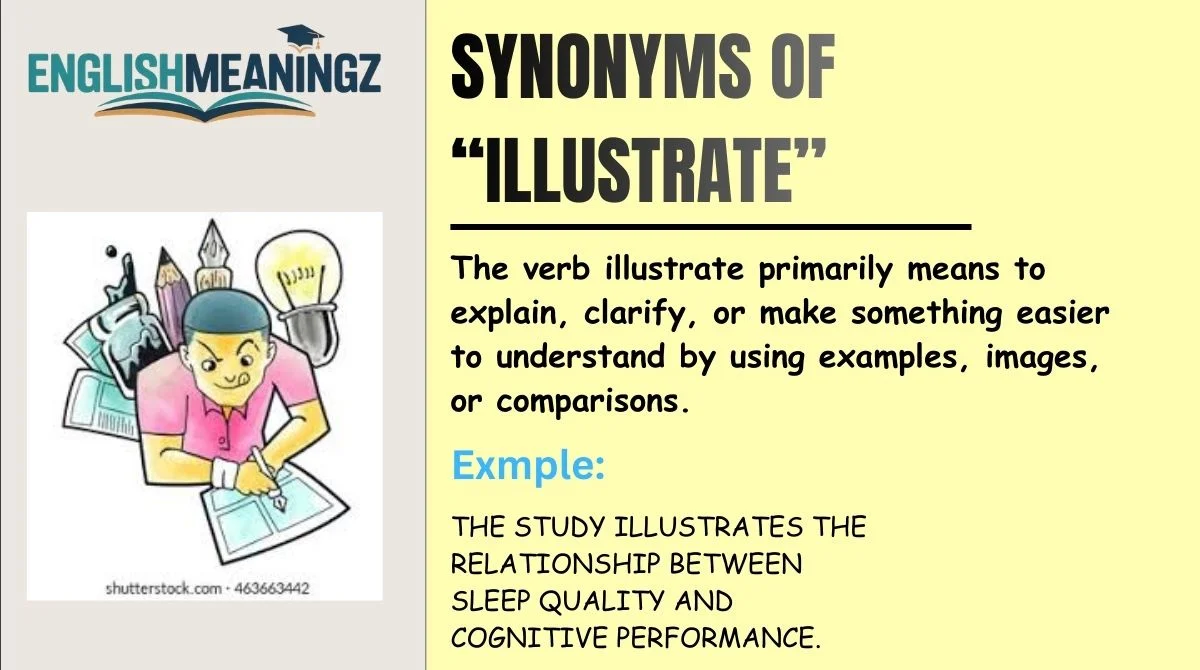
The verb illustrate primarily means to explain, clarify, or make something easier to understand by using examples, images, or comparisons. It often appears in educational, academic, and explanatory contexts.
In general communication, illustrate is used when a writer or speaker wants to support an idea with evidence or demonstration.
Example:
The teacher used diagrams to illustrate the structure of the human heart.
In academic writing, the word carries a more analytical meaning. It refers to the act of providing evidence, examples, or visual representation to support a claim or concept.
Example:
The study illustrates the relationship between sleep quality and cognitive performance.
In professional environments, the word is commonly used in presentations, reports, and training materials where complex ideas must be explained clearly.
Overall, illustrate functions as a bridge between abstract ideas and clear understanding.
13 Synonyms Grouped by Context
Understanding synonyms is not only about replacing a word. Each alternative has its own tone, context, and level of formality. Below are thirteen useful synonyms grouped according to their typical usage.
General Use Synonyms
Demonstrate
Meaning:
To clearly show how something works or prove that something is true.
Context:
Often used when evidence or action supports an explanation.
Example sentence:
The experiment demonstrates how temperature affects chemical reactions.
Explain
Meaning:
To make an idea or concept clear by describing it in detail.
Context:
Common in teaching, presentations, and instructional writing.
Example sentence:
The professor explained the theory using real-life examples.
Show
Meaning:
To present information in a visible or understandable way.
Context:
One of the most common everyday alternatives to illustrate.
Example sentence:
The graph shows a steady increase in population growth.
Depict
Meaning:
To represent something through description, images, or artistic representation.
Context:
Frequently used in literature, film analysis, and visual arts.
Example sentence:
The novel depicts the challenges faced by immigrants in a new country.
Formal and Academic Writing Synonyms
Exemplify
Meaning:
To serve as a typical example of something.
Context:
Used in academic essays when presenting a case that represents a broader concept.
Example sentence:
This case study exemplifies the impact of leadership on team performance.
Elucidate
Meaning:
To make something clear by providing detailed explanation.
Context:
Highly formal and common in scholarly writing.
Example sentence:
The researcher elucidated the complex process of gene regulation.
Clarify
Meaning:
To remove confusion and make a statement or idea easier to understand.
Context:
Used when addressing misunderstandings or complex topics.
Example sentence:
The lecturer clarified the difference between correlation and causation.
Outline
Meaning:
To describe the main points of something briefly and clearly.
Context:
Often used in academic planning or summaries.
Example sentence:
The report outlines the key steps required for project implementation.
Informal Usage Synonyms
Point Out
Meaning:
To direct attention to a particular fact or detail.
Context:
Common in conversations, blog posts, and informal writing.
Example sentence:
The author points out that small habits can lead to major success.
Highlight
Meaning:
To emphasize an important idea or feature.
Context:
Frequently used in presentations and articles.
Example sentence:
The report highlights the importance of digital literacy in modern education.
Technical or Subject-Specific Synonyms
Portray
Meaning:
To represent or describe a character, situation, or concept.
Context:
Used in media analysis, storytelling, and artistic discussions.
Example sentence:
The documentary portrays the effects of climate change on coastal communities.
Present
Meaning:
To introduce information formally to an audience.
Context:
Common in academic conferences and professional reports.
Example sentence:
The scientist presented new findings on renewable energy efficiency.
Visualize
Meaning:
To represent data or concepts using visual formats such as charts or diagrams.
Context:
Common in data science, statistics, and educational materials.
Example sentence:
The software helps researchers visualize complex data patterns.
Word Intensity and Tone Comparison Table
Different synonyms carry different levels of formality and emphasis. Understanding these differences helps writers choose the most appropriate word.
| Word | Formal Level | Emotional Strength | Typical Context |
|---|---|---|---|
| Show | Low | Neutral | Everyday communication |
| Explain | Medium | Neutral | Teaching and instruction |
| Demonstrate | Medium-High | Strong | Evidence-based writing |
| Depict | Medium | Moderate | Literature and art |
| Clarify | Medium-High | Neutral | Academic discussions |
| Exemplify | High | Moderate | Scholarly writing |
| Elucidate | Very High | Strong | Advanced academic texts |
| Highlight | Medium | Moderate | Reports and presentations |
| Portray | Medium | Moderate | Media and storytelling |
| Visualize | Medium-High | Moderate | Data analysis |
This comparison shows that some words function better in formal contexts, while others suit conversational or descriptive writing.
Common Mistakes When Using These Synonyms
Many writers misuse synonyms because they assume all alternatives have identical meanings. However, subtle differences can lead to errors.
Mistake 1: Using a formal synonym in casual writing
Incorrect:
Let me elucidate how this phone works.
Correct:
Let me explain how this phone works.
Explanation:
Elucidate is too formal for everyday conversation.
Mistake 2: Using “depict” for abstract explanations
Incorrect:
The teacher depicted the grammar rule.
Correct:
The teacher explained the grammar rule.
Explanation:
Depict is more suitable for visual or artistic descriptions.
Mistake 3: Confusing “outline” with “explain”
Incorrect:
The lecturer outlined the complex theory in detail.
Correct:
The lecturer explained the complex theory in detail.
Explanation:
Outline usually refers to a brief summary rather than detailed explanation.
Mistake 4: Overusing “highlight”
Incorrect:
The book highlights how the system works step by step.
Correct:
The book explains how the system works step by step.
Explanation:
Highlight emphasizes key points rather than full explanations.
Synonyms in Academic Writing
Example Paragraph 1
Economic inequality has become a major concern in modern societies. Recent studies demonstrate that income disparity can significantly influence social mobility and access to education. Researchers often highlight the role of government policy in reducing economic gaps. Statistical data further illustrates the connection between employment opportunities and financial stability.
Example Paragraph 2
The concept of sustainable development is widely discussed in environmental studies. Scholars frequently explain how economic growth must balance environmental protection. Case studies exemplify successful strategies adopted by several countries. These examples clarify the importance of long-term planning and responsible resource management.
These paragraphs show how multiple synonyms can improve writing flow and reduce repetition.
IELTS and Exam Writing Tips
Vocabulary variety is a major scoring factor in language exams. However, replacing words incorrectly can lower your score.
1. Avoid unnecessary repetition
Instead of repeating illustrate several times, vary your vocabulary.
Example:
The chart shows population growth. The data demonstrates a steady increase.
2. Use formal synonyms in essays
Words such as demonstrate, exemplify, clarify, and elucidate are appropriate for academic tasks.
3. Do not replace words blindly
Sometimes the original word is still the best choice.
Example:
The diagram illustrates the process.
Replacing it with portrays or depicts may sound unnatural depending on context.
4. Focus on accuracy first
Using a simple word correctly is better than using a complex word incorrectly.
Similar Words vs True Synonyms
Not every word that appears similar to illustrate functions as a perfect synonym. Some alternatives only overlap partially in meaning.
For instance, explain focuses on giving information, while demonstrate emphasizes evidence or proof. Similarly, depict and portray relate more closely to visual or artistic representation rather than analytical explanation.
Another distinction exists between highlight and clarify. Highlighting emphasizes importance, while clarifying removes confusion.
Understanding these subtle differences allows writers to select words that match their exact intention.
Practice Sentences
Choose the most appropriate synonym for each sentence.
- The scientist used charts to ______ the results of the experiment.
- The documentary ______ the lives of endangered animals.
- The teacher tried to ______ the complex mathematical concept.
- The report ______ the main challenges facing the healthcare system.
- The case study ______ the importance of ethical leadership.
- The professor will ______ the research findings at the conference.
- The author ______ several examples to support the argument.
Possible answers include: illustrate, depict, explain, outline, exemplify, present, and demonstrate.
Practicing these exercises helps strengthen vocabulary retention and writing flexibility.
FAQs
What is the best synonym for “illustrate”?
The best synonym depends on context. In academic writing, demonstrate and exemplify are strong alternatives, while show and explain work well in general communication.
Is “demonstrate” stronger than “illustrate”?
Yes. Demonstrate often implies proof or evidence, whereas illustrate mainly focuses on explanation or clarification.
Can “depict” replace “illustrate”?
Sometimes. However, depict usually refers to visual or artistic representation rather than analytical explanation.
Which synonym is most formal?
Among the synonyms listed, elucidate is considered one of the most formal and is commonly used in scholarly writing.
Why should writers learn synonyms for common words?
Learning synonyms improves vocabulary variety, enhances writing quality, and prevents repetition in essays, reports, and professional documents.
Conclusion
Expanding vocabulary is one of the most effective ways to strengthen writing skills. Words like illustrate are useful, but relying on them too frequently can make writing repetitive and less engaging.
By learning synonyms such as demonstrate, exemplify, elucidate, clarify, depict, highlight, and portray, writers gain the ability to express ideas more precisely and creatively.
These alternatives also help students achieve higher scores in academic exams and enable professionals to communicate complex information more effectively.
Consistent practice, careful reading, and attention to context will gradually improve vocabulary mastery.
With time, writers can confidently select the most appropriate word for every situation and produce clearer, more persuasive writing.