Vocabulary diversity is one of the most important indicators of strong writing.
Whether someone is writing academic essays, blog posts, business emails, or professional reports, repeating the same phrases can weaken the impact of the message.
One phrase that appears frequently in feedback and evaluation is “well done.” While it is a positive and encouraging expression, using it repeatedly can make writing sound limited and less sophisticated.
Expanding vocabulary with well done synonyms helps writers express appreciation, evaluation, and recognition more precisely.
Students preparing for academic exams, bloggers creating engaging content, and professionals communicating in the workplace can all benefit from replacing repetitive phrases with stronger alternatives.
In academic writing assessments such as IELTS or university essays, lexical variety is often directly connected to higher scores.
Using varied expressions to praise work, evaluate outcomes, or acknowledge achievement demonstrates stronger language command.
This article explores 13 powerful synonyms for “well done,” explains their meanings, demonstrates how they should be used in different contexts, and provides examples that help writers use them correctly in academic and professional communication.
Definition and Core Meaning of “Well Done”
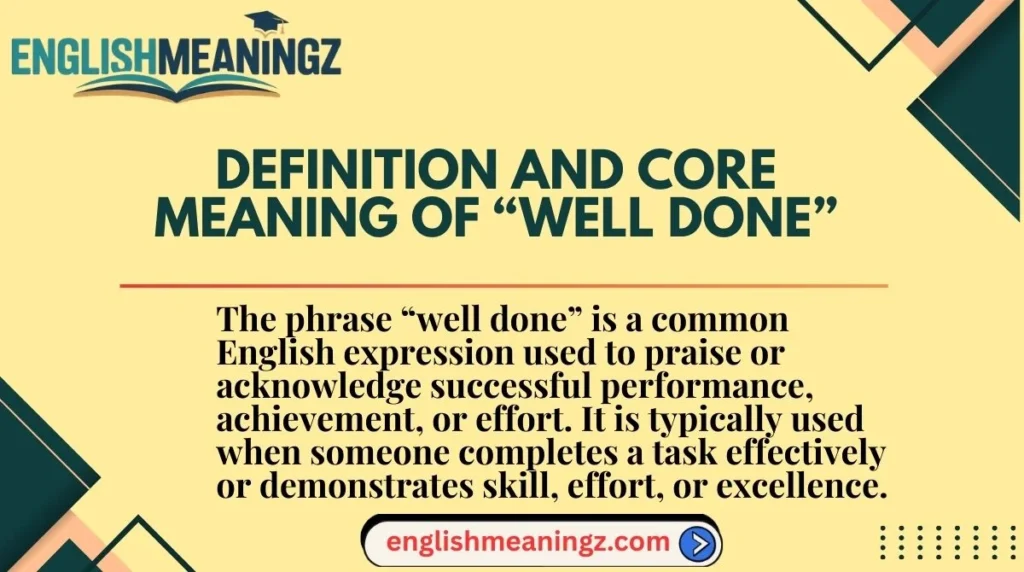
The phrase “well done” is a common English expression used to praise or acknowledge successful performance, achievement, or effort. It is typically used when someone completes a task effectively or demonstrates skill, effort, or excellence.
At its core, the phrase communicates approval, satisfaction, and recognition.
In everyday conversation, “well done” often functions as a short congratulatory remark. For example:
Well done on finishing the project ahead of schedule.
In academic and professional contexts, however, writers often prefer more precise vocabulary that reflects the level of achievement, formality, or professionalism required in the situation.
From a linguistic perspective, “well done” belongs to a group of evaluative expressions—phrases used to assess performance or outcomes. Writers and speakers frequently replace it with synonyms that convey different shades of meaning such as admiration, professionalism, or excellence.
Understanding these variations allows writers to select the most appropriate synonym depending on tone, audience, and purpose.
13 Synonyms Grouped by Context
Different situations require different levels of formality and tone. The following 13 well done synonyms are grouped by their most common contexts of use.
General Use
Excellent
Meaning:
“Excellent” describes something of very high quality or performance.
Context Explanation:
This synonym is widely used in education, workplace evaluations, and general communication. It conveys strong approval without sounding overly emotional.
Example Sentence:
The research methodology in your paper is excellent and demonstrates careful analysis.
Great Job
Meaning:
A casual expression used to praise someone’s effort or achievement.
Context Explanation:
Common in everyday conversation, teaching environments, and informal feedback situations.
Example Sentence:
You organized the presentation clearly. Great job explaining the complex data.
Outstanding
Meaning:
Indicates performance that is significantly better than average.
Context Explanation:
Often used in professional evaluations, awards, or formal recognition of achievements.
Example Sentence:
Her leadership during the project was outstanding and greatly contributed to the team’s success.
Impressive
Meaning:
Something that creates admiration due to quality, skill, or achievement.
Context Explanation:
Used when the result surprises or exceeds expectations.
Example Sentence:
Your ability to summarize the article in such detail is truly impressive.
Formal & Academic Writing
Commendable
Meaning:
Deserving praise because of effort, ethics, or quality.
Context Explanation:
Frequently used in academic writing, evaluations, and professional reports.
Example Sentence:
The student’s commitment to independent research is commendable.
Remarkable
Meaning:
Something that is notable or worthy of attention because of its excellence.
Context Explanation:
Appropriate for scholarly writing and professional assessments.
Example Sentence:
The study presents remarkable insights into environmental sustainability.
Exceptional
Meaning:
Far above the average standard.
Context Explanation:
Used in academic and professional contexts to highlight superior achievement.
Example Sentence:
Her analytical approach to the data demonstrates exceptional academic ability.
Exemplary
Meaning:
Serving as a perfect model or example.
Context Explanation:
Common in educational feedback and professional evaluations.
Example Sentence:
The structure of this report is exemplary and could serve as a model for other students.
Informal Usage
Nice Work
Meaning:
A friendly and encouraging way to acknowledge good effort.
Context Explanation:
Used among colleagues, friends, teachers, or mentors in casual situations.
Example Sentence:
You solved that problem quickly—nice work!
Fantastic
Meaning:
Extremely good or impressive.
Context Explanation:
Common in enthusiastic praise, especially in conversations or informal feedback.
Example Sentence:
The design of your website looks fantastic.
Technical or Subject-Specific Use
Proficient
Meaning:
Showing competence and high skill in a specific area.
Context Explanation:
Often used in professional or technical evaluations where skill mastery matters.
Example Sentence:
The engineer demonstrated proficient problem-solving during the system upgrade.
Skillful
Meaning:
Performed with expertise and careful technique.
Context Explanation:
Appropriate when highlighting technical ability or craftsmanship.
Example Sentence:
The surgeon’s skillful procedure ensured a successful operation.
Masterful
Meaning:
Demonstrating complete control, expertise, or authority.
Context Explanation:
Used when someone performs a task with exceptional mastery.
Example Sentence:
The author’s masterful storytelling keeps readers engaged throughout the novel.
Word Intensity & Tone Comparison Table
Different synonyms communicate different levels of praise and formality. The following comparison illustrates how tone and emotional strength vary among common alternatives.
| Word | Formal Level | Emotional Strength | Typical Context |
|---|---|---|---|
| Excellent | Medium–High | Strong | Academic feedback |
| Outstanding | High | Very strong | Professional recognition |
| Impressive | Medium | Moderate | Presentations or achievements |
| Commendable | High | Moderate | Formal reports |
| Exceptional | High | Very strong | Performance evaluation |
| Exemplary | High | Strong | Academic writing |
| Fantastic | Low | Very strong | Informal praise |
| Nice Work | Low | Mild | Casual conversation |
| Proficient | High | Moderate | Technical evaluation |
| Masterful | High | Very strong | Expert performance |
Understanding these differences allows writers to choose vocabulary that aligns with the desired tone and context.
Common Mistakes When Using These Synonyms
Although synonyms can enrich writing, misuse may lead to awkward or incorrect expressions.
Mistake 1: Using Informal Synonyms in Academic Writing
Incorrect:
The student produced a fantastic literature review.
Correct:
The student produced an excellent literature review.
Academic writing usually favors neutral or formal vocabulary.
Mistake 2: Overusing Strong Praise
Some words such as exceptional or outstanding imply extremely high achievement. Using them too frequently weakens their impact.
Incorrect:
Every section of the report was exceptional.
Correct:
The conclusion of the report was exceptional, while the analysis section was commendable.
Mistake 3: Confusing Skill with Effort
Words such as proficient or skillful specifically refer to ability, not effort.
Incorrect:
Her proficient attempt to finish the homework was appreciated.
Correct:
Her commendable effort to finish the homework was appreciated.
Synonyms in Academic Writing
Example Paragraph 1
The research project demonstrated commendable dedication to methodological accuracy. The student carefully reviewed multiple academic sources and constructed a logical framework for analyzing the data. This exemplary approach reflects a strong understanding of research ethics and academic integrity.
Example Paragraph 2
The presentation provided remarkable insights into climate policy. The speaker delivered an excellent explanation of the economic implications of environmental regulations, and the overall structure of the argument was exceptional in clarity and organization.
These examples show how synonyms can improve variety and precision in academic writing.
IELTS & Exam Writing Tips
Students preparing for language exams often struggle with repetition. Using synonyms strategically can improve lexical resource scores.
1. Replace Repetitive Praise
Instead of writing the same phrase repeatedly, alternate between synonyms.
Example:
Well done → excellent → commendable → impressive
2. Match the Level of Formality
Academic essays usually require formal vocabulary.
Prefer:
- Excellent
- Commendable
- Remarkable
- Exemplary
Avoid overly casual expressions such as nice work or fantastic.
3. Do Not Replace Words Without Understanding Meaning
Not every synonym fits every situation. Understanding subtle differences ensures accuracy.
4. Focus on Clarity First
Vocabulary variety should support clarity, not reduce it. If a synonym feels unnatural, the original phrase may be better.
Similar Words vs True Synonyms
Many words appear similar but do not function as perfect replacements for “well done.”
Praise vs Achievement
Words like praise or appreciation describe the act of recognition rather than the quality of performance.
Example:
Incorrect:
Your work is praise.
Correct:
Your work is excellent.
Skill vs Result
Words such as proficient describe ability, not a completed task.
Example:
Incorrect:
The project was proficient.
Correct:
The engineer was proficient, and the project results were excellent.
Enthusiasm vs Evaluation
Expressions like amazing express emotional excitement but may not provide professional evaluation.
Understanding these distinctions helps writers use synonyms accurately and effectively.
Practice Sentences
Fill in the blanks with an appropriate synonym of “well done.”
- The professor described the student’s research as __________ because of its originality.
- Your ability to explain complex theories is truly __________.
- The team delivered an __________ performance during the competition.
- Her dedication to volunteer work is __________ and deserves recognition.
- The architect created a __________ design that balanced creativity and practicality.
Possible answers include: excellent, commendable, outstanding, impressive, exemplary, remarkable.
Practicing vocabulary in context helps writers internalize new words and use them confidently.
FAQs
What are the best synonyms for “well done”?
Some of the most effective alternatives include excellent, outstanding, commendable, remarkable, exceptional, impressive, and exemplary. Each carries slightly different levels of formality and intensity.
Is “excellent” a synonym for “well done”?
Yes. “Excellent” is one of the closest synonyms and works well in both academic and professional contexts.
Which synonyms are suitable for academic writing?
Formal options include:
- Commendable
- Exceptional
- Exemplary
- Remarkable
- Outstanding
These words sound more professional than casual alternatives.
Are informal synonyms acceptable in professional communication?
Expressions such as nice work or fantastic are acceptable in friendly workplace communication but should generally be avoided in formal reports or academic papers.
Why should writers learn synonyms for common phrases?
Learning synonyms improves lexical diversity, prevents repetition, enhances clarity, and strengthens writing quality in academic, professional, and creative contexts.
Conclusion
Strong vocabulary is a powerful tool for effective communication. While the phrase “well done” is positive and widely understood, relying on it repeatedly can limit the sophistication of writing.
Expanding your vocabulary with synonyms such as excellent, commendable, outstanding, exemplary, remarkable, and exceptional allows you to communicate praise with greater precision and impact.
For students preparing for exams, bloggers seeking engaging language, and professionals writing reports or evaluations, mastering synonyms improves both readability and credibility.
The key is not simply memorizing alternative words but understanding when and how each synonym should be used.
By practicing contextual usage, comparing tone levels, and avoiding common mistakes, writers can gradually develop a richer and more versatile vocabulary.
Over time, this habit leads to clearer expression, stronger arguments, and more confident writing in every field.
Improving vocabulary is an ongoing process—but every new word learned adds another powerful tool to your writing.