Strong vocabulary is one of the most important tools for effective communication.
Whether someone is writing an academic essay, publishing a blog post, preparing professional content, or answering exam questions, word variety plays a significant role in improving clarity and quality.
Overusing the same word repeatedly can weaken writing and reduce its overall impact. This is why learning synonyms is an essential skill for students, bloggers, researchers, and professionals.
In academic writing especially, vocabulary diversity contributes to better readability and higher evaluation scores.
Examiners in standardized tests such as IELTS, TOEFL, and other academic assessments often evaluate lexical range.
Writers who can replace repetitive words with appropriate alternatives demonstrate a stronger command of language.
One common adjective that frequently appears in writing related to sports, fitness, and physical performance is athletic. While it is a useful and widely understood word, relying on it too often can make writing repetitive.
Expanding your vocabulary with precise synonyms helps you communicate more effectively and match the tone of different contexts.
This article explores 13 carefully selected synonyms for “athletic.” Each word will be explained with its meaning, context of use, and example sentences.
You will also learn how these synonyms differ in tone, formality, and strength. Additionally, practical writing tips, academic examples, and practice exercises will help you apply these words correctly.
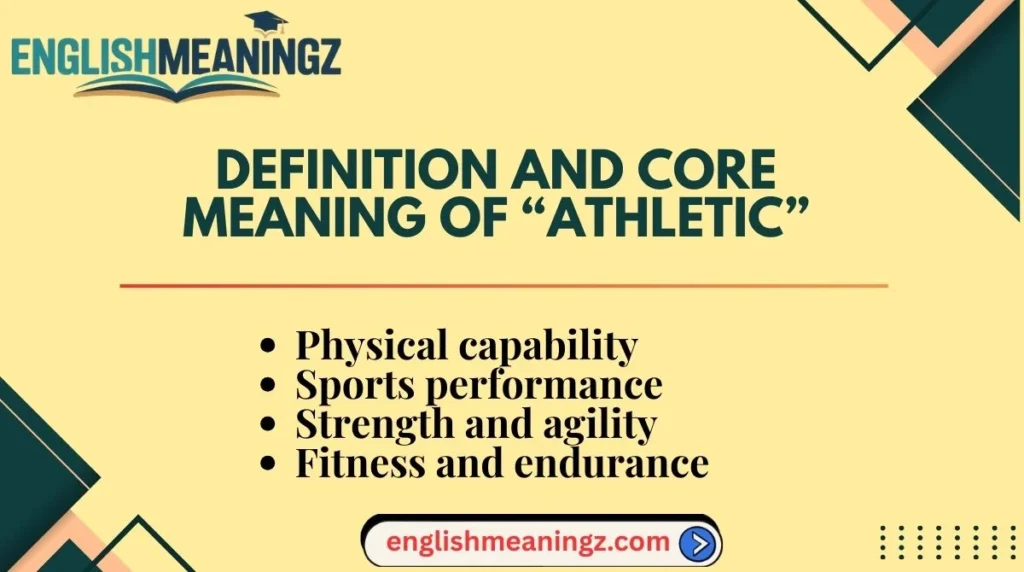
Definition and Core Meaning of “Athletic”
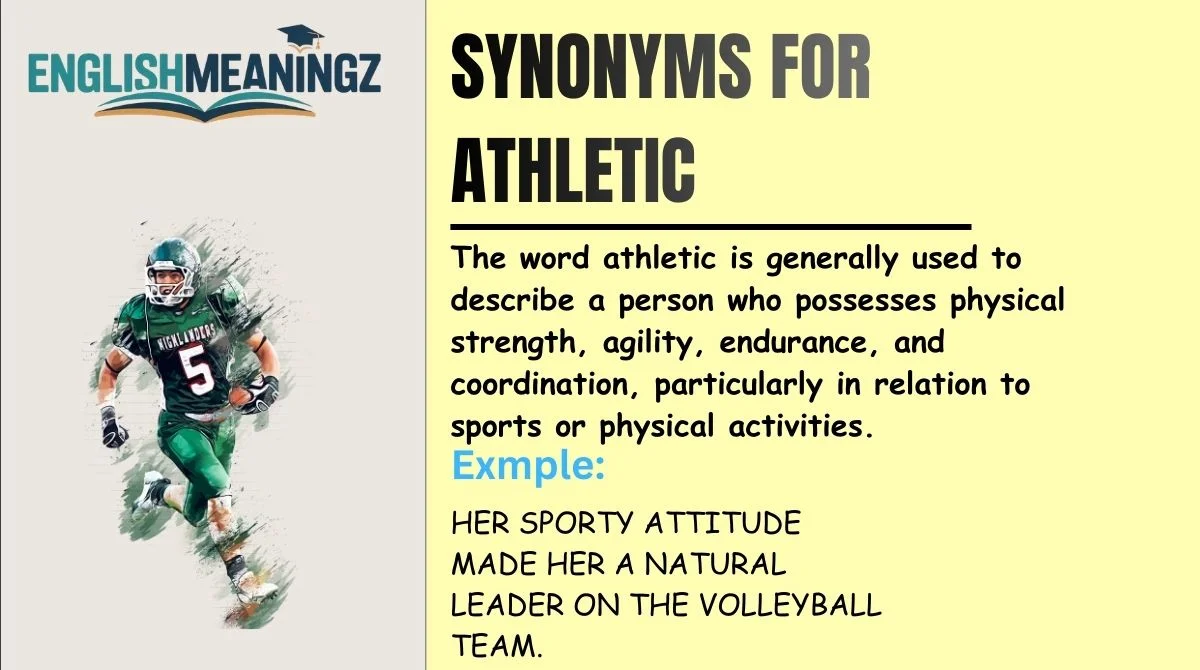
The word athletic is generally used to describe a person who possesses physical strength, agility, endurance, and coordination, particularly in relation to sports or physical activities.
In everyday language, the term often refers to individuals who are physically fit or skilled in sports. For example, a student who excels in soccer, basketball, or track events may be described as athletic.
From a broader linguistic perspective, the word can describe:
- Physical capability
- Sports performance
- Strength and agility
- Fitness and endurance
In academic or professional writing, athletic may also describe body types, physical movements, or training characteristics. For instance, a research paper about sports science might discuss athletic performance, athletic training, or athletic endurance.
However, depending on the situation, different synonyms may communicate a more precise meaning. For example, a scientist might prefer physically conditioned, while a casual conversation might use sporty.
Understanding these nuances allows writers to choose the most accurate word for their context.
13 Synonyms Grouped by Context
General Use
Active
Meaning: Energetic and physically engaged in movement or exercise.
Context Explanation:
The word active is commonly used in everyday conversation and general writing. It describes someone who frequently participates in physical activities, sports, or exercise routines.
Example Sentence:
She maintains an active lifestyle by running every morning and playing tennis on weekends.
Fit
Meaning: Physically healthy and in good condition.
Context Explanation:
Fit is one of the most widely used synonyms for athletic. It emphasizes physical health, stamina, and strength rather than sports skill alone.
Example Sentence:
After months of consistent training, he became extremely fit and improved his running performance.
Sporty
Meaning: Interested in sports or possessing a physical, energetic character.
Context Explanation:
This word is often used informally to describe people who enjoy sports or have a dynamic personality related to physical activities.
Example Sentence:
Her sporty attitude made her a natural leader on the volleyball team.
Energetic
Meaning: Full of vitality, energy, and physical enthusiasm.
Context Explanation:
While not exclusively related to sports, energetic often describes people who move quickly, participate actively, and maintain high physical energy.
Example Sentence:
The energetic midfielder ran across the field with impressive stamina.
Formal & Academic Writing
Physically Fit
Meaning: Having a healthy and strong body capable of physical exertion.
Context Explanation:
This phrase is commonly used in academic research related to health science, sports science, and physical education.
Example Sentence:
Participants who were physically fit showed better cardiovascular performance during testing.
Well-Conditioned
Meaning: Trained and prepared for physical activity through exercise.
Context Explanation:
This term is frequently used in sports training discussions and academic studies regarding athlete preparation.
Example Sentence:
The well-conditioned runners maintained consistent speed throughout the marathon.
Agile
Meaning: Able to move quickly and easily with flexibility.
Context Explanation:
Agile highlights coordination, balance, and quick physical movement. It is often used in sports analysis.
Example Sentence:
The agile gymnast executed a complex routine with remarkable precision.
Robust
Meaning: Strong, healthy, and capable of physical endurance.
Context Explanation:
This word often appears in formal writing to describe physical strength and resilience.
Example Sentence:
A robust training program improved the athlete’s endurance and muscular strength.
Informal Usage
Buff
Meaning: Muscular and physically strong.
Context Explanation:
This term is used in casual conversation and often refers to someone with a muscular physique.
Example Sentence:
After years of weight training, he developed a buff and powerful physique.
Ripped
Meaning: Extremely muscular with visible muscle definition.
Context Explanation:
Common in fitness culture and informal speech, this word emphasizes body appearance rather than performance.
Example Sentence:
The fitness trainer became famous for his ripped physique and disciplined lifestyle.
Strong
Meaning: Possessing physical power and muscular ability.
Context Explanation:
While broad in meaning, strong often serves as a simple substitute for athletic in everyday contexts.
Example Sentence:
The strong swimmer completed the race far ahead of the competitors.
Technical or Subject-Specific Use
Athletic-Minded
Meaning: Having a strong interest or orientation toward sports and physical performance.
Context Explanation:
This phrase is sometimes used in sports education and coaching discussions.
Example Sentence:
The academy encourages athletic-minded students to pursue competitive sports.
Physically Capable
Meaning: Having the physical ability to perform demanding tasks or sports.
Context Explanation:
Often used in professional or evaluation contexts such as training assessments or medical reports.
Example Sentence:
All recruits must be physically capable of completing the endurance test.
Word Intensity & Tone Comparison Table
| Synonym | Formal Level | Emotional Strength | Typical Context |
|---|---|---|---|
| Fit | Neutral | Moderate | Health, fitness |
| Active | Neutral | Mild | Daily lifestyle |
| Sporty | Informal | Moderate | Casual conversation |
| Agile | Formal | Strong | Sports analysis |
| Robust | Formal | Strong | Academic writing |
| Energetic | Neutral | Moderate | Personality descriptions |
| Buff | Informal | Strong | Gym culture |
| Ripped | Informal | Very strong | Fitness aesthetics |
| Well-conditioned | Formal | Strong | Training science |
| Physically capable | Formal | Moderate | Evaluations |
This comparison helps writers choose the most appropriate synonym based on tone and context.
Common Mistakes When Using These Synonyms
Mistake 1: Using informal synonyms in academic writing
Incorrect:
The study examined how ripped athletes perform in endurance tests.
Correct:
The study examined how well-conditioned athletes perform in endurance tests.
Explanation: Academic writing requires formal vocabulary.
Mistake 2: Confusing appearance with ability
Incorrect:
He looks buff, so he must be a professional athlete.
Correct:
He looks muscular, but athletic performance depends on training and skill.
Explanation: Physical appearance does not always equal athletic ability.
Mistake 3: Replacing the word unnecessarily
Incorrect:
The Olympic athletic competition featured many sporty runners.
Correct:
The Olympic athletic competition featured many elite runners.
Explanation: Some contexts require precise terminology.
Synonyms in Academic Writing
Example Paragraph 1
Regular physical activity contributes significantly to improved health outcomes. Individuals who maintain a physically fit lifestyle often demonstrate better cardiovascular endurance, muscular strength, and mental resilience. Studies show that students who participate in sports programs develop stronger discipline and time-management skills compared with less active peers.
Example Paragraph 2
Professional sports require athletes to maintain well-conditioned bodies through consistent training and nutrition planning. A combination of endurance exercises, strength training, and recovery strategies ensures optimal performance. Researchers continue to investigate how agile movement patterns and muscular coordination influence competitive success.
IELTS & Exam Writing Tips
Students preparing for language exams frequently struggle with repetition. Learning synonyms can help improve lexical variety, which is an important scoring criterion.
Strategies to improve vocabulary usage:
- Replace repeated adjectives with suitable synonyms.
- Choose words appropriate for formal writing.
- Avoid informal slang in essays.
For example, instead of repeating athletic, writers might use:
- physically fit
- agile
- well-conditioned
- active
However, it is also important to understand when not to replace a word. In some contexts, particularly technical writing about sports science or official athletic competitions, the word athletic may be the most accurate term.
Overusing synonyms simply to sound sophisticated can sometimes reduce clarity.
Similar Words vs True Synonyms
Not every word that seems similar to athletic carries exactly the same meaning. Understanding these distinctions prevents misuse.
Fit vs Athletic
A fit person may exercise regularly but may not participate in sports competitions.
Strong vs Athletic
Strength is only one component of athletic ability. Athletic individuals also require speed, coordination, and endurance.
Sporty vs Athletic
Sporty often refers to someone who enjoys sports casually, while athletic may indicate higher physical skill or capability.
Agile vs Athletic
Agility emphasizes flexibility and quick movement rather than overall physical fitness.
Recognizing these subtle differences helps writers communicate more accurately.
Practice Sentences (Fill-in Exercises)
Choose the most suitable synonym to complete each sentence.
- The gymnast’s ______ movements impressed the judges.
- Regular exercise helped her stay ______ and healthy.
- The trainer designed a program for ______ runners preparing for competition.
- His ______ personality keeps him involved in multiple sports.
- The soldiers must be physically ______ to complete the training course.
Suggested answers:
- agile
- fit
- well-conditioned
- active or sporty
- capable
Practicing these sentences strengthens vocabulary retention and writing confidence.
FAQs
What is the closest synonym for athletic?
The closest synonym is fit, because it directly refers to physical health and strength. However, words such as agile, active, and well-conditioned can also express similar ideas depending on context.
Which synonym is best for academic writing?
Formal phrases such as physically fit, well-conditioned, and robust are usually more suitable for academic or research writing.
Are sporty and athletic the same?
Not exactly. Sporty typically describes someone who enjoys sports casually, while athletic often suggests stronger physical ability or sports performance.
Can strong replace athletic?
In some cases yes, but strong only refers to physical power. Athletic ability usually includes endurance, speed, flexibility, and coordination.
Why is vocabulary variety important in writing?
Using varied vocabulary improves readability, prevents repetition, and demonstrates language proficiency. This is especially important in academic writing and standardized exams.
Conclusion
Expanding vocabulary is a powerful strategy for improving writing quality and communication skills.
The word athletic is useful but can become repetitive when used too frequently. Learning alternative expressions allows writers to match tone, context, and precision more effectively.
This article introduced 13 synonyms for athletic, explained their meanings, and demonstrated how they function in academic, professional, and informal contexts.
Understanding the differences between words such as fit, agile, well-conditioned, and sporty helps writers choose the most accurate expression for each situation.
Students preparing for exams, bloggers creating engaging content, and professionals writing reports can all benefit from vocabulary diversification.
Regular practice, reading, and contextual learning will gradually strengthen lexical range.
By intentionally expanding vocabulary and applying synonyms correctly, writers can produce clearer, more dynamic, and more persuasive writing.