Understanding opposites is one of the fastest ways to sharpen your writing, thinking, and communication. When you know not just what a word means—but also what it does not mean—you gain precision.
This is especially important with complex concepts like globalization, a term widely used in academic, business, and political discussions.
Learning antonyms of “globalization” helps you:
- Express contrasting ideas clearly
- Avoid vague or repetitive language
- Strengthen arguments in essays, reports, and debates
- Add depth and nuance to professional writing
In academic and professional communication, clarity and contrast are everything. Whether you’re writing an essay, preparing a presentation, or crafting SEO content, using the right opposite can dramatically improve your message.
What Does “Globalization” Mean?
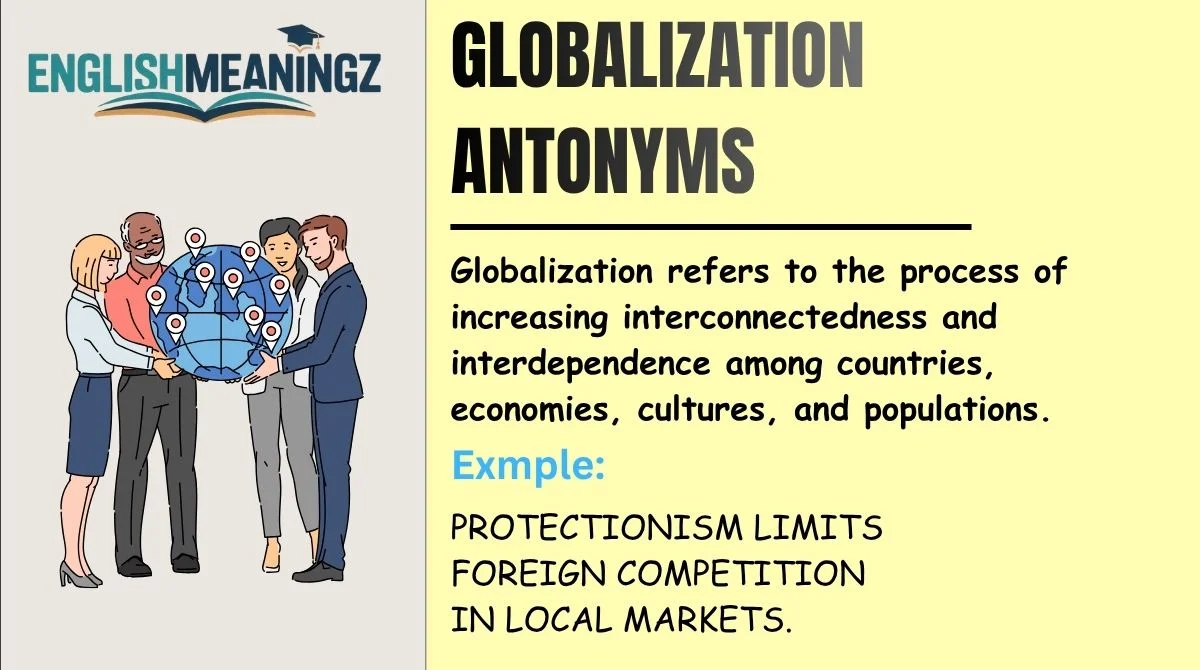
Globalization refers to the process of increasing interconnectedness and interdependence among countries, economies, cultures, and populations. It involves the flow of goods, services, information, technology, and people across borders.
Tone Explanation
The word carries a neutral to positive tone in business and economics but may become critical or negative in political or cultural contexts.
Emotional or Action Intensity
Globalization implies:
- Expansion
- Integration
- Openness
- Cross-border interaction
Its intensity is relatively high because it represents large-scale, systemic change rather than small or localized actions.
20 Best Antonyms for “Globalization”
Localization
Meaning: Focus on local production, culture, or markets
Tone: Academic / Professional
Example: The company shifted toward localization to better serve regional customers.
Why it’s opposite: It emphasizes local focus instead of global integration.
Isolation
Meaning: Separation from others
Tone: Emotional / Formal
Example: The country adopted policies of isolation to avoid foreign influence.
Why it’s opposite: Globalization connects; isolation disconnects.
Nationalism
Meaning: Prioritizing national interests over global cooperation
Tone: Political / Academic
Example: Rising nationalism has slowed international trade agreements.
Why it’s opposite: It resists global unity in favor of national identity.
Protectionism
Meaning: Restricting imports to protect domestic industries
Tone: Economic / Formal
Example: Protectionism limits foreign competition in local markets.
Why it’s opposite: It blocks global economic integration.
Regionalism
Meaning: Focus on specific regions rather than global scope
Tone: Academic
Example: Regionalism encourages cooperation within nearby countries.
Why it’s opposite: It limits interaction to smaller geographic areas.
Fragmentation
Meaning: Breaking into smaller parts
Tone: Formal
Example: Political fragmentation weakened international cooperation.
Why it’s opposite: Globalization unifies; fragmentation divides.
Decentralization
Meaning: Distribution of power away from a central authority
Tone: Professional
Example: Decentralization gave more control to local governments.
Why it’s opposite: It reduces centralized global systems.
Insularity
Meaning: Narrow-mindedness or lack of exposure
Tone: Academic
Example: Cultural insularity prevents the exchange of ideas.
Why it’s opposite: It limits global interaction.
Autarky
Meaning: Economic self-sufficiency
Tone: Academic
Example: The nation pursued autarky to avoid reliance on imports.
Why it’s opposite: Globalization relies on interdependence.
Segregation
Meaning: Separation of groups
Tone: Formal / Social
Example: Economic segregation reduces global collaboration.
Why it’s opposite: It enforces division instead of integration.
Disconnection
Meaning: Lack of connection
Tone: Neutral
Example: Disconnection from global markets harmed the economy.
Why it’s opposite: It removes links between systems.
Provincialism
Meaning: Limited perspective focused on local concerns
Tone: Slightly Negative
Example: Provincialism can hinder international cooperation.
Why it’s opposite: It restricts global awareness.
Closed Economy
Meaning: An economy with minimal foreign trade
Tone: Economic
Example: A closed economy limits international business opportunities.
Why it’s opposite: It avoids global exchange.
Separation
Meaning: Division or detachment
Tone: Neutral
Example: Cultural separation reduces mutual understanding.
Why it’s opposite: It removes unity.
Division
Meaning: Splitting into parts
Tone: Neutral
Example: Political division affects global partnerships.
Why it’s opposite: It contrasts with unity.
De-integration
Meaning: Breaking down of integrated systems
Tone: Academic
Example: Economic de-integration reversed decades of cooperation.
Why it’s opposite: It undoes globalization.
Independence
Meaning: Freedom from external control
Tone: Neutral / Positive
Example: The country emphasized economic independence.
Why it’s opposite: It reduces reliance on global systems.
Self-reliance
Meaning: Dependence on oneself
Tone: Positive
Example: Self-reliance reduces the need for imports.
Why it’s opposite: It avoids global dependency.
Restriction
Meaning: Limiting movement or exchange
Tone: Neutral
Example: Trade restrictions slowed economic growth.
Why it’s opposite: It blocks global flow.
Border Control
Meaning: Regulation of movement across borders
Tone: Political
Example: Strict border control limits international mobility.
Why it’s opposite: It prevents global openness.
Strong vs Mild Opposites
Not all antonyms carry the same intensity. Some directly oppose globalization, while others only partially contrast it.
Strong Opposites
These directly contradict globalization:
- Isolation
- Autarky
- Protectionism
- De-integration
They represent complete rejection of global interaction.
Mild Opposites
These suggest limited contrast:
- Localization
- Regionalism
- Decentralization
They modify or reduce globalization, rather than eliminate it.
Understanding this scale helps you choose the most accurate word depending on context.
Context-Based Opposites
Antonyms often depend on context. The opposite of globalization in one field may differ in another.
Economic Context
- Protectionism
- Closed economy
- Autarky
Cultural Context
- Insularity
- Provincialism
- Segregation
Political Context
- Nationalism
- Border control
- Independence
Business Context
- Localization
- Regional strategy
Using the right antonym requires understanding the situation, not just the dictionary definition.
Common Mistakes When Using Opposites

1. Using “Localization” as a Perfect Opposite
Incorrect: Localization always opposes globalization
Correct: It can coexist with globalization in business strategies
2. Confusing “Independence” with “Isolation”
Independence does not always mean cutting off global ties.
3. Overusing “Isolation”
It’s a strong word and may sound extreme in professional writing.
4. Ignoring Context
Using “nationalism” in an economic discussion may confuse readers.
5. Using Literal Instead of Conceptual Opposites
Globalization is abstract, so its opposites are often conceptual, not direct.
Sentence Transformation Examples
Original → With Antonym
Original: Globalization has increased international trade.
Rewritten: Protectionism has reduced international trade.
Original: Globalization connects cultures worldwide.
Rewritten: Insularity limits cultural exchange.
Original: Globalization encourages cooperation.
Rewritten: Fragmentation weakens cooperation.
Original: Globalization promotes economic interdependence.
Rewritten: Autarky promotes economic self-sufficiency.
Original: Globalization expands markets.
Rewritten: Localization narrows market focus.
FAQs
What is the exact opposite of globalization?
There is no single exact opposite, but isolation and autarky are the strongest conceptual opposites.
Is localization always the opposite of globalization?
No. Localization can actually work alongside globalization, especially in business strategies.
Which antonym is best for academic writing?
Protectionism, autarky, and de-integration are commonly used in academic contexts.
Can globalization and nationalism exist together?
Yes, but they often create tension because one promotes global unity while the other prioritizes national interests.
What is a simple antonym for beginners?
Isolation is the easiest and most direct opposite to understand.
Are all antonyms negative?
No. Words like self-reliance and independence can have positive meanings depending on context.
How do I choose the right antonym?
Consider:
- Context (economic, cultural, political)
- Tone (formal or informal)
- Intensity (strong or mild contrast)
Conclusion
Mastering antonyms of “globalization” gives you a powerful linguistic advantage. Instead of repeating the same ideas, you can introduce contrast, clarify meaning, and strengthen your arguments.
Whether you’re writing academically, professionally, or for SEO, understanding these opposites helps you communicate with precision and confidence.
From strong contrasts like isolation and autarky to softer alternatives like localization, each word offers a unique shade of meaning. The key is not just knowing these terms—but knowing when and how to use them effectively.