A strong vocabulary is one of the most powerful tools in effective communication.
Whether you are writing academic essays, blog articles, research papers, or professional reports, the ability to vary your word choices significantly improves clarity, sophistication, and readability.
One important strategy that enhances writing quality is the use of synonyms. Replacing repetitive words with appropriate alternatives demonstrates linguistic flexibility and helps writers express subtle differences in meaning.
For students preparing for exams such as IELTS, TOEFL, or university-level coursework, synonym variety often contributes directly to higher writing scores.
Examiners evaluate vocabulary range, accuracy, and contextual usage. Similarly, bloggers and content creators benefit from diverse word choices because search engines and readers both favor engaging, natural language over repetitive phrasing.
Professionals—including marketers, academics, journalists, and creative writers—also rely on nuanced vocabulary to convey tone, emotion, and precision. Certain words carry delicate connotations that shape how readers interpret a message.
One such word is “ethereal.” It is frequently used in literature, academic descriptions, art criticism, and everyday conversation when describing something delicate, otherworldly, or beautifully light.
Understanding the meaning of ethereal and learning its synonyms allows writers to describe abstract beauty, subtle emotions, spiritual imagery, and delicate atmospheres more effectively.
This guide explores 12 powerful ethereal synonyms, explains their meanings, provides contextual examples, and demonstrates how they can improve both academic and professional writing.
Definition and Core Meaning of “Ethereal”
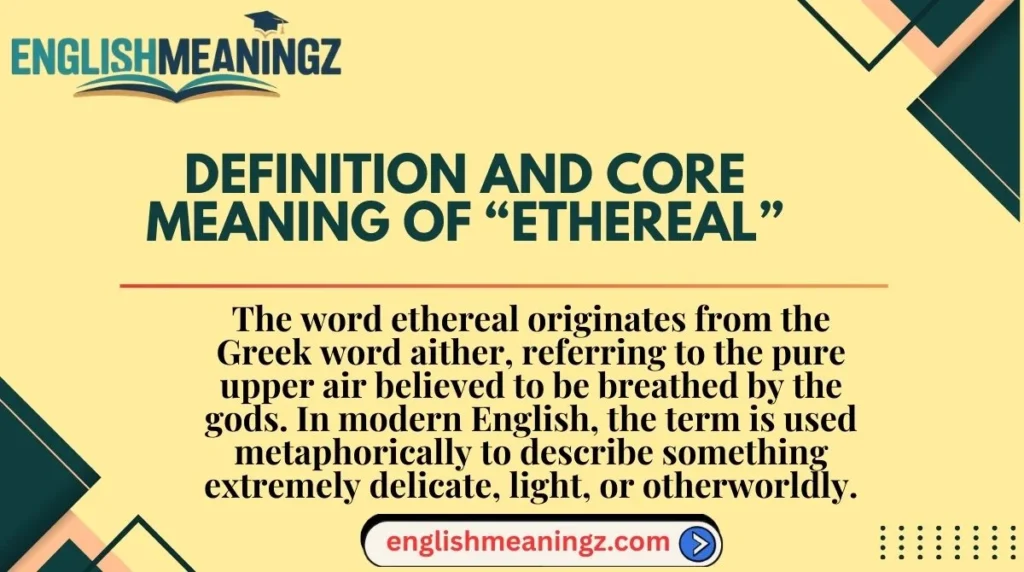
The word ethereal originates from the Greek word aither, referring to the pure upper air believed to be breathed by the gods. In modern English, the term is used metaphorically to describe something extremely delicate, light, or otherworldly.
At its core, ethereal refers to qualities such as:
- Lightness or airiness
- Spiritual or heavenly beauty
- Delicate, almost unreal presence
- Something too perfect or fragile for the physical world
In literature and descriptive writing, ethereal often appears when describing:
- Natural scenery (mist, light, clouds)
- Artistic beauty
- Music or voices
- Spiritual or mystical experiences
- Elegant physical appearance
For example:
The mountain landscape appeared ethereal under the early morning mist.
In academic or analytical contexts, the word may describe aesthetic qualities or conceptual ideas that feel intangible or transcendent.
Understanding synonyms of ethereal helps writers choose the most accurate word depending on tone, formality, and context.
12 Synonyms Grouped by Context
General Use Synonyms
Delicate
Meaning:
Something fragile, fine, or easily affected.
Context Explanation:
“Delicate” emphasizes fragility or subtle beauty. It can describe physical objects, emotions, or artistic features.
Example Sentence:
The artist painted the flowers with delicate brushstrokes that captured their natural elegance.
Airy
Meaning:
Light, spacious, and free-flowing.
Context Explanation:
“Airy” often describes environments, fabrics, or atmospheres that feel open and light.
Example Sentence:
The airy curtains moved gently with the breeze, creating a peaceful atmosphere.
Dreamlike
Meaning:
Resembling a dream; surreal or unreal.
Context Explanation:
Used when describing scenes or experiences that feel magical or slightly unreal.
Example Sentence:
The valley looked dreamlike as morning fog slowly lifted from the hills.
Formal & Academic Writing Synonyms
Transcendent
Meaning:
Beyond ordinary limits or human experience.
Context Explanation:
Frequently used in philosophy, theology, and academic analysis when discussing ideas that surpass normal reality.
Example Sentence:
The philosopher argued that beauty possesses a transcendent quality beyond physical perception.
Sublime
Meaning:
Of extraordinary beauty or spiritual greatness.
Context Explanation:
“Sublime” is widely used in literary criticism and aesthetic theory.
Example Sentence:
The novel captures the sublime beauty of nature through vivid descriptive language.
Celestial
Meaning:
Related to the sky, heavens, or outer space.
Context Explanation:
Often used metaphorically to describe heavenly or divine qualities.
Example Sentence:
The choir produced a celestial harmony that filled the cathedral.
Informal Usage Synonyms
Magical
Meaning:
Extraordinarily charming or enchanting.
Context Explanation:
Commonly used in everyday speech to describe special moments or beautiful experiences.
Example Sentence:
Watching the northern lights was a truly magical experience.
Otherworldly
Meaning:
Seeming to belong to another world.
Context Explanation:
Often used when describing mysterious beauty or unusual landscapes.
Example Sentence:
The glowing caves created an otherworldly environment beneath the mountains.
Heavenly
Meaning:
Extremely pleasant or beautiful.
Context Explanation:
Used informally to emphasize comfort, beauty, or pleasure.
Example Sentence:
The fragrance of fresh flowers in the garden felt heavenly.
Technical or Subject-Specific Synonyms
Spiritual
Meaning:
Connected to the soul, religion, or inner consciousness.
Context Explanation:
Frequently used in psychology, philosophy, and religious studies.
Example Sentence:
The meditation retreat offered a deeply spiritual experience for participants.
Intangible
Meaning:
Something that cannot be physically touched.
Context Explanation:
Often used in academic or business contexts to describe abstract concepts.
Example Sentence:
Trust and reputation are valuable intangible assets for any organization.
Vaporous
Meaning:
Light, mist-like, or lacking solid form.
Context Explanation:
Used in scientific or descriptive writing about fog, smoke, or delicate atmospheres.
Example Sentence:
The vaporous clouds drifted slowly across the evening sky.
Word Intensity & Tone Comparison Table
| Word | Formal Level | Emotional Strength | Typical Context |
|---|---|---|---|
| Ethereal | Medium | High | Art, literature |
| Delicate | Medium | Medium | Descriptions |
| Airy | Informal | Low | Environment |
| Dreamlike | Medium | Medium | Imagery |
| Transcendent | Very formal | Very high | Philosophy |
| Sublime | Formal | Very high | Literature |
| Celestial | Formal | High | Spiritual imagery |
| Magical | Informal | Medium | Everyday speech |
| Otherworldly | Medium | High | Fiction |
| Heavenly | Informal | High | Personal experience |
This comparison highlights how tone and formality influence word selection. Academic writing often favors transcendent, sublime, or celestial, while conversational contexts may use magical or heavenly.
Common Mistakes When Using These Synonyms
Writers sometimes misuse synonyms because they focus only on dictionary meaning rather than context.
Mistake 1: Using an overly formal word in casual writing
Incorrect:
The birthday party created a transcendent atmosphere.
Correct:
The birthday party created a magical atmosphere.
Mistake 2: Replacing words without considering tone
Incorrect:
The airy philosophy of the author inspired readers.
Correct:
The transcendent philosophy of the author inspired readers.
Mistake 3: Confusing physical and emotional meanings
Incorrect:
The vaporous performance of the musician impressed critics.
Correct:
The ethereal performance of the musician impressed critics.
Understanding subtle distinctions ensures that synonyms enhance rather than weaken writing clarity.
Synonyms in Academic Writing
Example Paragraph 1
Art historians frequently describe Renaissance paintings using language that reflects both physical beauty and spiritual symbolism. The use of soft lighting, balanced composition, and refined detail often produces an ethereal visual effect. Some scholars describe this quality as sublime, emphasizing the emotional response it evokes in viewers. Others interpret the imagery as transcendent, suggesting that the artwork invites audiences to reflect on ideas beyond ordinary reality.
Example Paragraph 2
Environmental researchers studying remote landscapes often describe their experiences using expressive vocabulary. Observations of glaciers, mist-covered mountains, and untouched forests create impressions that feel almost otherworldly. Such environments possess a rare combination of physical beauty and psychological impact. Scholars sometimes refer to these experiences as spiritual encounters with nature, highlighting the powerful connection between human perception and the natural world.
IELTS & Exam Writing Tips
Students preparing for language proficiency exams should use synonyms carefully.
1. Avoid repetition
Instead of repeating one word throughout an essay, alternate with context-appropriate synonyms.
Example:
Original repetition:
The landscape looked ethereal. The ethereal mountains attracted tourists.
Improved version:
The landscape looked ethereal, and the dreamlike mountains attracted tourists.
2. Do not replace technical terms
Certain words have precise meanings that should not be replaced.
Example:
Correct:
The study examines celestial bodies.
Incorrect:
The study examines magical bodies.
3. Use synonyms only when meaning stays accurate
Replacing a word simply to appear sophisticated can reduce clarity. Precision always matters more than complexity.
Similar Words vs True Synonyms
Not all related words share identical meanings. Some appear similar but differ in nuance.
Ethereal vs Dreamlike
- Ethereal emphasizes lightness or spiritual beauty.
- Dreamlike focuses on surreal or unreal experiences.
Ethereal vs Sublime
- Ethereal suggests delicacy.
- Sublime emphasizes overwhelming greatness or beauty.
Ethereal vs Celestial
- Ethereal refers to delicate beauty.
- Celestial specifically relates to the heavens or outer space.
Recognizing these subtle differences allows writers to select the most precise word.
Practice Sentences
Choose the most appropriate synonym.
- The violin produced a __________ sound that captivated the audience.
- The fog created a __________ landscape across the valley.
- Philosophers often discuss __________ ideas that extend beyond physical reality.
- The night sky appeared __________ with countless bright stars.
- The forest had an almost __________ atmosphere during sunrise.
Suggested answers: ethereal, dreamlike, transcendent, celestial, otherworldly.
FAQs
What does ethereal mean in simple words?
Ethereal describes something extremely light, delicate, or beautiful in a way that seems almost unreal or heavenly.
What are the best synonyms for ethereal?
Some strong synonyms include sublime, celestial, transcendent, dreamlike, airy, delicate, otherworldly, magical, heavenly, and vaporous.
Is ethereal a positive word?
Yes. Ethereal usually has a positive meaning and is often used to describe beauty, elegance, or spiritual qualities.
Can ethereal be used in academic writing?
Yes. Ethereal is commonly used in literature analysis, art criticism, and descriptive academic writing when discussing aesthetic qualities.
What is the difference between ethereal and celestial?
Ethereal refers to delicate beauty or lightness, while celestial specifically relates to the heavens, sky, or outer space.
Conclusion
Expanding vocabulary through the study of synonyms is one of the most effective ways to strengthen writing skills.
Words such as ethereal capture subtle qualities of beauty, delicacy, and transcendence that enrich both creative and academic expression.
By learning and practicing related terms—such as sublime, celestial, dreamlike, otherworldly, and transcendent—writers gain the flexibility to adapt their language for different audiences and contexts.
Students can improve exam performance by avoiding repetition and choosing precise vocabulary.
Bloggers and professionals benefit from more engaging writing, while academics can communicate nuanced ideas with greater clarity.
Consistent practice, careful reading, and mindful word selection gradually build a stronger and more sophisticated vocabulary.
Over time, this skill transforms ordinary writing into expressive, compelling communication.