In modern academic and professional writing, vocabulary variety plays a crucial role in improving clarity, credibility, and writing scores.
Overusing the same word repeatedly—such as specifically—can make writing appear repetitive and less sophisticated.
Strong writers understand how to replace common words with appropriate synonyms depending on context, tone, and audience.
For students, especially those preparing for exams like IELTS, TOEFL, or university essays, using varied vocabulary demonstrates lexical range—an important scoring factor.
Bloggers and content creators benefit from synonyms because they make articles more engaging and SEO-friendly.
Professionals and researchers use precise alternatives to maintain clarity and authority in reports, presentations, and academic papers.
However, not every synonym works in every situation. Some alternatives are more formal, some are informal, and others are used mainly in technical or academic contexts. Understanding these subtle differences helps writers communicate more accurately.
This guide explores 12 strong synonyms of “specifically,” explaining their meanings, contexts, and example sentences so you can confidently use them in essays, professional writing, and everyday communication.
Definition and Core Meaning of “Specifically”

The word specifically is an adverb used to introduce exact, detailed, or particular information about a subject. It signals that the speaker or writer is narrowing down a general idea to something more precise.
In simple terms, specifically means:
- In a clear and exact manner
- For a particular purpose
- In detail about a certain subject
For example:
The research focuses on climate change, specifically its impact on coastal cities.
Here, the word indicates that climate change is a broad topic, but the discussion is narrowed to one particular aspect.
In academic writing, specifically often appears when:
- Clarifying an argument
- Introducing supporting evidence
- Identifying a precise example
- Narrowing a research focus
Because of its frequent use, writers often need alternative expressions that convey the same precision while improving vocabulary variety.
12 Synonyms Grouped by Context
General Use Synonyms
These words can replace specifically in many everyday writing situations.
Particularly
Meaning: More than usual; especially or in particular.
Context Explanation:
Particularly is commonly used when emphasizing one item from a larger group.
Example Sentence:
The course is useful for many students, particularly those studying environmental science.
Precisely
Meaning: Exactly and accurately.
Context Explanation:
Used when emphasizing correctness, accuracy, or detailed specification.
Example Sentence:
The report identifies precisely how the policy affects small businesses.
Exactly
Meaning: In an accurate or perfectly correct way.
Context Explanation:
Often used in both formal and informal contexts to stress correctness or agreement.
Example Sentence:
The results show exactly which factors contributed to the experiment’s success.
Notably
Meaning: Worth mentioning or especially important.
Context Explanation:
Used to highlight a significant detail among several possibilities.
Example Sentence:
Several cities experienced growth, notably Jakarta and Lagos.
Formal & Academic Writing Synonyms
These synonyms are frequently used in research papers, reports, and scholarly writing.
Explicitly
Meaning: Stated clearly and directly without ambiguity.
Context Explanation:
Common in academic writing when instructions, statements, or policies are clearly expressed.
Example Sentence:
The author explicitly states the limitations of the study in the final section.
Expressly
Meaning: Clearly and deliberately stated.
Context Explanation:
Often used in legal, contractual, or formal documents.
Example Sentence:
The agreement was created expressly for international partnerships.
Namely
Meaning: That is to say; used to introduce exact information.
Context Explanation:
Useful when identifying or listing precise examples that explain a previous statement.
Example Sentence:
The project focuses on three major areas, namely education, healthcare, and infrastructure.
Informal Usage Synonyms
These alternatives appear frequently in everyday conversation, blogs, or casual writing.
Chiefly
Meaning: Mainly or primarily.
Context Explanation:
Used when something is the main or most important factor.
Example Sentence:
The company’s success is due chiefly to its innovative marketing strategies.
Primarily
Meaning: For the most part; mainly.
Context Explanation:
Often used in explanations to identify the main cause or purpose.
Example Sentence:
The software is designed primarily for small businesses.
Technical or Subject-Specific Synonyms
These alternatives are useful when emphasizing precision, uniqueness, or intention.
Distinctly
Meaning: Clearly different or easily recognizable.
Context Explanation:
Used when highlighting clear distinctions or unique features.
Example Sentence:
The new policy is distinctly different from previous regulations.
Uniquely
Meaning: In a way that is unlike anything else.
Context Explanation:
Used when emphasizing special or exclusive characteristics.
Example Sentence:
This university program is uniquely designed for interdisciplinary research.
Intentionally
Meaning: Done on purpose or deliberately.
Context Explanation:
Often used when explaining purposeful decisions or actions.
Example Sentence:
The researcher intentionally focused on rural populations to fill a knowledge gap.
Word Intensity & Tone Comparison Table
| Synonym | Formal Level | Tone Strength | Typical Usage |
|---|---|---|---|
| Particularly | Medium | Moderate | General writing |
| Precisely | High | Strong | Academic or technical writing |
| Exactly | Medium | Moderate | Everyday or explanatory writing |
| Notably | High | Moderate | Highlighting important points |
| Explicitly | Very High | Strong | Academic or legal writing |
| Expressly | Very High | Strong | Legal or contractual language |
| Namely | High | Neutral | Listing specific items |
| Chiefly | Medium | Moderate | Analytical explanations |
| Primarily | Medium | Neutral | Describing main causes |
| Distinctly | High | Strong | Differentiation or comparison |
This comparison helps writers select the right synonym depending on formality, emphasis, and context.
Common Mistakes When Using These Synonyms
Even advanced writers sometimes misuse synonyms of specifically. Understanding common errors helps avoid confusion.
Mistake 1: Using an Informal Synonym in Academic Writing
Incorrect:
The experiment focused exactly on plant growth in cold climates.
Correct:
The experiment focused precisely on plant growth in cold climates.
Explanation:
Precisely sounds more formal and suitable for academic writing.
Mistake 2: Confusing “Namely” with “For Example”
Incorrect:
The research studies several animals, namely lions and tigers for example.
Correct:
The research studies several animals, namely lions and tigers.
Explanation:
Namely already introduces examples, so adding for example is unnecessary.
Mistake 3: Using “Explicitly” When Meaning “Mainly”
Incorrect:
The project is explicitly about renewable energy.
Correct:
The project is primarily about renewable energy.
Explanation:
Explicitly means clearly stated, not mainly.
Synonyms in Academic Writing
Example Paragraph 1
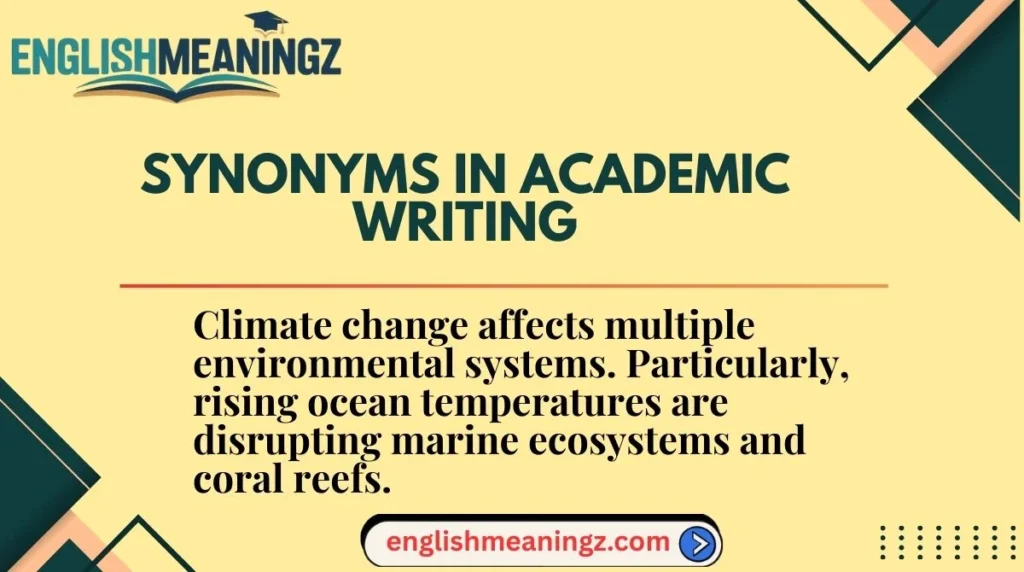
Climate change affects multiple environmental systems. Particularly, rising ocean temperatures are disrupting marine ecosystems and coral reefs. Researchers have identified several causes, namely increased carbon emissions and industrial pollution. These findings demonstrate precisely how human activity accelerates ecological damage.
Example Paragraph 2
Education policy reforms aim to improve access to quality learning. Recent studies focus primarily on rural regions where educational resources remain limited. The government has explicitly stated that investment in teacher training will be the central strategy for addressing this issue.
These examples show how synonyms can improve flow and prevent repetition in essays.
IELTS & Exam Writing Tips
Students preparing for IELTS or similar exams should learn how to use synonyms strategically.
1. Avoid Repetition
Instead of repeating specifically many times, alternate with:
- particularly
- namely
- precisely
- primarily
This improves lexical variety, which is an important scoring criterion.
2. Choose the Correct Tone
Academic writing favors:
- explicitly
- precisely
- notably
- namely
Avoid overly casual replacements in formal essays.
3. Do Not Replace Every Word
Sometimes the original word is the clearest option.
Example:
Incorrect:
The research focuses uniquely on climate policy.
Correct:
The research focuses specifically on climate policy.
Overusing synonyms can make writing sound unnatural.
Similar Words vs True Synonyms
Some words appear similar to specifically but do not always function as true replacements.
Particularly vs Specifically
- Particularly emphasizes importance.
- Specifically introduces detailed clarification.
Example:
She enjoys science, particularly biology.
The report examines climate change, specifically coastal flooding.
Precisely vs Exactly
Both indicate accuracy, but:
- Precisely is more formal.
- Exactly is common in conversation.
Primarily vs Chiefly
These words indicate the main reason, not necessarily a precise detail.
Example:
The project focuses primarily on renewable energy.
Here the meaning is “mainly,” not “in detail.”
Understanding these differences ensures correct usage in academic contexts.
Practice Sentences
Choose the best synonym of specifically to complete each sentence.
- The research examines environmental policy, ______ climate regulations in Europe.
- The professor ______ explained the assignment requirements.
- The program is designed ______ for graduate students.
- Several factors caused the decline, ______ poor management and financial instability.
- The study identifies ______ how social media influences political opinions.
Suggested Answers
- particularly
- explicitly
- primarily
- namely
- precisely
Practicing with sentences helps learners internalize vocabulary and improve writing accuracy.
FAQs
What is the best synonym for “specifically” in academic writing?
Common academic alternatives include precisely, explicitly, and namely, because they provide clarity and sound formal in scholarly texts.
Can “particularly” replace “specifically”?
Yes, but only when emphasizing importance rather than providing detailed clarification.
Is “exactly” formal enough for essays?
It is acceptable but slightly less formal than words like precisely or explicitly.
How many synonyms should I use in an essay?
Use synonyms naturally when repetition occurs. Overusing them can make writing sound forced.
Why is vocabulary variety important for IELTS?
IELTS writing scoring includes lexical resource, which measures vocabulary range and accurate word choice.
Conclusion
Developing a strong vocabulary is one of the most effective ways to improve writing quality.
While the word specifically is useful for introducing detailed information, relying on it repeatedly can weaken clarity and variety.
By learning alternatives such as particularly, precisely, namely, explicitly, and primarily, writers gain greater flexibility in expressing ideas.
These synonyms allow students, bloggers, and professionals to communicate with greater precision and sophistication.
Improving vocabulary is a gradual process. Reading widely, practicing writing regularly, and consciously incorporating new words into essays and reports will steadily enhance language skills.
Over time, these small improvements lead to more confident, persuasive, and professional writing.