Effective writing depends not only on ideas but also on vocabulary variety. Repeating the same word multiple times can weaken the clarity and sophistication of a piece of writing.
One of the most commonly overused words in essays, storytelling, and professional writing is “narrative.” Expanding your vocabulary with suitable synonyms helps improve readability, writing quality, and academic scores.
Students preparing for academic exams such as IELTS, university essays, and research assignments often need alternative words to avoid repetition.
Bloggers and content creators also benefit from using varied vocabulary because it enhances reader engagement and improves SEO performance.
Professionals who write reports, case studies, or presentations similarly gain credibility by demonstrating strong vocabulary control.
This guide explores 25 narrative synonyms, explains their meanings, shows how they differ in tone and context, and demonstrates how they can be used effectively in real sentences.
By the end, you will have a stronger vocabulary toolkit for academic, professional, and creative writing.
Definition and Core Meaning of “Narrative”
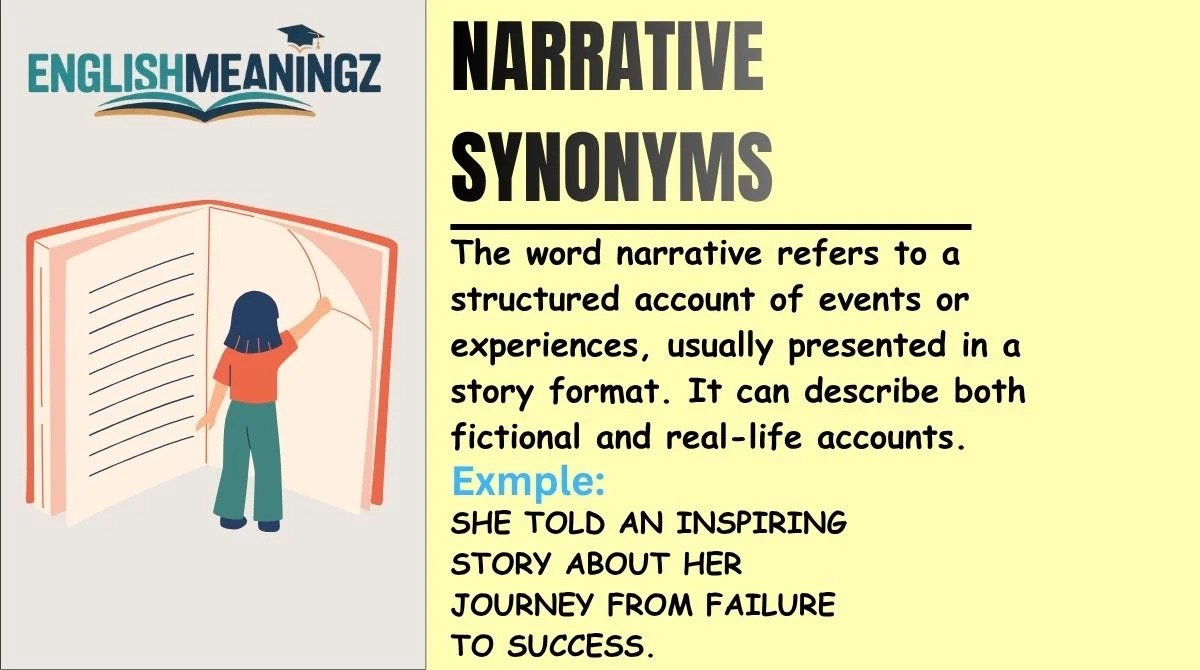
The word narrative refers to a structured account of events or experiences, usually presented in a story format. It can describe both fictional and real-life accounts.
In literature, a narrative is the method through which a story is told, including characters, plot, and sequence of events. In academic contexts, a narrative may refer to a descriptive explanation or interpretation of events, especially in research or historical writing.
In professional contexts, the word can also describe the overall storyline or explanation used to present information—for example, the narrative behind a business strategy or historical development.
Key characteristics of a narrative include:
- A sequence of events
- A logical structure
- A perspective or point of view
- A purpose such as explanation, storytelling, or analysis
Because the word is used in many fields—literature, journalism, education, and communication—writers often benefit from using precise synonyms that match the intended tone.
25 Synonyms Grouped by Context
General Use Synonyms
Story
Meaning: A description of events involving characters and actions.
Context: Commonly used in everyday communication and literature.
Example:
She told an inspiring story about her journey from failure to success.
Account
Meaning: A detailed description or report of events.
Context: Often used in both formal and informal situations.
Example:
The witness provided an accurate account of the incident.
Tale
Meaning: A story that may be imaginative, entertaining, or moralistic.
Context: Frequently used in literature or folklore.
Example:
The author wrote a fascinating tale about adventure and discovery.
Chronicle
Meaning: A factual record of events arranged in chronological order.
Context: Often used in historical writing.
Example:
The book is a chronicle of political changes in the country.
Description
Meaning: A detailed explanation of events, situations, or experiences.
Context: Useful when emphasizing details rather than plot.
Example:
Her description of the village created a vivid image for readers.
Report
Meaning: A factual presentation of information or events.
Context: Frequently used in journalism or official documentation.
Example:
The journalist’s report revealed new details about the investigation.
Recital
Meaning: A spoken or written account of events.
Context: Often used in storytelling or formal speech.
Example:
The historian delivered a compelling recital of ancient traditions.
Formal & Academic Writing Synonyms
Discourse
Meaning: A formal discussion or written treatment of a subject.
Context: Common in academic and philosophical writing.
Example:
The article contributes to the broader discourse on climate change.
Interpretation
Meaning: An explanation or analysis of events or ideas.
Context: Often used in research, literary studies, and criticism.
Example:
The professor presented a new interpretation of the novel.
Exposition
Meaning: A detailed explanation intended to clarify a concept.
Context: Widely used in academic essays and research papers.
Example:
The essay offers a clear exposition of economic theory.
Documentation
Meaning: A collection of recorded information or evidence.
Context: Used in academic research and professional reports.
Example:
The study includes extensive documentation of historical sources.
Analysis
Meaning: A detailed examination of a topic.
Context: Used in research papers, academic writing, and critical reviews.
Example:
The researcher’s analysis provides insight into social trends.
Commentary
Meaning: An explanation or interpretation of events or texts.
Context: Used in journalism, literature, and academic discussion.
Example:
The article includes thoughtful commentary on political developments.
Informal Usage Synonyms
Yarn
Meaning: An entertaining or exaggerated story.
Context: Often used in casual conversation.
Example:
He told a funny yarn about his travel experiences.
Anecdote
Meaning: A short, interesting story about a real event.
Context: Frequently used in speeches and casual writing.
Example:
The speaker began with a humorous anecdote.
Chat
Meaning: An informal conversation or storytelling session.
Context: Used in casual communication.
Example:
They had a long chat about their childhood memories.
Gossip
Meaning: Informal talk about people’s lives.
Context: Casual or social communication.
Example:
The conversation quickly turned into friendly gossip.
Technical or Subject-Specific Synonyms
Case Study
Meaning: A detailed examination of a particular subject or event.
Context: Common in research, psychology, and business studies.
Example:
The research includes a case study of organizational change.
Testimony
Meaning: A formal statement describing personal knowledge of events.
Context: Used in legal or investigative contexts.
Example:
Her testimony played a key role in the trial.
Record
Meaning: A documented account of facts or events.
Context: Used in historical or administrative writing.
Example:
The archive contains a record of cultural developments.
Memoir
Meaning: A personal account of experiences written by an individual.
Context: Often used in autobiographical writing.
Example:
The author published a memoir about her career in journalism.
Biography
Meaning: A detailed account of a person’s life written by another author.
Context: Common in history and literature.
Example:
The biography explores the scientist’s groundbreaking discoveries.
History
Meaning: A narrative record of past events.
Context: Used in academic research and historical documentation.
Example:
The book presents the history of technological innovation.
Plot
Meaning: The sequence of events that make up a story.
Context: Used mainly in literature and storytelling.
Example:
The novel’s plot unfolds through unexpected twists.
Account of Events
Meaning: A structured explanation describing what happened.
Context: Often used in formal writing.
Example:
The investigation produced a detailed account of events.
Word Intensity & Tone Comparison Table
| Synonym | Formal Level | Emotional Strength | Typical Context |
|---|---|---|---|
| Story | Low | Medium | Everyday communication |
| Account | Medium | Low | Journalism and reports |
| Chronicle | High | Low | Historical writing |
| Tale | Low | High | Literature |
| Discourse | Very High | Low | Academic discussion |
| Analysis | High | Low | Research papers |
| Anecdote | Medium | Medium | Speeches and blogs |
| Memoir | High | High | Personal writing |
| Commentary | High | Medium | Journalism |
| Plot | Medium | High | Fiction writing |
Common Mistakes When Using These Synonyms
Writers sometimes assume that all synonyms have identical meanings. However, context and tone play an important role.
Mistake 1: Using Informal Words in Academic Writing
Incorrect:
The research paper tells a funny yarn about historical events.
Correct:
The research paper presents a detailed account of historical events.
Mistake 2: Confusing “Plot” with “Story”
Incorrect:
The historian explained the plot of World War II.
Correct:
The historian explained the history of World War II.
Mistake 3: Replacing Words Without Considering Tone
Incorrect:
The professor shared gossip about economic theory.
Correct:
The professor presented commentary on economic theory.
Synonyms in Academic Writing
Example Paragraph 1
Modern historians often construct a detailed account of political transformations using archival records and eyewitness testimony. This analysis allows researchers to understand the broader social and cultural factors that influence historical events.
Example Paragraph 2
Scholars have produced extensive commentary on literary themes within modern fiction. Their interpretation of character development provides valuable insight into the underlying messages of the text.
IELTS & Exam Writing Tips
Avoid Repetition
In academic essays, repeating the same word can reduce the overall quality of writing. Instead of using “narrative” multiple times, writers can alternate with terms like account, analysis, or exposition.
Example:
Original:
The narrative explains the historical event. This narrative also describes the social impact.
Improved:
The account explains the historical event. This analysis also describes the social impact.
When NOT to Replace the Word
Sometimes replacing a word can create confusion. For example, in literature studies, the word narrative may refer specifically to storytelling structure. In such cases, replacing it with another word may reduce precision.
Similar Words vs True Synonyms
Although many words appear similar to “narrative,” they are not always exact substitutes.
- Story vs Narrative: “Story” is more informal and widely used in conversation.
- Account vs Narrative: “Account” focuses on factual explanation.
- Memoir vs Narrative: A memoir is a specific type of narrative focused on personal experiences.
- Plot vs Narrative: Plot refers to event structure, while narrative refers to the method of telling the story.
Understanding these subtle differences helps writers choose the most appropriate word.
Practice Sentences
Fill in the blanks with a suitable synonym for “narrative.”
- The historian wrote a detailed ______ of ancient civilizations.
- The speaker began with a short ______ about his childhood.
- The research paper includes a critical ______ of social behavior.
- The author’s ______ describes life during wartime.
- The novel’s ______ becomes more complex toward the end.
Suggested answers may include: account, anecdote, analysis, memoir, plot.
FAQs
What is the best synonym for narrative?
The best synonym depends on context. “Story,” “account,” and “chronicle” are among the most commonly used alternatives.
Is narrative a formal word?
Yes. The word is widely used in both academic and professional writing, especially in literature and research contexts.
Can narrative be used in academic essays?
Yes. In academic writing, it often refers to structured explanations or interpretations of events.
What is the difference between narrative and story?
A story is a general description of events, while a narrative refers to the structured method of presenting those events.
Why should writers use synonyms for narrative?
Using synonyms improves vocabulary variety, reduces repetition, and makes writing more engaging.
Conclusion
Expanding your vocabulary with narrative synonyms is a powerful way to strengthen your writing. Whether you are a student preparing for exams, a blogger creating engaging content, or a professional writing reports, using varied vocabulary improves clarity and sophistication.
By understanding the subtle differences between words like account, chronicle, analysis, and memoir, writers can choose the most accurate term for each context.
Over time, practicing with these alternatives will enhance both written expression and communication skills.
Consistent vocabulary improvement not only strengthens writing quality but also increases confidence in academic and professional environments.