Strong writing is not only about ideas; it is also about vocabulary. One of the most effective ways to improve clarity, professionalism, and readability is by using varied word choices.
When writers repeatedly use the same word, their writing can feel repetitive and less engaging. This is especially true for common academic words such as overview.
Vocabulary variety plays an important role in improving writing scores in exams such as IELTS, TOEFL, and university assessments.
Examiners often look for lexical resource — the ability to use a range of words naturally and accurately.
Similarly, bloggers, researchers, and professionals benefit from varied vocabulary because it enhances credibility and keeps readers engaged.
For students writing essays, professionals preparing reports, or bloggers creating informative articles, knowing suitable alternatives to the word overview can significantly strengthen communication.
This article explores 14 powerful synonyms for “overview,” explaining their meanings, contexts, and examples so you can confidently use them in academic, professional, and everyday writing.
Definition and Core Meaning of “Overview”
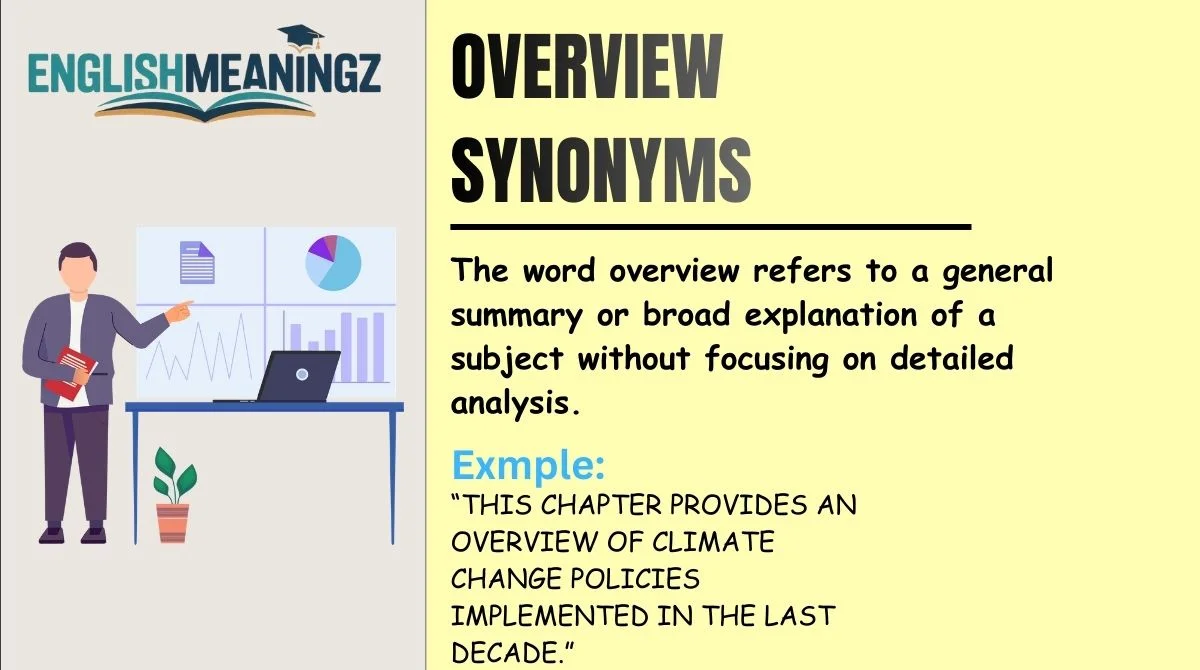
The word overview refers to a general summary or broad explanation of a subject without focusing on detailed analysis. It is commonly used when introducing a topic or presenting the main ideas in a simplified form.
In academic writing, an overview often appears at the beginning of essays, research papers, presentations, or reports. Its purpose is to help readers quickly understand the main theme or structure of the content.
For example:
“This chapter provides an overview of climate change policies implemented in the last decade.”
In this sentence, the word overview indicates that the chapter presents a general explanation rather than a detailed analysis.
Different fields also use the term:
- Education: overview of a course or topic
- Business: overview of company performance
- Research: overview of literature or methodology
- Technology: overview of a system architecture
Because the word appears so frequently, writers benefit from learning alternative terms that fit different tones and contexts.
14 Synonyms Grouped by Context
General Use Synonyms
These words can replace overview in most everyday writing situations.
Summary
Meaning:
A short statement that presents the main points of a topic.
Context Explanation:
This synonym is widely used in academic writing, journalism, and business reports when condensing information.
Example Sentence:
The report begins with a summary of the key findings from the research.
Outline
Meaning:
A structured list or plan showing the main points of a topic.
Context Explanation:
Commonly used in academic planning, presentations, and essays before detailed discussion begins.
Example Sentence:
The professor provided an outline of the lecture topics for the semester.
Snapshot
Meaning:
A brief and quick representation of a situation at a specific moment.
Context Explanation:
Often used in journalism, reports, and digital analytics.
Example Sentence:
The infographic offers a snapshot of global internet usage trends.
Survey
Meaning:
A general examination or study of a subject.
Context Explanation:
This word is often used in academic research when reviewing a field or topic.
Example Sentence:
The article presents a survey of recent developments in artificial intelligence.
Formal and Academic Writing Synonyms
These alternatives are especially suitable for research papers, essays, and professional reports.
Synopsis
Meaning:
A concise summary of a larger work or subject.
Context Explanation:
Commonly used in academic writing, literature reviews, and film or book descriptions.
Example Sentence:
The introduction provides a synopsis of the research objectives and methodology.
Abstract
Meaning:
A short summary that highlights the key points of a research paper.
Context Explanation:
Frequently used in academic journals and scholarly publications.
Example Sentence:
The abstract gives readers a quick understanding of the study’s findings.
Review
Meaning:
A general examination or evaluation of a topic or literature.
Context Explanation:
Often used in research papers, especially in “literature review” sections.
Example Sentence:
The study begins with a review of previous research on renewable energy.
Brief
Meaning:
A short statement summarizing key information.
Context Explanation:
Used in professional reports, policy discussions, and academic summaries.
Example Sentence:
The manager delivered a brief overview of the company’s strategic goals.
Informal Usage Synonyms
These alternatives are suitable for casual writing, blogs, and everyday communication.
Rundown
Meaning:
A quick explanation or list of important points.
Context Explanation:
Common in conversational English and informal articles.
Example Sentence:
Here is a quick rundown of the most important features of the new smartphone.
Walkthrough
Meaning:
A step-by-step explanation of a process or topic.
Context Explanation:
Popular in tutorials, software guides, and educational blogs.
Example Sentence:
This article provides a simple walkthrough of setting up your online store.
Glimpse
Meaning:
A very brief look or insight into something.
Context Explanation:
Often used in storytelling, journalism, and descriptive writing.
Example Sentence:
The documentary offers a glimpse into the daily life of scientists in Antarctica.
Technical or Subject-Specific Synonyms
These terms are more specialized and commonly appear in academic or professional contexts.
Introduction
Meaning:
The opening section that presents the main topic and context.
Context Explanation:
In essays and reports, the introduction often serves as an overview of the content.
Example Sentence:
The introduction provides background information on the research problem.
Digest
Meaning:
A condensed version of longer information.
Context Explanation:
Often used in media, newsletters, and professional summaries.
Example Sentence:
The weekly digest summarizes the most important business news.
Compendium
Meaning:
A collection of summarized knowledge or information on a topic.
Context Explanation:
Used in scholarly or reference works.
Example Sentence:
The book serves as a compendium of modern marketing strategies.
Word Intensity and Tone Comparison Table
| Word | Formality Level | Emotional Strength | Typical Use |
|---|---|---|---|
| Summary | Neutral | Low | Essays, reports |
| Outline | Neutral | Low | Planning writing |
| Synopsis | Formal | Low | Academic texts |
| Abstract | Very Formal | Very Low | Research papers |
| Review | Formal | Medium | Academic studies |
| Snapshot | Informal | Medium | Media, reports |
| Rundown | Informal | Medium | Blogs, conversations |
| Walkthrough | Semi-formal | Medium | Tutorials |
| Digest | Formal | Low | News summaries |
| Compendium | Very Formal | Low | Scholarly references |
This comparison shows how word choice changes tone and formality. Writers should select synonyms based on their audience and purpose.
Common Mistakes When Using These Synonyms
Even though many words share similar meanings, they are not always interchangeable. Misusing them can reduce clarity.
Mistake 1: Using “Abstract” in General Writing
Incorrect:
The blog begins with an abstract of the topic.
Correct:
The blog begins with a summary of the topic.
Explanation:
“Abstract” is mainly used in academic research papers.
Mistake 2: Confusing “Outline” with “Summary”
Incorrect:
The outline explains the research findings.
Correct:
The summary explains the research findings.
Explanation:
An outline lists points, while a summary explains them briefly.
Mistake 3: Using Informal Words in Academic Writing
Incorrect:
This essay provides a rundown of economic theories.
Correct:
This essay provides a review of economic theories.
Explanation:
“Rundown” sounds informal and is rarely appropriate in academic writing.
Synonyms in Academic Writing
Example Paragraph 1
Modern universities increasingly emphasize interdisciplinary research. A review of recent academic publications reveals that collaboration between fields such as computer science and biology has accelerated scientific discoveries. This review highlights how technological advancements support innovative research methodologies.
Example Paragraph 2
The first chapter of the thesis provides a synopsis of existing theories related to urban development. It also presents an outline of the research structure, guiding readers through the objectives, methodology, and expected outcomes of the study.
These examples demonstrate how different synonyms can improve clarity while maintaining an academic tone.
IELTS and Exam Writing Tips
Vocabulary variety is essential for high exam scores, but replacing words blindly can cause errors. Consider the following tips:
Avoid Repetition Strategically
Instead of repeating “overview,” alternate between:
- summary
- outline
- review
- synopsis
This improves lexical diversity.
Maintain Context Accuracy
Not every synonym fits every sentence. For example, “abstract” should only appear in academic research contexts.
Do Not Replace Key Terms
If a specific technical term appears repeatedly in a paper, it may be better to keep it rather than replacing it with a synonym.
Focus on Clarity
Exam markers value clarity more than complicated vocabulary. Always prioritize meaning over complexity.
Similar Words vs True Synonyms
Many words appear similar but have subtle differences.
Overview vs Summary
- Overview: broad explanation of a topic
- Summary: condensed version of key points
Overview vs Outline
- Overview: general description
- Outline: structured list of ideas
Overview vs Review
- Overview: neutral description
- Review: evaluation or examination
Understanding these distinctions helps writers avoid confusion and maintain precision.
Practice Sentences
Choose the best synonym for overview in each sentence.
- The research paper begins with an ______ explaining the main findings.
- The instructor provided an ______ of the lecture structure.
- The magazine published a weekly ______ of technology news.
- The documentary gives viewers a ______ into wildlife conservation efforts.
- The tutorial includes a step-by-step ______ of the installation process.
Suggested answers:
- summary
- outline
- digest
- glimpse
- walkthrough
Practicing with real sentences helps reinforce vocabulary understanding.
FAQs
What is the best synonym for “overview” in academic writing?
Common academic alternatives include summary, synopsis, review, and abstract, depending on the context and level of detail required.
Can “outline” replace “overview”?
Sometimes, but not always. An outline presents a structured list of points, while an overview explains the general concept.
Is “snapshot” formal enough for essays?
Usually not. “Snapshot” is better suited for journalism, blogs, or casual reports.
Why should writers use synonyms?
Using synonyms prevents repetition, improves readability, and demonstrates stronger vocabulary skills.
Which synonym is most formal?
“Abstract” and “compendium” are among the most formal alternatives commonly used in academic contexts.
Conclusion
Expanding vocabulary is one of the most effective ways to improve writing quality. Words like overview appear frequently in essays, research papers, reports, and professional communication.
However, repeating the same term can weaken writing and reduce reader engagement.
By learning alternatives such as summary, synopsis, review, outline, digest, and snapshot, writers gain greater flexibility and precision.
These synonyms allow students, bloggers, and professionals to adapt their tone to different audiences and contexts.
Regular practice, careful reading, and mindful word selection will gradually strengthen vocabulary skills.
Over time, this improvement will lead to clearer communication, stronger academic performance, and more engaging writing.