One of the most common issues in writing—whether academic essays, blog articles, or professional reports—is repetition of the same vocabulary.
Using the same word repeatedly can weaken clarity, reduce engagement, and lower the overall quality of writing. This is especially true with frequently used words such as “unique.”
Expanding vocabulary through synonyms allows writers to express ideas with greater precision, nuance, and stylistic variety.
In academic writing, lexical variety can improve grading criteria related to vocabulary range and coherence. In professional communication, it enhances credibility and authority.
For bloggers and digital writers, synonym variation also improves SEO performance by capturing related search terms and improving readability.
Students preparing for exams such as IELTS, TOEFL, and other academic assessments are often encouraged to avoid repetition. Strategic use of synonyms demonstrates language proficiency and improves lexical resource scores.
This guide explores 14 carefully selected synonyms for the word “unique,” organized by context and tone.
Each synonym includes a clear definition, contextual explanation, and example sentence so you can confidently incorporate it into your writing.
By the end of this article, students, bloggers, and professionals will gain a deeper understanding of how to choose the right synonym for the right situation, strengthening both academic and professional communication.
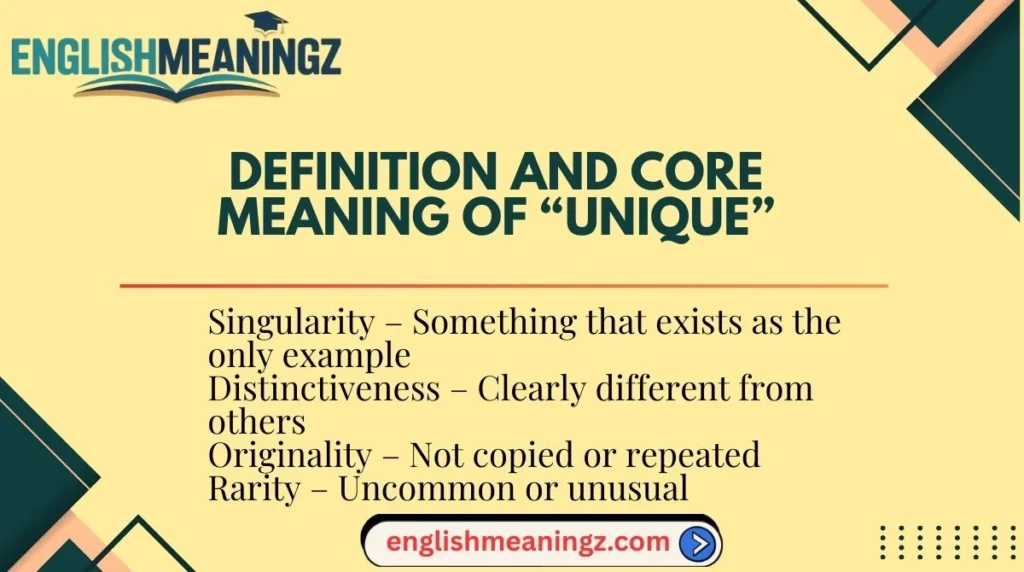
Definition and Core Meaning of “Unique”
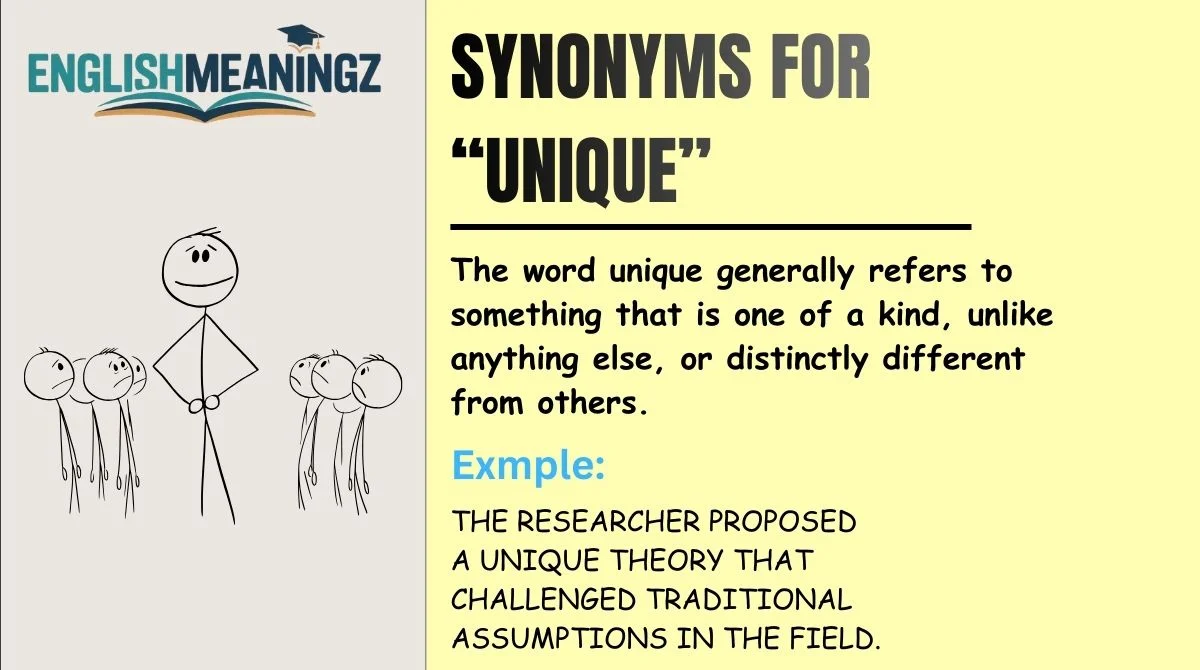
The word unique generally refers to something that is one of a kind, unlike anything else, or distinctly different from others.
In its strictest definition, unique means “being the only one of its kind.” However, in modern usage, it is often applied more broadly to describe something special, remarkable, or distinctive.
Core characteristics of the word “unique”
- Singularity – Something that exists as the only example
- Distinctiveness – Clearly different from others
- Originality – Not copied or repeated
- Rarity – Uncommon or unusual
Example
The researcher proposed a unique theory that challenged traditional assumptions in the field.
In academic and professional contexts, writers often need alternative expressions for this concept in order to maintain clarity and lexical diversity. This is where synonyms become valuable.
14 Synonyms for “Unique” Grouped by Context
General Use
These synonyms are versatile and can be used in both formal and informal writing.
Distinctive
Meaning: Clearly different from others; recognizable due to specific features.
Context: Often used when highlighting identifiable characteristics of a person, object, or concept.
Example sentence:
The city has a distinctive architectural style that attracts tourists from around the world.
Exceptional
Meaning: Unusually excellent or outstanding.
Context: Used when something stands out due to superior quality.
Example sentence:
Her exceptional analytical skills made her an invaluable member of the research team.
Remarkable
Meaning: Worthy of attention because it is unusual or impressive.
Context: Suitable for both academic and descriptive writing.
Example sentence:
The scientist made a remarkable discovery that advanced medical research.
Formal & Academic Writing
These synonyms are particularly suitable for essays, academic papers, and professional reports.
Unparalleled
Meaning: Having no equal; unmatched in quality or nature.
Context: Often used in scholarly discussions or formal evaluations.
Example sentence:
The study provides unparalleled insight into climate change patterns.
Singular
Meaning: Unique in character or distinction.
Context: Frequently used in literary and academic writing.
Example sentence:
The philosopher’s work represents a singular contribution to ethical theory.
Unprecedented
Meaning: Never done or known before.
Context: Common in academic writing, research analysis, and journalism.
Example sentence:
The pandemic created unprecedented challenges for global economies.
Informal Usage
These synonyms are commonly used in everyday conversation, blogs, and creative writing.
One-of-a-kind
Meaning: The only example of something; extremely special.
Context: Informal but expressive; often used for creative or descriptive writing.
Example sentence:
The handmade necklace is truly one-of-a-kind.
Special
Meaning: Different in a positive way; not ordinary.
Context: Simple, conversational synonym suitable for general audiences.
Example sentence:
This restaurant offers a special dining experience.
Rare
Meaning: Not commonly found; unusual.
Context: Often used in descriptions of objects, events, or qualities.
Example sentence:
The museum displayed a rare artifact from ancient history.
Technical or Subject-Specific Use
These synonyms are useful in specialized fields such as research, science, and professional communication.
Distinct
Meaning: Clearly separate or different from others.
Context: Frequently used in academic analysis and classification.
Example sentence:
The experiment revealed two distinct behavioral patterns.
Novel
Meaning: New and original, especially in research or technology.
Context: Very common in academic journals and scientific literature.
Example sentence:
The researchers introduced a novel approach to machine learning.
Innovative
Meaning: Featuring new methods or ideas.
Context: Used in business, technology, and research discussions.
Example sentence:
The company developed an innovative solution to reduce energy consumption.
Original
Meaning: Not derived from something else; created independently.
Context: Useful in both academic and creative writing.
Example sentence:
Her original theory challenged established assumptions in psychology.
Extraordinary
Meaning: Extremely unusual or impressive.
Context: Often used when emphasizing exceptional quality or impact.
Example sentence:
The athlete demonstrated extraordinary determination during the competition.
Word Intensity & Tone Comparison Table
| Word | Formal Level | Emotional Strength | Typical Context |
|---|---|---|---|
| Unique | Neutral | Medium | General writing |
| Distinctive | Medium | Medium | Description and analysis |
| Exceptional | Medium | High | Achievement or performance |
| Remarkable | Medium | Medium | Observations and findings |
| Unparalleled | High | High | Academic or formal praise |
| Singular | High | Medium | Literary or academic writing |
| Unprecedented | High | High | Historical or global events |
| Rare | Low–Medium | Medium | Informal or descriptive writing |
| Novel | High | Medium | Research and scientific writing |
| Innovative | Medium–High | High | Technology and business |
This comparison helps writers select the synonym that best fits the tone and purpose of their writing.
Common Mistakes When Using These Synonyms
Although synonyms may appear interchangeable, misuse can weaken writing clarity.
Mistake 1: Using “unique” with degrees
Incorrect:
This design is very unique.
Correction:
This design is unique.
Because something is either unique or not, modifiers like very or extremely are unnecessary.
Mistake 2: Confusing “rare” with “unique”
Incorrect:
This species is unique in the region.
Correction:
This species is rare in the region.
If multiple examples exist but they are uncommon, rare is more accurate than unique.
Mistake 3: Overusing “innovative” in academic writing
Incorrect:
The innovative study discusses historical trends.
Correction:
The study provides a novel analysis of historical trends.
“Innovative” should be used when new methods or ideas are actually introduced.
Mistake 4: Using informal synonyms in formal writing
Incorrect:
The research presents a one-of-a-kind method.
Correction:
The research presents a novel method.
Academic writing generally prefers formal vocabulary.
Synonyms in Academic Writing
Example Academic Paragraph 1
Recent research has introduced a novel framework for analyzing climate adaptation strategies. Unlike previous models, this framework incorporates both social and environmental variables, providing a distinct perspective on policy implementation. The findings reveal unprecedented interactions between community engagement and environmental sustainability, suggesting that interdisciplinary collaboration may be essential for future policy development.
Example Academic Paragraph 2
The philosopher’s argument represents a singular contribution to ethical theory. By integrating classical principles with modern social dynamics, the author proposes an innovative interpretation of moral responsibility. This remarkable approach challenges conventional perspectives and encourages further exploration within the field.
IELTS & Exam Writing Tips
Students preparing for language proficiency exams often struggle with repetition of key vocabulary.
Tip 1: Use synonyms strategically
Instead of repeating a word, choose a synonym that fits the context.
Example:
The city has a unique culture. This distinctive culture attracts tourists.
Tip 2: Avoid unnecessary replacement
Not every repetition should be replaced.
If the original word is precise and accurate, it may be better to repeat it.
Example:
In technical writing, replacing “unique identifier” with another phrase may cause confusion.
Tip 3: Understand tone
Some synonyms are too informal for academic writing.
Avoid:
one-of-a-kind solution
Prefer:
innovative solution
Tip 4: Focus on meaning, not just variety
Vocabulary variety is important, but clarity is more important. Only replace a word if the synonym maintains the same meaning.
Similar Words vs True Synonyms
Many words appear to be synonyms of unique, but they carry slightly different meanings.
Unique vs Rare
- Unique: the only one of its kind
- Rare: uncommon but not necessarily the only one
Example:
The artifact is rare but not unique.
Unique vs Innovative
- Unique: different from others
- Innovative: introducing new ideas or methods
Example:
A design may be unique without being innovative.
Unique vs Distinctive
- Unique: completely one-of-a-kind
- Distinctive: recognizable due to specific features
Example:
A brand may have a distinctive logo even if it is not unique.
Understanding these subtle differences helps writers maintain accuracy and sophistication in their language.
Practice Sentences
Complete the sentences using the most appropriate synonym.
- The scientist proposed a ______ approach to solving the problem.
- The museum displayed a ______ artifact from the ancient civilization.
- Her research provides ______ insight into human behavior.
- The author introduced a ______ theory in the field of sociology.
- The athlete demonstrated ______ talent during the competition.
- The experiment revealed two ______ patterns of response.
- The company created an ______ technology that improved efficiency.
- The landscape has a ______ beauty that attracts photographers.
Suggested answers:
- novel
- rare
- unparalleled
- original
- extraordinary
- distinct
- innovative
- distinctive
FAQs
What is the best synonym for “unique” in academic writing?
Words such as novel, singular, distinctive, and unprecedented are commonly preferred in academic writing because they convey precision and maintain a formal tone.
Is it incorrect to say “very unique”?
In strict grammatical terms, “unique” should not be modified by degree words like “very.” Something is either unique or it is not.
Which synonym for “unique” is best for IELTS writing?
Useful IELTS synonyms include distinctive, remarkable, exceptional, and innovative, as they demonstrate vocabulary variety without sounding unnatural.
What is the difference between “unique” and “original”?
Original refers to something that has not been copied, while unique emphasizes being one of a kind.
How can I improve my vocabulary for academic writing?
You can improve vocabulary by reading academic texts, practicing synonym replacement, and studying word usage in context.
Conclusion
Expanding your vocabulary is one of the most effective ways to improve writing clarity, sophistication, and engagement.
Words like unique are useful, but repeating them too frequently can weaken the quality of writing.
By learning alternatives such as distinctive, exceptional, unparalleled, novel, and innovative, writers gain the flexibility to communicate ideas more precisely.
Understanding the subtle differences between synonyms also helps avoid common mistakes and ensures that each word fits the intended context.
Students preparing for exams, bloggers creating engaging content, and professionals writing reports can all benefit from strategic synonym usage.
With practice, choosing the right word becomes easier, allowing writers to produce more compelling and polished work.
Consistent vocabulary development not only strengthens communication but also builds confidence and credibility in written expression.