Vocabulary variety plays a crucial role in effective communication. Whether someone is writing academic essays, professional reports, blog posts, or exam answers, repeating the same word can weaken the impact of the message.
One of the most commonly repeated words in English writing is “power.” While it is a useful and versatile term, relying on it too frequently can make writing sound repetitive and less sophisticated.
Using appropriate synonyms improves clarity, tone, and credibility. In academic environments, vocabulary diversity can significantly influence writing scores.
Students preparing for exams such as IELTS or university essays often benefit from replacing overused words with precise alternatives.
Bloggers and content creators also rely on varied vocabulary to maintain reader engagement and strengthen search engine optimization.
Professionals in business, politics, and science often use nuanced vocabulary to convey authority and accuracy. Instead of repeatedly writing “power,” they might use terms such as authority, influence, or capacity depending on the context.
This guide explores 26 synonyms for “power,” explaining their meanings, contexts, and example usage. By understanding these alternatives, writers can choose the most appropriate word for different situations and improve the overall quality of their writing.
Definition and Core Meaning of “Power”
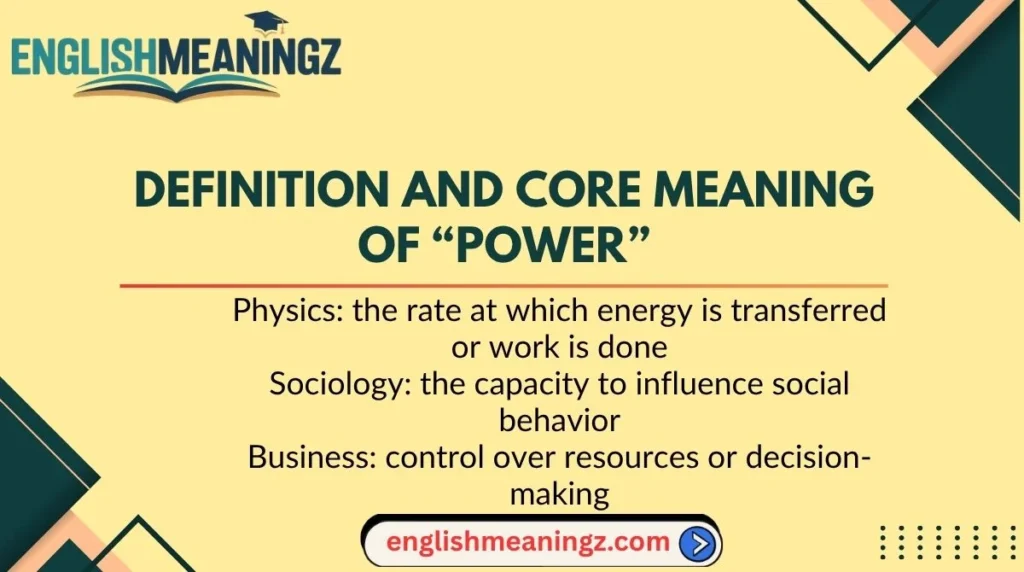
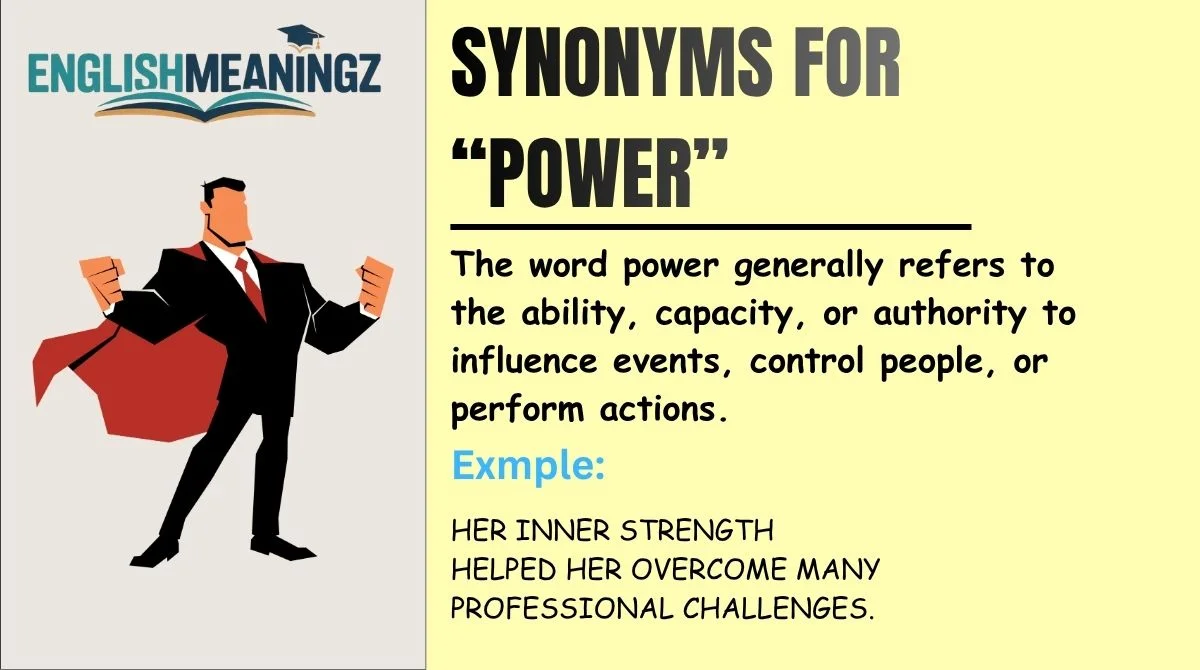
The word power generally refers to the ability, capacity, or authority to influence events, control people, or perform actions.
In everyday language, power may describe physical strength, political authority, or the ability to achieve results.
In academic contexts, the meaning can vary depending on the subject:
- Political science: authority or control over governance
- Physics: the rate at which energy is transferred or work is done
- Sociology: the capacity to influence social behavior
- Business: control over resources or decision-making
Because the word carries multiple meanings, selecting the correct synonym requires understanding the specific context.
26 Synonyms Grouped by Context
General Use Synonyms
Strength
Meaning: Physical or mental force that allows someone to perform actions.
Context: Often used when discussing endurance, resilience, or capability.
Example:
Her inner strength helped her overcome many professional challenges.
Force
Meaning: Energy or pressure applied to cause movement or change.
Context: Used in both physical and metaphorical situations.
Example:
Public opinion became a powerful force in shaping government policies.
Ability
Meaning: The skill or competence to perform a task.
Context: Common in education and professional development discussions.
Example:
Her analytical ability made her an excellent researcher.
Capacity
Meaning: The potential or capability to do something.
Context: Frequently used in academic and organizational discussions.
Example:
The organization has the capacity to expand its operations globally.
Control
Meaning: The authority to manage or direct something.
Context: Used in leadership, management, and psychology.
Example:
The committee maintained full control over the project budget.
Influence
Meaning: The ability to affect the decisions or behavior of others.
Context: Common in political, social, and marketing discussions.
Example:
Social media has enormous influence on modern consumer behavior.
Dominance
Meaning: A position of superiority or control.
Context: Often used in competition or hierarchy.
Example:
The company maintained market dominance for nearly a decade.
Formal and Academic Writing Synonyms
Authority
Meaning: The legitimate right to make decisions or enforce rules.
Context: Used in legal, governmental, and academic writing.
Example:
The central bank holds the authority to regulate financial institutions.
Command
Meaning: Control or mastery over a subject or situation.
Context: Often used when referring to expertise or leadership.
Example:
She demonstrated exceptional command of economic theory.
Jurisdiction
Meaning: Official power to make legal decisions.
Context: Primarily used in legal or governmental discussions.
Example:
The court has jurisdiction over the dispute.
Governance
Meaning: The process of exercising authority in organizations or states.
Context: Used in political science and public administration.
Example:
Effective governance ensures transparency and accountability.
Supremacy
Meaning: The state of being the highest in authority or status.
Context: Used in political or historical analysis.
Example:
Technological innovation helped the nation achieve economic supremacy.
Capability
Meaning: The practical ability to accomplish a task.
Context: Common in management and academic writing.
Example:
The company’s research team has the capability to develop advanced solutions.
Potency
Meaning: The strength or effectiveness of something.
Context: Often used in scientific or analytical discussions.
Example:
The potency of the new medication surprised researchers.
Informal Usage Synonyms
Might
Meaning: Great strength or power.
Context: Often used in storytelling or casual writing.
Example:
The athlete displayed incredible might during the competition.
Muscle
Meaning: Strength or force used to achieve an outcome.
Context: Informal expression often used in business or politics.
Example:
The company used financial muscle to dominate the market.
Edge
Meaning: A competitive advantage or superiority.
Context: Frequently used in business and sports discussions.
Example:
Advanced technology gave the firm a strategic edge.
Clout
Meaning: Influence or authority, especially in politics.
Context: Informal yet common in media writing.
Example:
The organization has significant political clout.
Pull
Meaning: Informal term for influence or persuasion.
Context: Used when someone can obtain favors or opportunities.
Example:
She used her professional pull to secure the partnership.
Firepower
Meaning: Strong ability to compete or produce results.
Context: Often used in business, marketing, or sports.
Example:
The company’s marketing firepower increased brand visibility.
Technical or Subject-Specific Synonyms
Energy
Meaning: The capacity to perform work.
Context: Used in physics and environmental sciences.
Example:
Solar panels convert sunlight into electrical energy.
Output
Meaning: The amount of work or energy produced.
Context: Used in engineering and industrial contexts.
Example:
The generator increased its power output significantly.
Efficiency
Meaning: The ability to achieve results with minimal waste.
Context: Used in engineering, business, and management.
Example:
Improved system design enhanced operational efficiency.
Leverage
Meaning: Strategic advantage used to influence outcomes.
Context: Common in finance and business strategy.
Example:
Data analytics provides companies with competitive leverage.
Authority Structure
Meaning: Organized system of power within an institution.
Context: Used in sociology and management studies.
Example:
The organization redesigned its authority structure to improve decision-making.
Word Intensity and Tone Comparison Table
| Synonym | Formal Level | Emotional Strength | Typical Context |
|---|---|---|---|
| Authority | High | Moderate | Legal, academic |
| Influence | Medium | Moderate | Social and marketing |
| Strength | Medium | Moderate | General writing |
| Dominance | High | Strong | Competitive analysis |
| Control | Medium | Neutral | Management |
| Capability | High | Neutral | Academic |
| Clout | Informal | Strong | Politics/media |
| Force | Medium | Strong | Physical or metaphorical |
| Potency | High | Strong | Scientific discussion |
| Edge | Informal | Moderate | Business strategy |
Common Mistakes When Using These Synonyms
Mistake 1: Using “force” instead of “authority”
Incorrect:
The government used its force to pass the law.
Correct:
The government used its authority to pass the law.
Explanation:
“Force” implies physical pressure, while “authority” refers to legal power.
Mistake 2: Replacing “influence” with “control”
Incorrect:
Social media has full control over public opinion.
Correct:
Social media has strong influence on public opinion.
Explanation:
Influence suggests persuasion rather than direct control.
Mistake 3: Misusing “dominance”
Incorrect:
Her dominance helped her complete the assignment.
Correct:
Her ability helped her complete the assignment.
Explanation:
Dominance implies superiority over others, not personal skill.
Synonyms in Academic Writing
Example Paragraph 1
Political scientists often examine how authority, influence, and control interact within governmental systems. Authority typically derives from legal frameworks, while influence emerges from social or economic relationships. Leaders who successfully balance these elements can maintain stable governance and encourage public trust.
Example Paragraph 2
In business management, organizational capability and strategic leverage are critical for long-term success. Companies that effectively utilize resources and knowledge often gain a competitive edge in global markets. This combination of expertise and innovation allows organizations to expand their economic influence.
IELTS and Exam Writing Tips
Avoid unnecessary repetition
Repeated words reduce writing quality. Instead of writing:
The government has power. This power helps the government maintain power.
You could write:
The government holds authority, which allows it to maintain political control.
Use synonyms carefully
Not every synonym fits every situation. For example:
- Power plant cannot become authority plant
- Political power may become political influence or authority
Always check context before replacing a word.
Maintain clarity
Overusing complex vocabulary can make writing confusing. Use synonyms only when they clearly improve the sentence.
Similar Words vs True Synonyms
Some words appear similar to “power” but are not perfect replacements.
Strength vs Power
Strength refers more to physical ability, while power can include authority or influence.
Influence vs Authority
Influence persuades people indirectly, while authority allows direct decision-making.
Dominance vs Control
Dominance suggests superiority over competitors, whereas control simply refers to management.
Understanding these subtle differences helps writers choose more accurate vocabulary.
Practice Sentences
Fill in the blanks with the most appropriate synonym for “power.”
- The judge has the legal ______ to issue the final verdict.
- The company gained significant market ______ through innovation.
- Her analytical ______ helped solve the complex problem.
- The country increased its economic ______ in global trade.
- The new technology improved the engine’s energy ______.
Suggested answers: authority, dominance, ability, influence, output.
Frequently Asked Questions
What is the best synonym for “power” in academic writing?
The best synonym often depends on context. Words like authority, capability, and influence are commonly used in academic texts because they sound precise and formal.
How many synonyms for “power” should students know?
Students should understand at least 10–15 commonly used synonyms to avoid repetition and improve writing quality.
Are all synonyms interchangeable with “power”?
No. Each synonym has its own tone and context. For example, force implies physical pressure, while authority refers to legal control.
Which synonym works best in business writing?
Words like leverage, influence, capability, and edge are commonly used in professional business communication.
Can using synonyms improve IELTS writing scores?
Yes. IELTS examiners evaluate lexical resource. Using varied vocabulary appropriately can improve band scores in the writing section.
Conclusion
Expanding vocabulary is one of the most effective ways to improve writing quality. The word power is versatile but often overused in essays, articles, and professional communication.
By learning alternative words such as authority, influence, capability, dominance, and leverage, writers can communicate ideas more precisely and avoid repetition.
Students can enhance exam performance by practicing these synonyms in essays and practice sentences. Bloggers and professionals benefit from clearer, more engaging content when they use varied vocabulary strategically.
Ultimately, mastering synonyms is not just about replacing words—it is about selecting the most accurate term for each context.
Continuous practice, reading, and writing will gradually strengthen vocabulary and elevate overall communication skills.